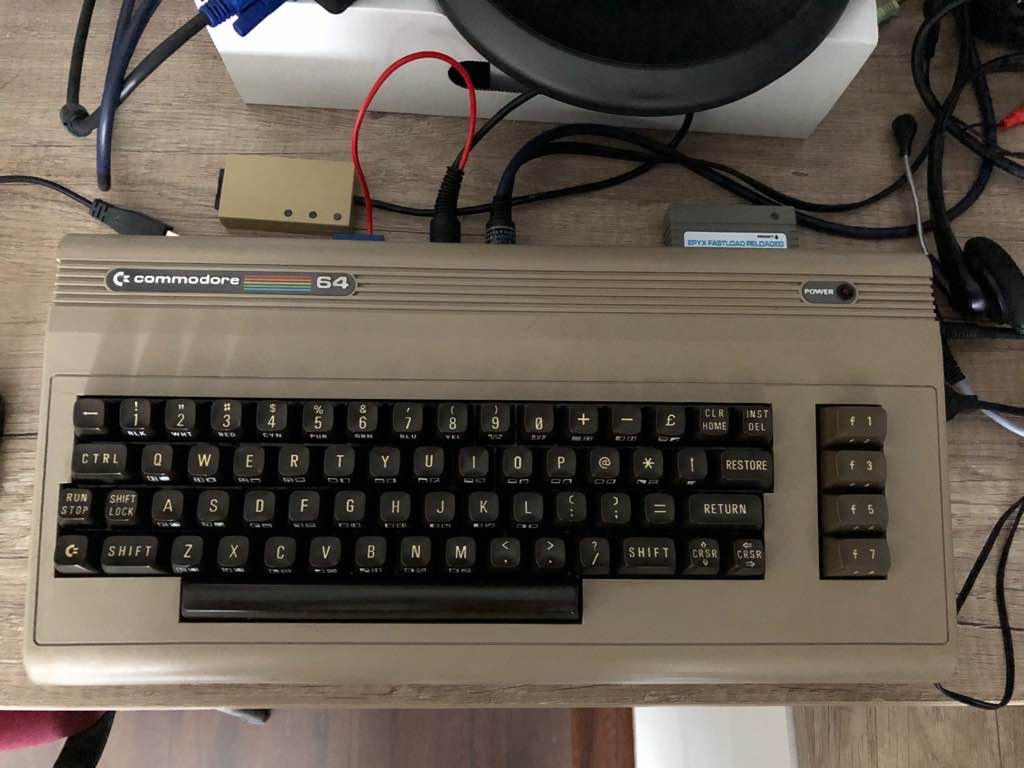
There has never been a better time to get into the Commodore 64 — or a more confusing one. In 1985 the decision was simple: you bought the beige box, plugged it into the family television and waited six minutes for a cassette to load. In 2026 you can choose between a forty-year-old original, a modern replica in a working keyboard, an FPGA recreation, a premium collector’s machine, or an emulator on the laptop you already own — all of them legitimate, all of them playing the same extraordinary library of games and SID music, and each with its own traps for the unwary. This guide walks through every route in, what each one costs you in money (described in honest bands, not invented prices), effort and authenticity, and the safety checks that matter — including one about power supplies that you should read before you plug anything in.

Route one: original hardware
Nothing else feels like the real thing: the springy keyboard, the chunky 1541 disk drive clunking through a load, a genuine 6581 SID chip growling through a proper speaker. Original C64s are plentiful — millions were made — and in the UK and Europe a working breadbin or C64C in fair condition typically changes hands for well under £100 unboxed, with prices climbing for boxed, serviced or recapped examples. North American readers will find the same pattern in dollars. The supply is deep, the community support is enormous, and every game ever written will run exactly as intended.
But a 1982–1994 machine is an old machine, and there is one component you should treat with genuine respect: the power supply. The original Commodore PSU — the heavy black or beige brick — has a well-documented failure mode. Its 5-volt rail can drift upwards as the unit ages and its components degrade, and an over-voltage PSU will quietly cook the RAM and custom chips in your C64. This is not forum folklore; it is the single most common way healthy C64s die, and it is why the community’s standard advice is blunt: do not run a newly acquired C64 on its original brick until that brick has been tested, and preferably not at all. Modern replacement PSUs are widely available from retro specialists, are inexpensive relative to the cost of a dead machine, and are the first purchase every new owner should make — before games, before cables, before anything. Saver devices that cut the power on over-voltage also exist for owners who insist on original bricks. Test first, or replace. Your chips will thank you.
While you are in maintenance mode: check the machine works before you pay collector money, expect to budget for a composite or S-video cable to connect to a modern screen (the C64’s output looks far better than its RF connection suggests), and know that common failures — dead PLA chips, tired RAM, dry capacitors — are all documented and repairable by a healthy network of independent specialists. None of this should put you off. It should simply be priced into the adventure.
Making original hardware painless: storage and loading
The other 1980s experience you do not need to relive is storage. Cassettes are charming for exactly one nostalgic load; floppy disks and 1541 drives are authentic, mechanical and increasingly temperamental. The modern answer is solid-state storage that pretends to be a disk drive. The SD2IEC is the budget classic: a small device that plugs into the serial port, reads disk, tape and program images from an SD card, and costs a fraction of the machine itself. It handles the great majority of single-load and standard disk software, though some games that use exotic fast-loaders or heavy copy protection will not play along.
Step up to a Kung Fu Flash or similar cartridge-based solution and compatibility climbs again, with cartridge images, easykernal-style utilities and fast loading from a menu. At the top of the tree sit devices that emulate the 1541 at a hardware level, cycle-exact, for the awkward titles nothing else will load. You do not need the top of the tree on day one. An SD2IEC and a folder of classics will keep you busy for a year.

Route two: THEC64 range
If you want the shape of the thing without the soldering iron, Retro Games Ltd’s THEC64 range is the mainstream answer. THEC64 Mini is a miniature, HDMI plug-and-play console with a built-in library of licensed games and the ability to load your own from USB; the full-size THEC64 restores the big beige case with a working keyboard, adds a micro-switched joystick and a proper BASIC mode, and later special editions have refreshed the formula. These are emulation-based machines, licensed and legal out of the box, and for living-room play they are hard to beat for convenience: one HDMI cable, instant loading, save states, and no PSU anxiety whatsoever.
The honest caveats: you are buying convenience, not components — there is no real SID inside, and purists can hear and feel small differences in sound and timing. The built-in game lists vary by model and region, so check the exact list for the exact unit you are buying. And while you can add your own games via USB, these are curated consoles first and open platforms second. As a first taste, or a gift for a lapsed owner, they are superb.
Route three: C64 Ultimate and FPGA
Between replica consoles and original hardware sits the enthusiast tier. The C64 Ultimate line — FPGA-based machines in newly manufactured cases, developed under the revived Commodore brand — aims to recreate the original at hardware level: an FPGA reimplementation of the C64’s logic rather than software emulation, real cartridge and serial ports for original peripherals, HDMI and analogue output, and compatibility targets that emulation cannot always meet. These are premium products, priced accordingly, and availability has historically come in batches — check current status before planning a purchase around one. FPGA cores on general platforms such as MiSTer offer a similar hardware-level experience for owners of that ecosystem, with the same selling point: timing and behaviour that feel indistinguishable from the real machine, without depending on forty-year-old silicon.
Who is this tier for? The owner who wants the definitive experience, plans to run demos and awkward edge-case software, or simply refuses to gamble on ageing chips. If that is you, it is worth every penny. If you just want to play Monty on the Run tonight, it is magnificent overkill.
Route four: emulation on the computer you own
The cheapest route costs nothing. VICE is the definitive Commodore emulator — free, open-source, running on Windows, macOS and Linux, and maintained to a standard that makes it the reference tool even for owners of real hardware. Its cycle-exact modes, true drive emulation and SID options (including emulation of both the 6581 and 8580 variants) mean the games play as they should, and features the original never had — save states, warp-speed loading, screenshots — smooth every rough edge. Pair it with a USB joystick or a modern controller and a decent pair of speakers and you are, functionally, a C64 owner by tonight.

Emulation is also the right way to audition the hobby. Spend a month with VICE and you will know whether the C64’s particular charms — the games, the music, the BASIC prompt blinking at you — have their hooks in you. If they do, the hardware routes above will still be there, and you will shop for them with educated eyes.
Screens, sticks and the finishing touches
Whichever route you choose, two accessories decide how the hobby feels day to day. The first is the display. A C64 on a period CRT television looks exactly right — the machine’s chunky pixels and colour bleed were designed for it — but a modern flat panel via a good composite or S-video lead is perfectly serviceable, and FPGA and replica machines with HDMI are sharper still. What you should avoid is judging the machine by a fuzzy RF connection through three adapters: half the “the C64 looked terrible” stories are really cable stories. The second is the controller. A micro-switched joystick is not nostalgia, it is the input device this library was tuned for — diagonals matter in C64 games, from Impossible Mission’s somersaults to The Last Ninja’s strikes — and modern replicas of classic sticks, as well as adapters that let original sticks talk to USB and vice versa, are easy to find. Budget for a good stick before you budget for a second machine.
Finally, a word about software sources. The C64 scene is unusually well served: publishers including the rights-holders of many classic catalogues sell or give away legitimate downloads, modern C64 games are sold on cartridge and as downloads by independent developers, and community archives preserve the rest with the blessing of many original creators. Start with the legal shelves — they are fuller than you expect — and your conscience and your SD card will both be in good shape.
Your first ten games
Whichever door you walk through, the library is waiting — and it is vast. Start with these ten and you will understand the machine: Impossible Mission for the platforming and the voice; The Last Ninja for the atmosphere; Elite for the ambition; Paradroid for the design genius; Wizball for the sheer originality; Mayhem in Monsterland for what late-era programmers could squeeze out; Boulder Dash for timeless arcade craft; Bruce Lee for multiplayer joy; International Karate + for the greatest three-player fighting on 8-bit; and Sam’s Journey to prove the machine is still receiving masterpieces today. After that, the demoscene, the SID archives and forty years of software are yours.
And if it breaks?
A short, reassuring section for the original-hardware route, because fear of repairs puts off more newcomers than price does. The C64 is one of the best-documented computers ever made: schematics, diagnostic cartridges, test harnesses and forty years of accumulated repair knowledge are freely available, and its common failures are a known list rather than a mystery. Most chips sit in a machine built from standard parts by the standards of its day, a healthy trade in modern replacements exists for the custom silicon, and independent repairers in most countries will recap, test and resurrect a board for less than the cost of a modern game. Buy a machine that is honestly described, keep it dry and powered by a safe supply, and the odds are strongly in your favour.
The bottom line
Choose emulation to start, a replica to relax, FPGA for the definitive setup, and original hardware for the real, warm, slightly risky thing itself — with a modern power supply, which is the one piece of advice in this guide that is not a matter of taste. The Commodore 64 sold its millions on a promise: a real computer, real games, real music, for ordinary people. In 2026 that promise is cheaper and easier to keep than it has ever been. Ready. RUN.