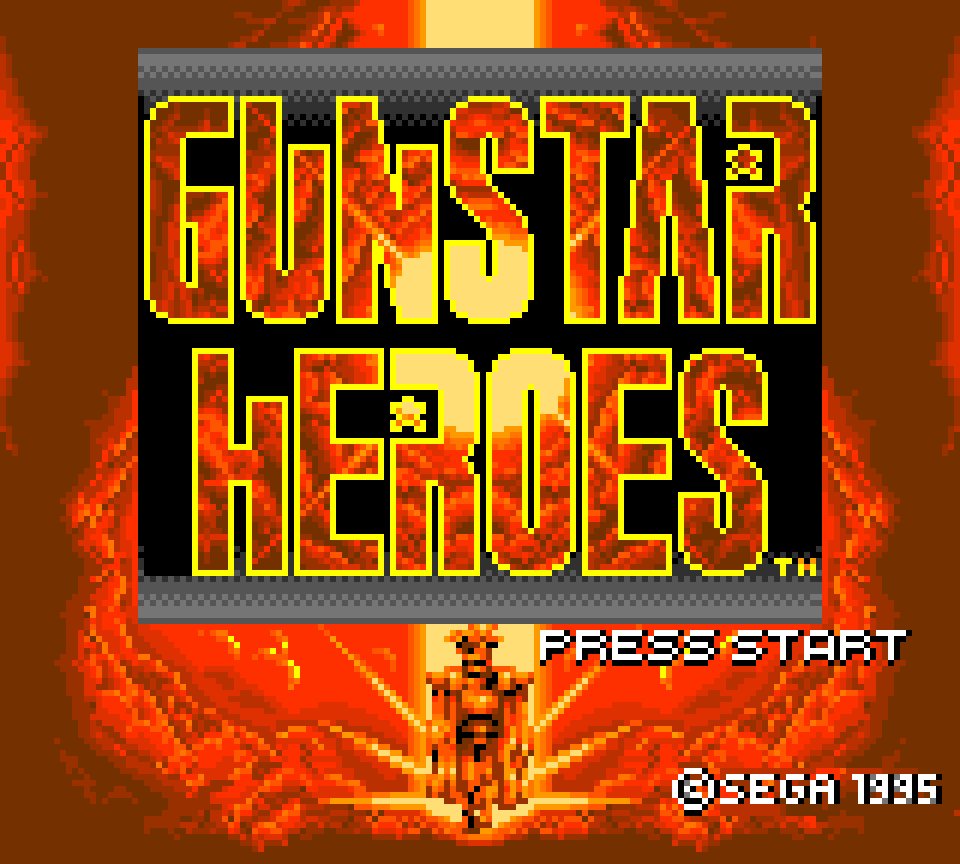
At a glance: Gunstar Heroes · Game Gear · M2 / Sega, 1995 · Run-and-gun · Score: 7.5/10
Some ports are acts of translation. The Game Gear version of Gunstar Heroes is an act of daring. Treasure’s 1993 Mega Drive masterpiece — a run-and-gun of such technical violence that it redefined what the 16-bit hardware could do — was never meant to fit on an 8-bit handheld with a fraction of the power. M2, the conversion specialists who would later become the industry’s gold standard for exactly this kind of impossibility, took the job anyway in 1995, Japan-only, late in the system’s life. What they produced is not the Mega Drive game. It is something arguably more interesting: a careful, loving demake that keeps Gunstar’s soul — the weapon mixing, the throws, the bosses — while redesigning almost every stage around the little machine’s limits.
The story survives the shrink intact in outline: the Gunstar twins, Red and Blue, race the Empire for the four gems that would wake the planet-destroying Golden Silver, facing Colonel Red’s menagerie of bosses along the way. What changes is the route. Stages are shorter, set pieces are re-choreographed, and the famous dice-board gauntlet and mine-cart heroics of the original are reimagined or replaced. M2 understood that a frame-for-frame copy would collapse, so they built a parallel Gunstar — recognisably the same adventure, told in a smaller, punchier dialect.
The weapons still sing
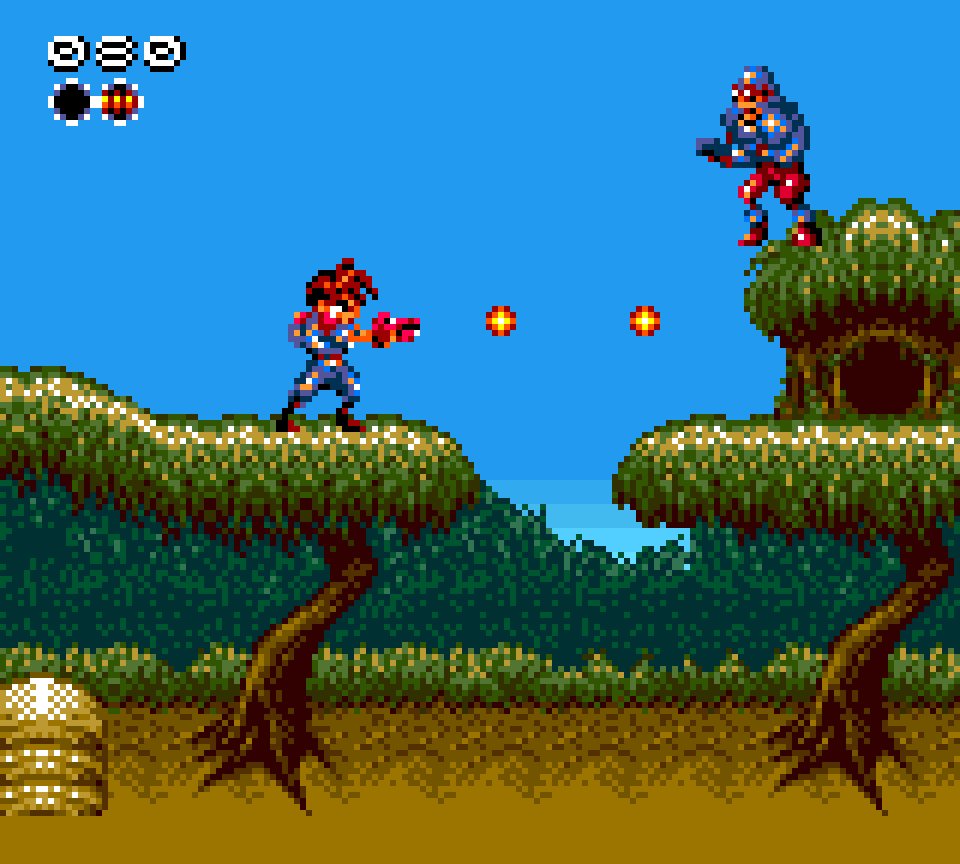
The heart of Gunstar is its weapon system, and it beats strongly here. Two weapon pods combine into fourteen configurations — the homing laser, the double chaser, the force-flame hybrids — and every combination from the Mega Drive original is present, on a machine with a fraction of the sprites to spare. Fixed versus free shot, the sliding tackle, the throw that turns enemies into projectiles: the moveset survives whole. On the Game Gear’s small screen the action is inevitably more intimate — fewer enemies, tighter arenas, bosses scaled to dominate the display — and M2 compensates with encounter design that tests positioning rather than crowd control. Pink’s cube boss, Green’s Seven Force in reduced but recognisable form, Black’s dice game reborn as a simpler board: each is a cover version that knows which notes matter.
Technically, it is a small miracle with visible seams. The frame rate breathes hard when explosions stack up, sprites flicker in the honest 8-bit way, and the spectacular scaling and rotation of the Mega Drive original are replaced by clever sprite work and sheer pace. But the colour is unmistakably Game Gear-rich, the animation keeps Treasure’s squash and swagger, and the soundtrack — those heroic, heroic tunes — survives the sound chip with its chin up. Playing it in 1995, on the machine whose rivals were grey, must have felt like a magic trick.
A Japan-only treasure
The Western absence is part of the game’s biography. By 1995 Sega of America had moved on; the Game Gear’s twilight software, including this and several other late gems, stayed in Japan, and the cartridge became one of the system’s famous imports — helped, crucially, by the Game Gear’s complete lack of region lockout, so any copy plays on any machine. Prices followed rarity, and for years the GG Gunstar was a rumour most Western fans never verified. Its modern availability through collections and emulation has finally let it be judged as a game rather than a legend, and it survives the judgement.
Not the Mega Drive game in miniature — a parallel Gunstar, redesigned stage by stage by people who understood exactly which notes mattered.
The compromises deserve a clear list. Two-player co-operative play — half the original’s joy — is gone; this is a solo campaign. The campaign is shorter, the difficulty gentler, and veterans of the Mega Drive version will feel the missing chaos in the quieter screens. A handful of weapon combinations lose their lustre against the simplified enemy waves. And the late bosses, Seven Force above all, are shadows of their 16-bit selves, impressive as tributes rather than as spectacles.

Why it matters
Gunstar Heroes on Game Gear matters because it marks the moment the industry learned a lesson it now takes for granted: a great port is a redesign, not a reduction. M2’s philosophy — keep the soul, rebuild the body — became the studio’s signature across decades of celebrated work, and you can watch it being invented here, stage by stage, on the least powerful hardware they ever tackled. As a game it is a brisk, inventive, charming run-and-gun. As a document, it is priceless.

Reading the redesign
The stage-by-stage changes are a masterclass in editorial judgement, and worth tracing for any player who knows the original. Where the Mega Drive game sprawls — the endless jungle escalations, the seven-screen board game — the Game Gear version compresses toward the essential encounter, keeping the silhouette of each set piece while cutting its repetitions. The dice palace survives as a shorter board with the same cruel humour; the flying sections are rebalanced for a screen where a bullet’s warning is measured in pixels. Even the famous weapon-combination table is preserved entire, at the cost of enemy density — a choice that tells you exactly what M2 thought Gunstar was: not the crowds, but the combinations, the throws, the bosses’ personalities. Posterity has agreed with them at every re-release since.
As a collector’s object, it carries the late-era Japanese Game Gear story in one cartridge: Sega’s handheld division still commissioning excellence for a home market that still cared, from the studio that would define how the whole industry treats its back catalogue. If the Game Gear has a cartridge that belongs in a museum of craft, the little Gunstar — impossible, unnecessary, superbly judged — has a strong claim to the plinth.
One more consideration for the score: difficulty. The Mega Drive original is rightly feared in its later stages, and the handheld quietly re-tunes the contract — continues are kinder, boss patterns a fraction more legible on the small screen, the campaign’s spikes filed to a handheld player’s evening. Purists may call it softened. The fairer word is translated: a game redesigned for its context in difficulty as in layout, by a studio that understood translation as a creative act. That philosophy is M2’s whole legend, and it begins in cartridges like this.
It should also be said that the cartridge is simply fun in the hand — the pad layout flatters the throw-and-shoot rhythm, the continues are where they should be, and a full run fits the handheld session the machine was built for. Masterpieces scaled down usually lose their joy first. This one kept its joy and lost only its scale, which is why it charms even players who bounce off its compromises.
Verdict
As a conversion, this is a triumph of judgement over horsepower; as a game, a very good run-and-gun that only suffers by comparison with one of the greatest ever made. Solo-only play and a gentler campaign keep it from the top tier, but the weapon system, the redesigned stages and M2’s craftsmanship make it essential for Gunstar devotees and Game Gear collectors alike. The little cartridge that shouldn’t exist is one of the system’s proudest possessions.