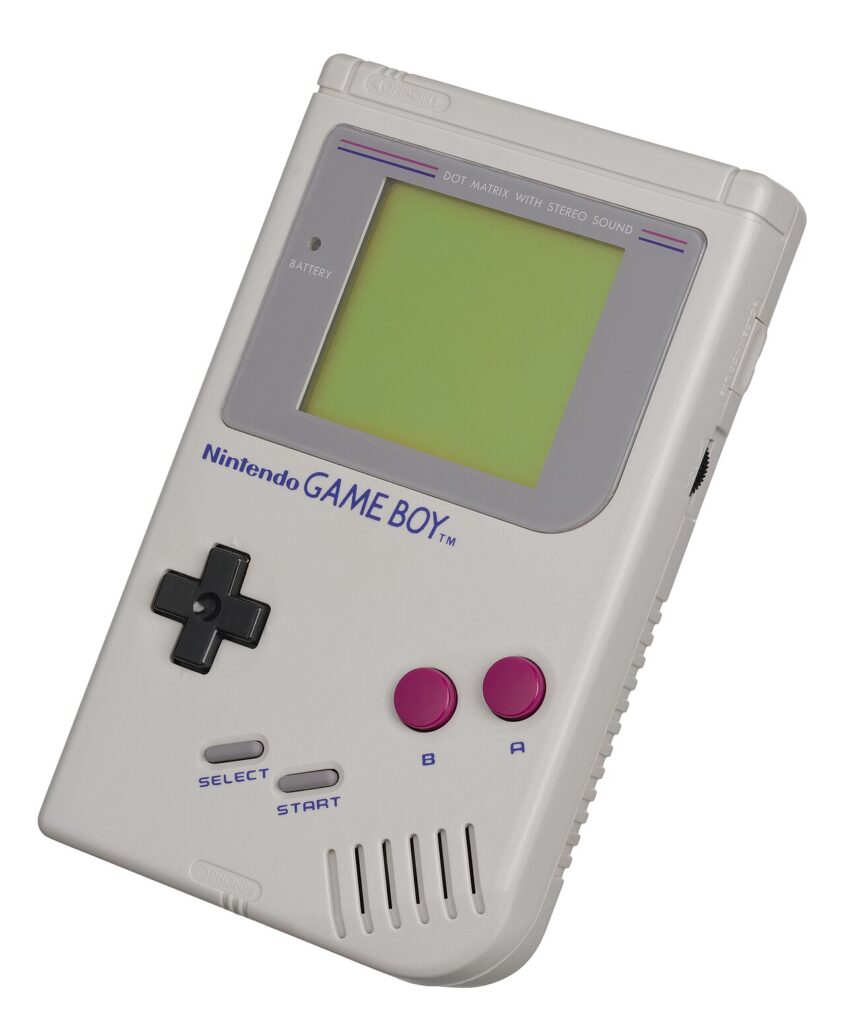
Some formulas are so sturdy that each new generation of hardware gets handed them like a family recipe. Paddle at the bottom, ball in the middle, wall of bricks at the top: that arrangement was already forty years old when, in September 2016, a homebrew developer named Jonas Fischbach released Retroid for the original Nintendo Game Boy, free of charge. This site’s original report ran to a couple of sentences. The game deserves a longer look, not because it reinvented anything — reinvention is not really the point of a brick-breaker — but because it is a neat case study in why the oldest arcade idea in the book keeps finding new homes, and what a solo developer working for a 1989 handheld had to understand to make it sing there.
Editorial note, stated plainly: Retroid was a legitimate free homebrew release, and this feature covers it as such. No ROM download links are provided here. The interesting questions are about design and lineage, and those can be explored perfectly well without pointing anyone at a file.
Forty Years Of Hitting A Wall
The lineage begins with Atari’s Breakout in 1976, conceived by Nolan Bushnell and Steve Bristow and prototyped in hardware by a young Steve Wozniak, with Steve Jobs acting as intermediary — a footnote that later attached improbable historical weight to a game about knocking down bricks. Breakout took the paddle logic of Pong and turned it ninety degrees into a solo test of angles and nerve: eight rows of coloured bricks, a ball that accelerates as rallies lengthen, a paddle that cruelly shrinks once the ball breaks through to the top wall. It was a worldwide hit, it influenced the design of the Apple II that Wozniak built next, and it founded an entire genre that Japan would come to call block kuzushi — block-breaking games.
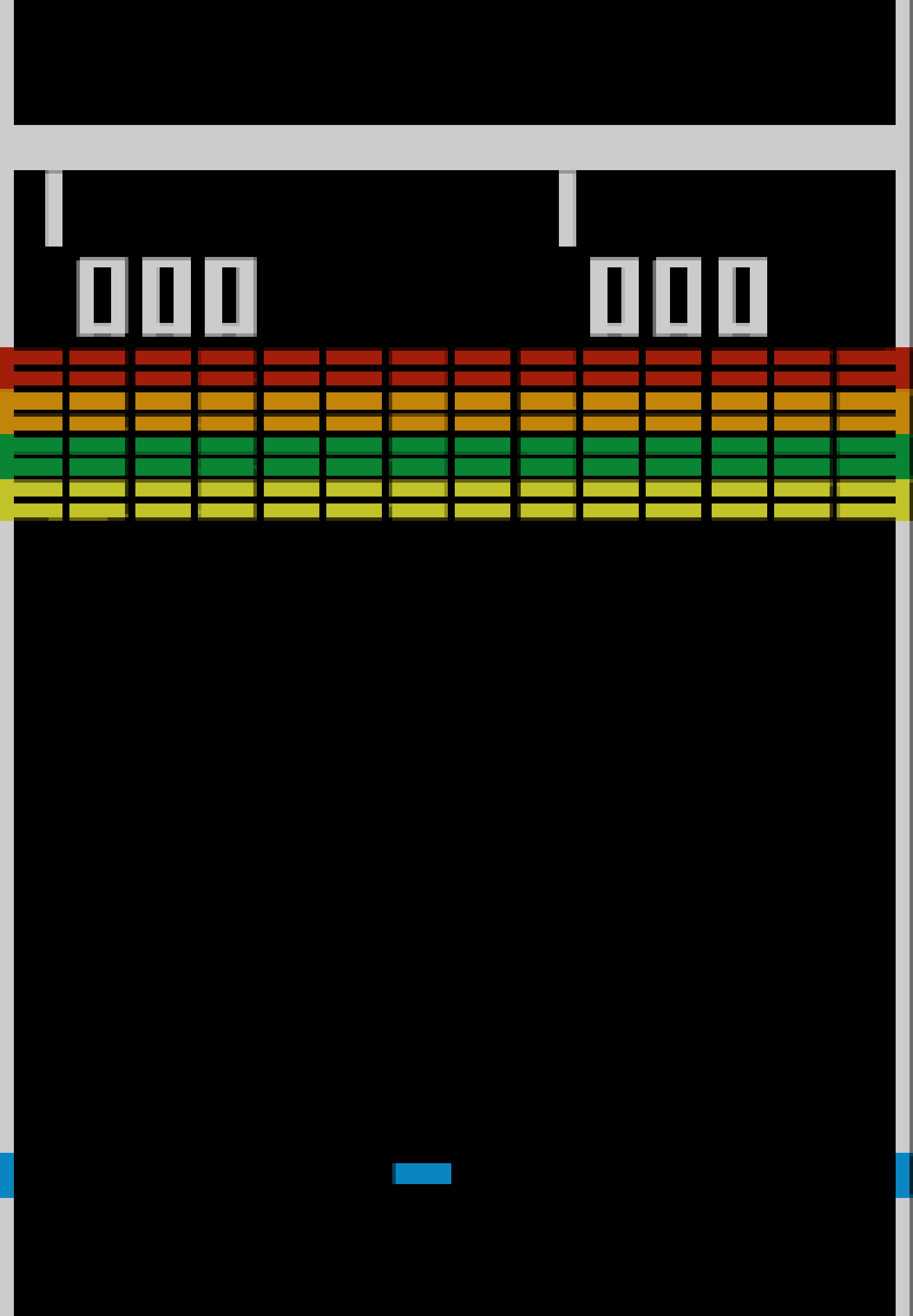
Atari’s Breakout (1976), the ancestor of the whole genre, enlarged from its original arcade screenshot via Wikipedia. Retroid’s paddle, ball and brick wall descend directly from this arrangement.
A decade later Taito’s Arkanoid (1986) gave the formula its second, decisive evolution. The paddle became a spacecraft, the Vaus, piloted through a science-fiction frame story; bricks began falling as capsules that transformed play — widening the paddle, splitting the ball, slowing it down, or arming the Vaus with lasers — and stages acquired shapes, indestructible blocks and a final confrontation with the entity Doh. Arkanoid was, legally and mechanically, a descendant of Breakout, but in feel it was a different animal: part reflex test, part light puzzle, part power-up management. Almost every brick-breaker since, Retroid included, is really an answer to the question Arkanoid posed: once the wall can fight back and help you at the same time, how far can you push the variations?
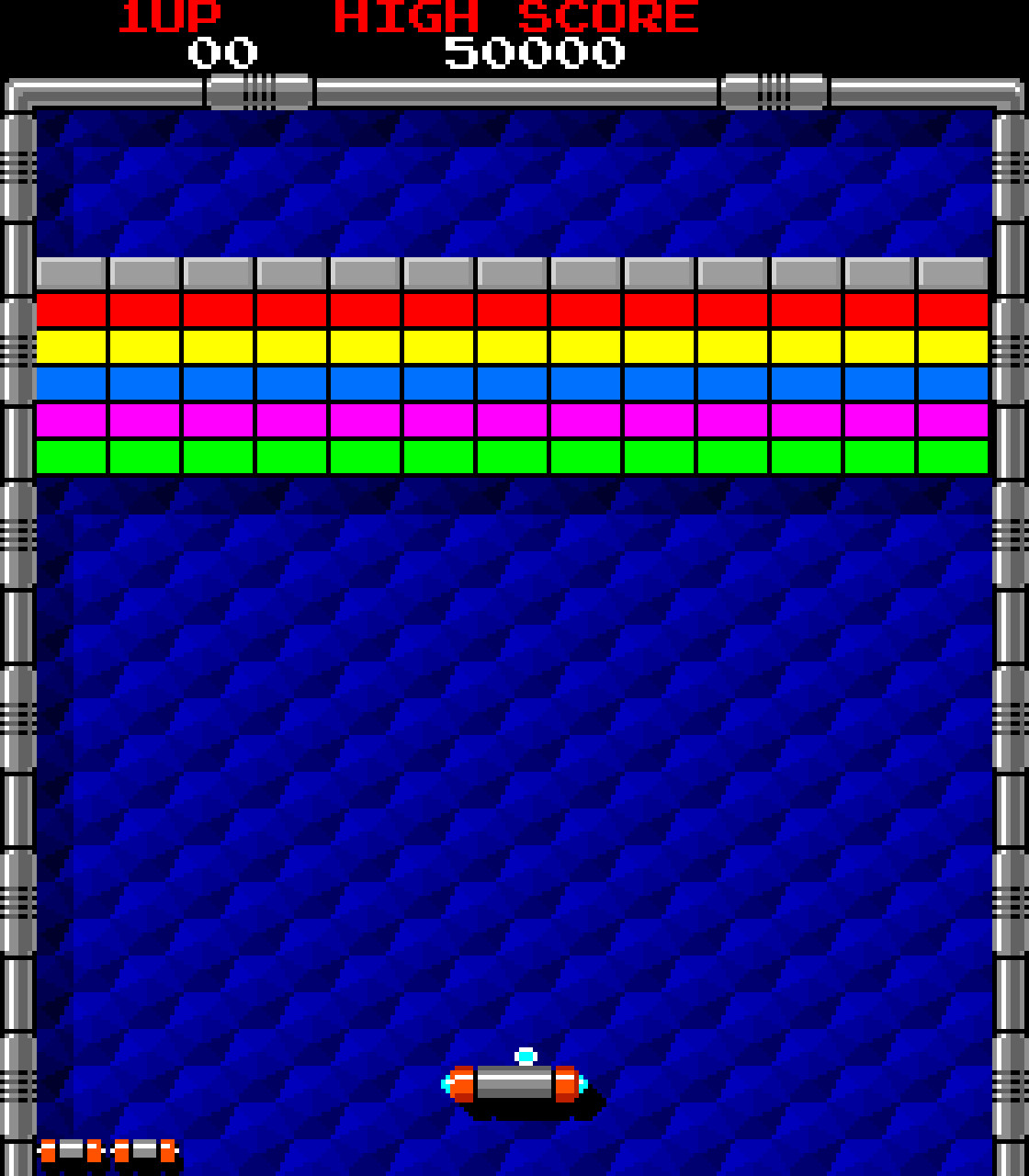
Taito’s Arkanoid (1986), enlarged from its arcade screenshot via Wikipedia. Falling power-up capsules and shaped brick layouts turned Breakout’s purity into the template Retroid follows.
The Game Boy Already Had One — Sort Of
Any Game Boy brick-breaker also has to reckon with a ghost in the cartridge slot. Nintendo’s own Alleyway was a 1989 launch-window title for the handheld, a deliberately stripped-back take on Breakout in which the paddle is piloted by Mario and later stages arrange bricks into patterns drawn from the Mario universe. Alleyway proved the concept travelled beautifully to a small monochrome screen and short sessions. It also, by modern standards, stopped early: no power-up capsules raining down, no boss encounters, none of Arkanoid‘s escalation. For players who grew up with the handheld, that gap was an itch. The commercial era never really scratched it, which is precisely the sort of gap the homebrew scene exists to fill.
That context matters for judging Retroid fairly. Fischbach was not competing with contemporary releases on a shop shelf. He was making, in 2016, the fuller-featured brick-breaker that the Game Boy’s 1989–1990s catalogue arguably should have contained, and giving it away to anyone with the means to run homebrew code — on real hardware via flash cartridges, or in an emulator. Homebrew catalogues date version 1.0 to 17 September 2016, days before this site first flagged the release, and describe it plainly as a take on Atari’s classic. The modesty of that description undersells what a complete, polished, multi-stage game represents on this platform.
What Retroid Does With The Recipe
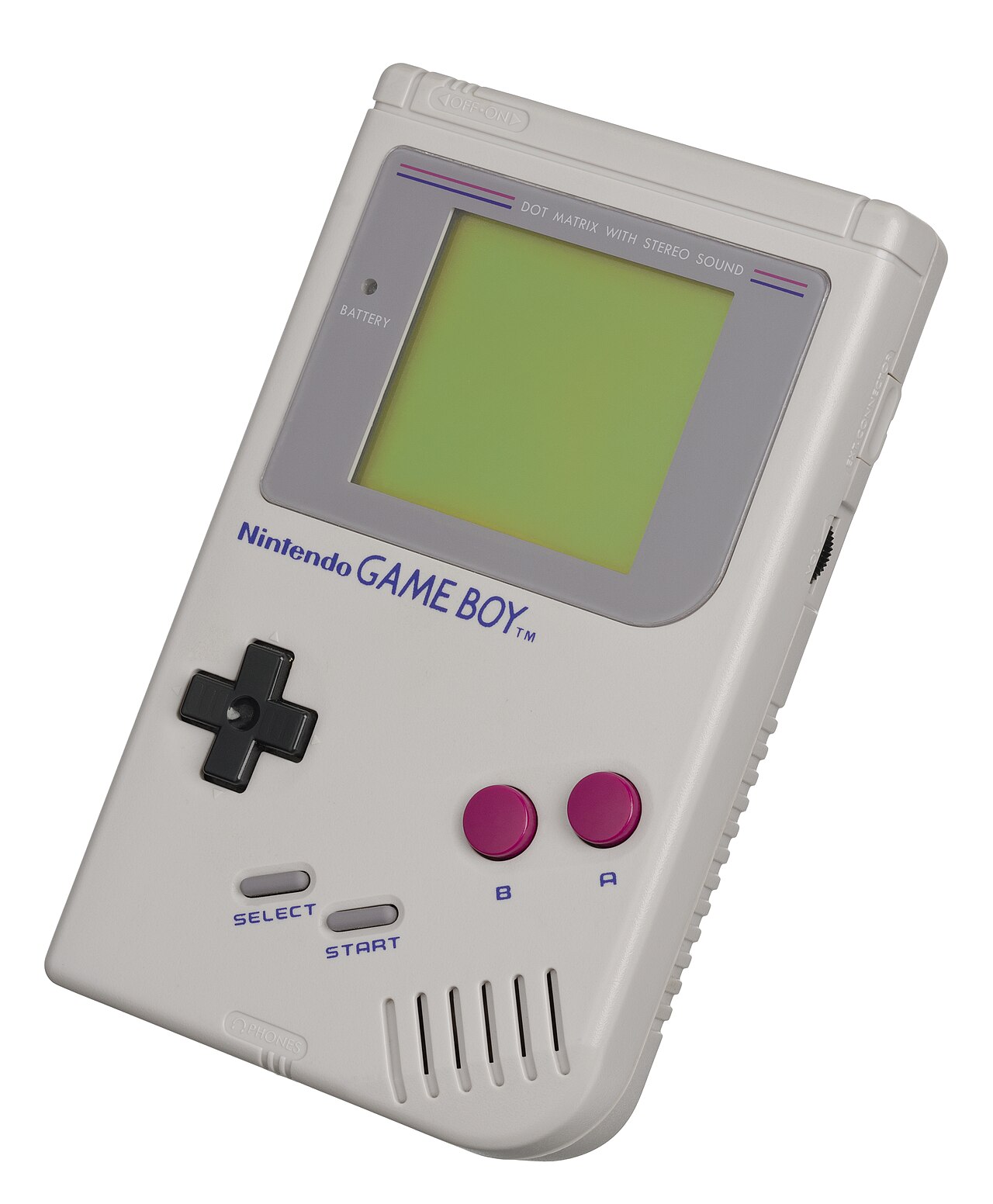
The original Nintendo Game Boy, Retroid’s target hardware — a 1989 handheld whose four-shade screen and simple controls suit the brick-breaker formula perfectly. Photo: Wikimedia Commons.
The core, as it must be, is untouched. You slide the paddle along the base of the screen, keep the ball alive, and clear each layout brick by brick, reading angles rather than merely reacting to them — because on a small screen with a digital D-pad, precision comes from positioning early, not from last-second saves. Where Retroid honours the Arkanoid branch of the family rather than the Breakout branch is in everything layered on top of that core. Later catalogue descriptions of the game credit it with twenty stages, boss battles punctuating the run, and a power-up set that includes cannon fire, a flaming ball and an enlarged paddle. Even taken as a summary rather than a specification sheet, that list tells you the design intent clearly: variety of layout, variety of threat, and periodic set-piece encounters so that clearing walls does not blur into one undifferentiated marathon.
Bosses deserve a specific word, because they change the psychology of a brick-breaker more than any capsule can. A wall of bricks is passive; it can only wait to be dismantled. A boss — Arkanoid‘s Doh being the genre’s founding example — occupies the top of the screen as an antagonist, something the ball must be aimed at deliberately while survival continues underneath. It converts the end of a run from bookkeeping into a duel. Building such encounters for the Game Boy means spending the machine’s modest resources on one large, expressive presence instead of on dozens of small ones, and it gives a free homebrew release a sense of occasion that a simple high-score loop cannot match.
The hardware shapes the rest. The Game Boy offers four shades, a screen resolution that forgives chunky, readable sprites, and a speaker best suited to short, punchy effects. A brick-breaker is almost comically well matched to those limits: bricks read clearly in four shades, the ball’s position is never ambiguous, the playfield fits the portrait screen as if designed for it — which, historically, it nearly was, since the arcade ancestors also lived in vertical cabinets. Sessions suit the handheld’s original purpose, too. A stage is a bus stop, a coffee, a five-minute gap. Fischbach’s decision to build for the DMG rather than for a modern platform is the whole aesthetic statement: constraint first, polish inside it.
Why Free Homebrew Mattered In 2016
It is worth pausing on the word “free”, because in the 2016 retro landscape it distinguished Retroid from much of the news around it. That autumn, as other stories in this very batch of our archive show, lost commercial games were resurfacing through paid cartridge campaigns and crowdfunding drives — exciting, but transactions nonetheless. Homebrew of Retroid‘s kind belonged to an older gift economy: a developer builds something for a beloved machine, releases it to the scene’s archives and libraries, and the reward is simply that people play it and remember it. GameBrew’s homebrew listings still carry the game with its 2016 date and its author’s name attached, which is how that economy keeps its accounts — attribution instead of invoices.
Hindsight. Looking back from later years, Retroid also sits at an inflection point for Game Boy development. The late 2010s would bring friendlier toolchains, a wave of new commercial-grade releases for the handheld, and eventually full boxed games competing for the same audience. A compact, finished, freely given brick-breaker in September 2016 was an early sign of that coming weather: proof that individual developers could still treat the DMG as a living platform rather than a museum piece, and that there was an audience ready to load a new game onto thirty-year-old hardware simply because it was good. None of that was knowable on release day. What was knowable — what this site’s two sentences were gesturing at — is that the paddle, the ball and the wall had completed another successful journey onto another machine, forty years after Atari first stacked the bricks. On the evidence of Retroid, the recipe has plenty of journeys left.