
At a glance: 8Bit Music Power (2016) · Producer/illustration: RIKI · Publisher: Columbus Circle · Platform: Nintendo Famicom (and compatibles) · Release: 30 January 2016 · Content: 12 tracks, 44 minutes 20 seconds · Score: 8.0/10
Every chiptune album ever released is, in some small way, a forgery. The genre’s whole aesthetic imitates hardware — square waves, triangle bass, a noise channel pretending to be a drum kit — but the MP3 on your phone was rendered in a studio, polished by plugins, and could imitate a Famicom the way a photograph imitates dinner. 8Bit Music Power refuses the imitation. Released in Japan on 30 January 2016 by accessory maker Columbus Circle, it is a chiptune album that exists only as a Famicom cartridge: twelve tracks by eleven of the form’s greatest living practitioners, plus one secret, which your thirty-year-old Nintendo hardware composes live every time you press power. There is no recording on the cart. The console is the instrument. It was billed, not unreasonably, as the Famicom’s first commercial cartridge release in over two decades.
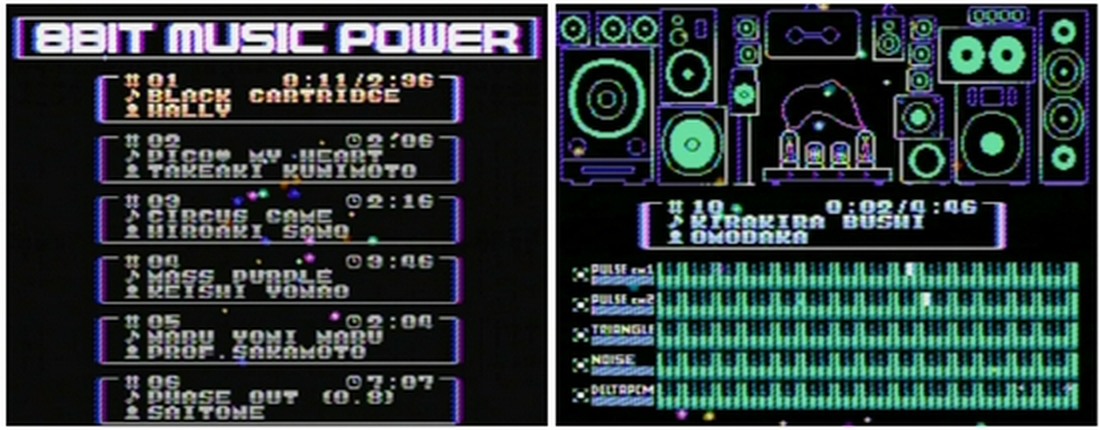
The object itself is lovely. Columbus Circle matched the real thing: a full-colour box wrapped in producer RIKI’s Day-Glo pixel-art illustration, a black cartridge (catalogue number CBC-8M, because of course it has one), and the tiny print of an artefact that knows exactly what it is. Slot it into a Famicom and the player boots to a track menu; pick a song and the screen fills with a boom box illustration and a live channel visualiser, needles dancing separately for pulse, triangle and noise. The first production run was a thousand cartridges, sold through Amazon Japan and Play-Asia, and an 8Bit Music Power Live concert followed in Tokyo a fortnight after launch. This is not a novelty pressing. It is a record release, conducted entirely in the grammar of 1986.
The lineup is the review
Albums live or die on tracklists, and this one reads like a hall of fame induction ceremony. Hally opens proceedings with BLACK CARTRIDGE, all momentum and melody. Takeaki Kunimoto — Hudson’s Star Soldier composer — contributes PICO MY HEART, unmistakably his: bright, athletic, grinning. Yuriko Keino, who scored Namco’s early-eighties arcade canon, offers EIGHT BIT JUNGLE, a masterclass in doing more with three melodic channels than most producers manage with thirty. Nobuyuki Shioda, whose Recca soundtrack remains the Famicom’s most famous act of technical violence, closes the listed programme with the seven-minute TestPattern, the album’s longest and strangest workout. Between them: Keishi Yonao’s MASS PURPLE, Professor Sakamoto’s naru Yoni naru, Saitone’s glitchy PHASE OUT (0.8), Masahiro Kajihara’s ORIENTAL MYSTIQUE, Tappy’s TIP-TRACK 303, Hiroaki Sano’s CIRCUS GAME, and Omodaka’s Kirakira Bushi, which grafts enka singing-song phrasing onto square waves and somehow lands it. Even the visual staff cheats: the pixel art had help from Hiroshi Ono, the Namco artist behind the look of Pac-Man, Galaga and Dig Dug. Forty-four minutes, and the filler never shows up — indeed, the tracklist ends with a credit that simply reads “00 / secret: secret,” and finding it feels exactly like finding a warp whistle in 1988.
As a listening experience it is sequenced like a concert, not a compilation. The front half runs bright and quick — Hally, Kunimoto and Sano all deal in momentum, tunes that sound like title screens for games you wish existed — while the back half grows stranger and more confident, Yonao and Saitone bending the hardware toward abstraction before Keino’s jungle groove resets the room and Shioda’s seven-minute closer treats the sound chip like an endurance athlete. Leave any single track running and the room changes: this is music designed to be generated in a space, by a machine sitting in it, and the gentle hiss and hum of real hardware through a television speaker becomes part of the arrangement in a way no remaster will ever reproduce. The visualiser is more than decoration, too — watching the triangle channel carry a bassline you can hear working is a small education in why these composers were geniuses of economy.
The case for inconvenience
Let us state the obvious objections, because they are also the point. You need a working Famicom (or compatible; even Columbus Circle hedged that some clone hardware may refuse the cart). Your listening room is wherever the console is. There is no shuffle culture here, no skipping to the chorus on a train — there is a cartridge, a television, and an album that plays in an order chosen by its makers, wearing its track listing on a menu screen. Judged as a delivery mechanism, it is absurd. Judged as an argument — that chiptune is not a style of music but a music of a specific machine, with a specific voice, which emulation flatters and recordings embalm — it is completely persuasive. Every note you hear was synthesised, that second, by a Ricoh 2A03 chip that may be older than the person holding the controller. No two ageing consoles will sound quite identically warm. A CD edition followed later in 2016, and a sequel, 8Bit Music Power Final, arrived in March 2017 with eighteen tracks and an even deeper bench (ZUN, Manami Matsumae, Motoaki Furukawa) — but the original cartridge remains the purest statement of the idea.
Context made it possible. Columbus Circle had built a business on exactly this audience — modern accessories and reproductions for the Famicom hardware Japan never stopped owning — and RIKI, an illustrator steeped in the demoscene and chipmusic world, had the Rolodex and the credibility to recruit a generation of composers back to the chip many of them had defined. The project was documented almost like a summit: a companion book of interviews with the participants followed (including an English edition), the launch concert put the composers on a stage with their own cartridge, and the whole endeavour treated a ¥-price-tag novelty like a cultural event. In a decade when “new game for a dead console” was becoming a Kickstarter genre, 8Bit Music Power asked a ruder question: what if the dead console got a new album first?
Is it short-sighted or genius, as the original version of this review wondered in 2016? A decade on, with the Famicom’s commercial catalogue still growing and this cart a collector’s item — first-run copies long gone from retail, the sequel likewise, signed examples from that Tokyo launch show changing hands like first pressings — the question has answered itself. Scarcity was never really the trick, though; plenty of limited objects are merely limited. This one is limited and right. The music is excellent; the medium is the message; and the medium, gloriously, still works.
“Eleven masters, one 1983 sound chip, and not a single recorded note — the most honest chiptune album ever made, because your Famicom performs it.”
Verdict: 8.0/10. An album you have to plug in — so plug it in, turn the television up, and listen to 1983 perform 2016.