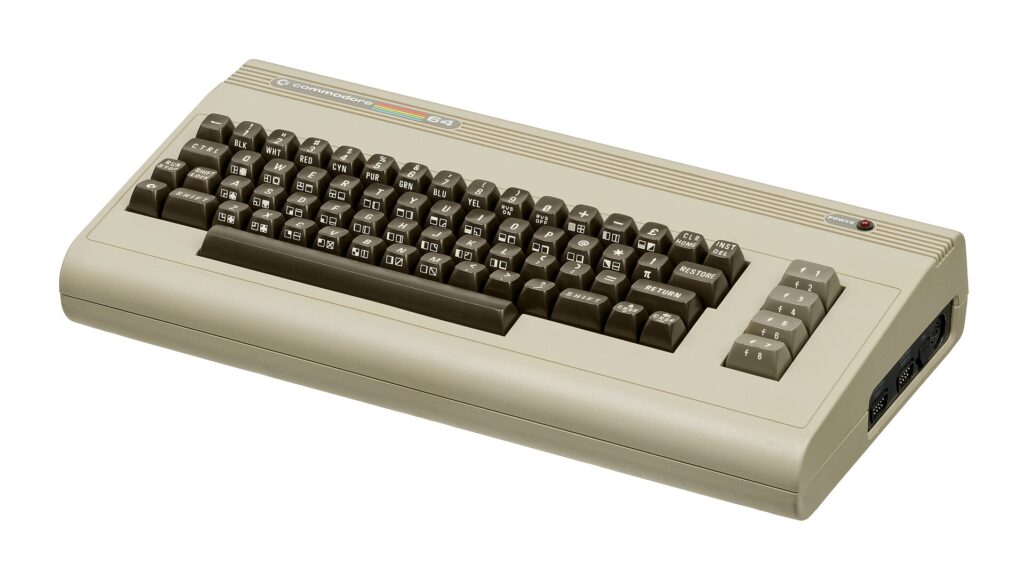
Some games are love letters to a specific machine. Hyper Sentinel is a love letter to the Commodore 64 — to Andrew Braybrook’s Uridium, to the sideways fury of Delta and Armalyte, to an era when a single programmer-artist could define a genre. Its own story has an pleasingly old-school shape, too: a first Kickstarter that failed, a leaner second campaign that triumphed, and a release that put a defiantly 8-bit-hearted shooter onto the most powerful consoles of 2018. The original 16 Bit World post caught the second campaign mid-flight in February 2017. Here is the whole story.

Uridium’s children
Hyper Sentinel was created by Jonathan Port, working as Four5Six Pixel, and his influences were worn proudly on the Kickstarter page: Uridium, Tornado Low Level, Cybernoid, Delta, Armalyte, Sanxion and Defender. The core idea comes straight from Uridium (1986): skim your fighter across the surface of an enormous enemy dreadnought, blasting gun emplacements and waves of defenders, then destroy the ship and move on. Hyper Sentinel rebuilt that loop with modern smoothness — twelve levels, three difficulty modes, up to sixty medals to earn, online leaderboards, a power-up system, boss encounters, and a SID-style chiptune soundtrack that pushed its inspiration right into your ears.
Publishing the game was Huey Games, and that is where the story gains its beautiful symmetry. Huey was founded by Rob Hewson — a veteran of TT Games’ LEGO titles — together with John Ogden, with Rob’s father Andrew Hewson as chairman. Andrew Hewson founded Hewson Consultants, the legendary British publisher behind Uridium itself, along with Paradroid, Nebulus, Cybernoid and Exolon. The man who published the game that inspired Hyper Sentinel was now, three decades later, helping publish its spiritual descendant — with his son running the company. Retro gaming rarely produces circles that close this neatly.
The Uridium blueprint, updated
For readers who never owned a C64, Uridium’s design needs a word of explanation, because Hyper Sentinel inherits it wholesale. Andrew Braybrook’s 1986 classic put your Manta fighter on the deck of a solar dreadnought the length of the screen many times over; you skimmed its surface at ferocious speed in both directions, weaving between towers, destroying launch ports and ground targets in the correct order, and when the dreadnought’s core was exposed, you landed the killing blow and escaped before the explosion. It was blindingly fast by 1986 standards and famously unforgiving.
Hyper Sentinel keeps that skeleton and rebuilds everything hung on it. The dreadnoughts are larger and their defences layered; power-ups drop from destroyed installations and let you sculpt a build mid-level; alien fighter waves interrupt your strafing runs; and each ship culminates in a guardian boss rather than Uridium’s single core moment. The medal system — up to sixty across the game — rewards the score-attack discipline that 1980s players practised for free. Add the extra display modes unlocked through the campaign’s stretch goals, letting the game wear period-authentic graphics filters, and Hyper Sentinel becomes something like a museum exhibit you can play at 60 frames per second: the ancestors visible in the glass, the descendant doing push-ups in front of it.
Failure first, then funding
The first Hyper Sentinel Kickstarter, in 2016, asked for £35,000 and fell well short, closing at £12,653. Many projects die there. Port and Huey instead did the unfashionable thing: they listened, cut the goal, improved the game, and came back. The second campaign — the one our original post covered on 20 February 2017 — targeted £15,000, opened with the game already dramatically improved, and offered console versions as standard rather than distant stretch goals.
The response vindicated them. The campaign passed its goal with weeks to spare, stood at £18,744 with 48 hours still to run in mid-March 2017, and chased stretch goals including a Commodore 64 graphics mode — the most on-brand stretch goal imaginable — plus limited-edition USB cassette releases stuffed with extras. It remains a textbook example of how to run a comeback crowdfunding campaign: smaller ask, bigger proof, and a community treated as partners rather than wallets.
In play, the finished game divides its pleasures between the Arcade mode’s structured campaign — twelve dreadnoughts, escalating defences, guardian bosses — and a Survival mode built for score-chasers, where the online leaderboards turned into a small war among exactly the generation of players who once competed on magazine high-score tables. The medal system threading through both is pure Hewson-era discipline: sixty targets, no participation trophies, and a Hall of Fame immortalising the demo’s top scorers, a promise made on the Kickstarter page and kept in the shipped game. It plays, in short, like a C64 classic that has been given forty years of accumulated craft all at once.
Launch: May 2018, everything at once
Hyper Sentinel launched on 11 May 2018, simultaneously for PlayStation 4, Xbox One, Nintendo Switch and PC via Steam, priced at £11.99, with an iOS version following in November 2018 at $1.99. Huey’s own pitch for it was “neo-retro”: not a recreation of how 8-bit shooters actually were — jerky scrolling, brutal difficulty spikes and all — but how they felt in your imagination when you were ten years old. Reviewers largely agreed the trick worked; the game was received as a fast, polished, generous arcade shooter that understood its ancestors without being imprisoned by them.
Huey Games, meanwhile, grew from the project into a small but distinctive retro-first publisher, the Hewson name once again fronting the kind of precise, score-obsessed arcade games it had championed in the eighties. The firm’s whole identity — down to the USB cassette releases and floppy-disk special editions — treats physical nostalgia as a design material rather than a marketing trick, and Hyper Sentinel was the proof of concept that made the rest possible.
And the story has a coda so perfect it sounds scripted. In 2026, the Hewsons returned to Kickstarter with Hyper Sentinel Fusion, a sequel blending the original formula with new ideas — and offered it in a special edition packaged inside a floppy disk. It cleared its £15,000 goal with room to spare, raising £24,387 from 606 backers. Forty years after Hewson Consultants was posting C64 games through letterboxes, the family business is still shipping shooters on deliberately obsolete media. Some traditions are worth keeping.
One more detail completes the portrait. Port developed Hyper Sentinel in the great bedroom-coder tradition — a small-team labour of years rather than a funded studio production — which makes the Hewson connection more than a marketing flourish. Braybrook, the programmer-designer whose Uridium defined the form in 1986, was the archetype of that tradition, and his publisher’s family shepherding a spiritual sequel three decades later is the British games industry remembering its own methods fondly, and finding they still work.
Why Hyper Sentinel matters
Hyper Sentinel’s journey — failed campaign, humbler return, multi-platform launch, sequel a decade later — is the crowdfunding model working exactly as advertised, which makes it the exception that proves how hard the model is. It also demonstrated something the retro scene sometimes forgets: the pioneers of the 1980s are not museum pieces. Andrew Hewson’s name on a 2018 shooter was not a nostalgia garnish; his company published it, his son directed the firm, and the result was one of the most enjoyable Uridium descendants ever made. The dreadnoughts never stood a chance.