
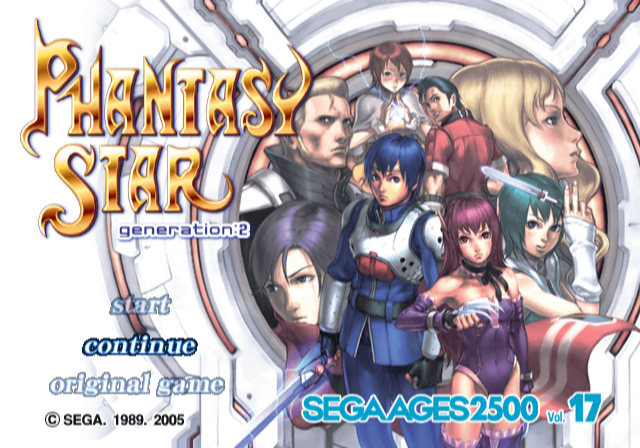
Of all the cruelties in Sega’s catalogue, few run deeper than this one: one of the greatest RPGs of the 16-bit era received a loving, ground-up remake — and the remake was never released outside Japan. Phantasy Star Generation 2, part of the Sega Ages 2500 series for PlayStation 2, rebuilt 1989’s Phantasy Star II with new art, new events and decades of hindsight. It sat behind the language barrier for ten years. Then, in 2015, the fans simply climbed over it, releasing a complete English translation patched together from a prior French effort — and closing one of the retro era’s longest-running injustices. This is the story of the remake, and of the rescue.
The Sega Ages experiment
First, the context. Sega Ages 2500 was one of the strangest publishing programmes of the PlayStation 2 era: a long-running budget line, named for the flat 2,500-yen price point, in which Sega’s back catalogue was reissued — sometimes as faithful ports, sometimes as full polygonal remakes with redrawn art and rearranged music. Golden Axe got the treatment. So did Out Run, Space Harrier, Fantasy Zone and dozens more, to wildly varying quality. The crown jewels of the line, by common consent, were its two RPG volumes: Phantasy Star Generation 1, remaking the Master System original, and Generation 2, remaking its far more famous sequel.
The remakes were not lazy. Both games were redrawn from scratch in a clean, storybook style, with animated character portraits, a re-recorded soundtrack and scripts expanded with new dialogue and scenes. Quality-of-life thinking ran through them: the original Phantasy Star II is a magnificent game wrapped in 1989’s cruelties — glacial walking speed, mazes clearly designed by an enemy of mankind, and a difficulty curve that mistakes attrition for challenge. The remake softens none of the story’s bleakness but sands down the friction around it, and adds one feature that alone justifies its existence: with clear data from Generation 1, the remake allows Nei — whose death in the original is one of gaming’s defining gut-punches — to be revived. Sega built a machine for healing a sixteen-year-old wound, and then declined to sell it to the people who had been wounded.

Newcomers should know what the fuss is about. Phantasy Star II, released for the Mega Drive in 1989 and the West in 1990, was years ahead of its medium: a science-fiction epic set a millennium after the first game, in a terraformed paradise quietly rotting from within. Its hero, Rolf, is a government agent investigating a breakdown in the climate systems run by the supercomputer Mother Brain, and the story that unfolds — through bio-monster outbreaks, a prison satellite, a dying planet’s last stand and the drowning of a world — keeps escalating toward one of the most debated endings in RPG history. It was also famously, defiantly hard: dungeons like the dams of Mota remain benchmarks for labyrinth design, and its mid-game loss of a beloved party member set the template for a thousand later imitators. This was the game Sega chose to remake, and they chose well.
Why it never came West
The Ages line did reach the West once, sort of: a 2005 compilation, Sega Classics Collection, bundled a selection of the 3D remake volumes for North America and Europe. Reviewers were unkind, sales were modest, and the two Phantasy Star volumes were not even on the disc — the RPGs, text-heavy and expensive to localise, were exactly the entries a budget programme could not justify. The arithmetic of the mid-2000s was brutal and simple: a niche remake of a 1989 RPG, however beloved, does not pay for its own translation. The door was closed, and for a decade it stayed closed. Fans made do with the original — reissued faithfully on every platform under the sun, to be fair — and with the knowledge that somewhere in Japan sat the better version, glowing behind glass.
The fan rescue
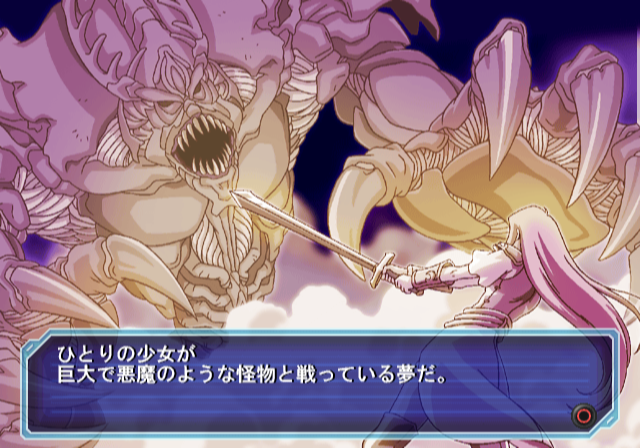
The rescue came in the established way of fan translation: slowly, then all at once. The groundwork was French. A team of French-speaking fans, working in the grand tradition of that country’s formidable translation scene, produced a complete French patch for Generation 2, cracking the game’s text systems and proving the project possible. Building on that foundation — with the French team’s tools and blessing — an English version followed, released in 2015, translating the full script: every line of Rolf’s journey across Mota, every new scene the remake had added, every menu and item description. What the patch delivered was not a curiosity but the definitive edition of Phantasy Star II, finally readable by the audience that had loved the original for twenty-six years.
It is worth dwelling on why this matters beyond one game. The fan translation scene of the 2000s and 2010s quietly became the retro industry’s unofficial localisation department, delivering Mother 3, Seiken Densetsu 3, dozens of Super Famicom RPGs and now a PlayStation 2 remake to audiences the rights holders had written off. Generation 2’s path — Japanese exclusive, French beachhead, English completion — is that whole ecosystem in miniature: international, volunteer, patient and utterly indifferent to the commercial logic that kept the game locked away. Sega’s own position has softened over the years into something like tolerance, and the modern era of official retro publishing owes these translators a debt it rarely acknowledges: they kept the catalogue alive during the years when keeping it alive made nobody any money.
The technical side of the rescue deserves a sentence of respect. Translating a PlayStation 2 game is not translating a ROM with a hex editor and optimism: the text lived inside a modern, compiled, disc-based production, and untangling it required reverse-engineering skills closer to software archaeology than to the 16-bit patching scene that raised most fan translators. That the project succeeded twice — once into French, once into English — on volunteer time, for a game with no commercial future, remains one of the scene’s purest achievements. Download numbers are hard to verify and beside the point; the point is that a finished, polished, fully translated Generation 2 exists at all.
Should you play it?
First-time players, incidentally, should not fear the game’s reputation for cruelty bleeding through the remake untouched. The Generation versions rebalanced the grind that made the 1989 original a war of attrition, and the fan patch preserves those mercies intact — this is Phantasy Star II with its teeth filed to a humane sharpness, which veterans may debate but newcomers will simply enjoy.
Emphatically yes — with a caveat. The remake’s art style divides opinion: some players find its clean, bright redraw a betrayal of the original’s brooding palette, and the arranged soundtrack lacks the FM bite of the Mega Drive original. But as a way to experience Phantasy Star II’s story — still one of the darkest, boldest narratives of its generation, ending on a note of ambiguity games twice its size would not attempt — the fan-translated Generation 2 is unmatched. The remake Sega would not sell you is out there, in English, finished by the people who loved the game most. In the end, that may be the most Phantasy Star ending imaginable: the official channels failed, and ordinary people crossed a star system to fix it.