
At a glance: K.C.’s Krazy Chase! · Odyssey 2 · Magnavox, 1982 · Maze chase · Score: 8.0/10
History wrote this game’s design brief. When the courts ordered K.C. Munchkin! off the market in 1982, Magnavox needed a sequel different enough to survive the lawyers and similar enough to keep the audience — and Ed Averett’s answer was to change what the maze is for. K.C. still runs a maze, but now he hunts the Dratapillar: a long, segmented centipede-like creature winding through the corridors. Eat its segments one by one and it shrinks; eat its head and the round ends in triumph. Munchers still patrol, trees block corridors and periodically shift the maze’s shape — and the whole thing plays like a conversation between Pac-Man and Centipede conducted entirely in Odyssey 2.
How it plays
The Dratapillar is a genuinely good idea. A moving, multi-part target turns route-planning into pursuit planning: do you chase the head and risk the Munchers on the way, or harvest the tail segments safely and let the creature stay long and fast? The trees add a second system — they obstruct, they can be eaten through at a cost in time, and their growth changes the maze between and during rounds, so no two chases share a map for long.
And then there is the voice. Krazy Chase launched alongside The Voice module in September 1982 and was built to sell it: K.C. gets shouted encouragement, warnings and exclamations — ‘Go!’, ‘Run!’, ‘Incredible!’, ‘Oh no!’ — timed to the action with a game-show host’s enthusiasm. Without the module the game is complete but quieter in every sense; with it, the cartridge has a personality no silent maze game can match. It remains one of the module’s defining titles.
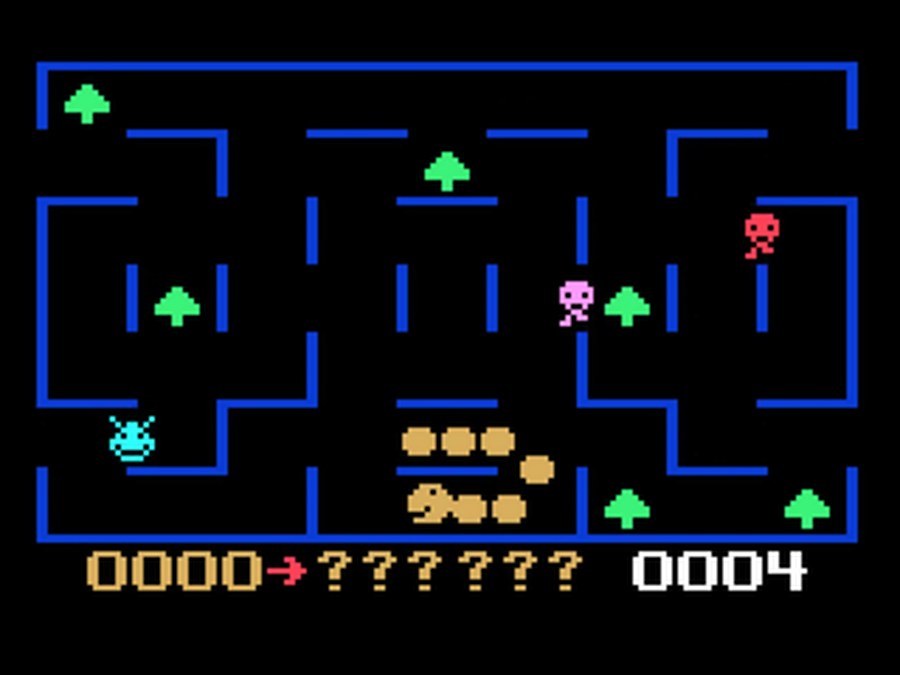
Ordered by a court to be different, K.C.’s Krazy Chase! turned the difference into the game — a centipede hunt with a shouting commentator built in.
The details that decide it
Judged coldly against its predecessor, Krazy Chase is the slightly lesser game — the original’s purity is a hard act to follow, and the Dratapillar’s pursuit can feel less tense than the wandering dots’ endgame. Judged as its own cartridge, it is inventive, fast and characterful, and its existence is a small monument to designing under legal constraint: the differences the lawyers demanded became features players remember.
The longer game
The Dratapillar’s pursuit has a tactical texture its predecessor’s dots could not offer. A segmented target has a geography: the head is the prize and the danger, since ending the creature ends the round, but the tail is where the safe points graze. The creature’s length is therefore both score and shield — harvest it and the round quickens — while the Munchers patrol independently, so every chase is two problems overlaid. The trees, growing and shifting, keep redrawing the maze’s answers mid-question. In aggregate it is a busier, more improvisational game than K.C. Munchkin!, and if it lacks that game’s purity it compensates with incident: Krazy Chase rounds generate stories, and stories are what get cartridges reinserted.
The legal shadow deserves its footnote in any honest review. Krazy Chase exists because an appeals court drew a line around a maze game; its differences from its predecessor are, in a real sense, court exhibits that learned to be fun. That it succeeded commercially and critically anyway — and launched The Voice in the same box season — is a tribute to a small team’s refusal to ship a sulk. The Odyssey 2’s catalogue is full of ingenuity under constraint; this is the title where the constraint had a case number.
Playing it today
Tactically, the Dratapillar rewards a discipline the original never asked for: patience at the head. The head is worth the round, but it is also the creature’s most defended point — the Munchers’ patrols intersect its path constantly — and greedy head-hunting is the cartridge’s leading cause of death. The professional play is harvest and herd: take the tail segments as they present, keep the creature long and therefore slower to complete its circuits, and strike for the head when a Muncher pattern opens the corridor. The trees, meanwhile, are not scenery but a slow second maze being written underneath the first; a player who notices the maze changing — who treats a growing tree line as a door closing — lasts measurably longer than one who runs the maze they remember.
The Voice performance, too, has more craft in it than ‘it shouts.’ The exclamations are timed to reversals — the warning as a Muncher closes, the celebration as a segment lands — so the module functions as commentary in the true sense, telling the game’s story back to the player at the speed of play. It is easy, now, to hear it as camp. In September 1982 it was a console narrating its own game, live, and the players who heard it first did not laugh. They bought the module.
K.C.’s two cartridges, shelved together, tell the Odyssey 2’s best story — triumph, lawsuit, comeback — in two boxes. The comeback is the one with the shouting. Play it loud.
Verdict
K.C.’s two adventures belong together on the shelf — the classic and the comeback. The comeback is better than it ever needed to be.
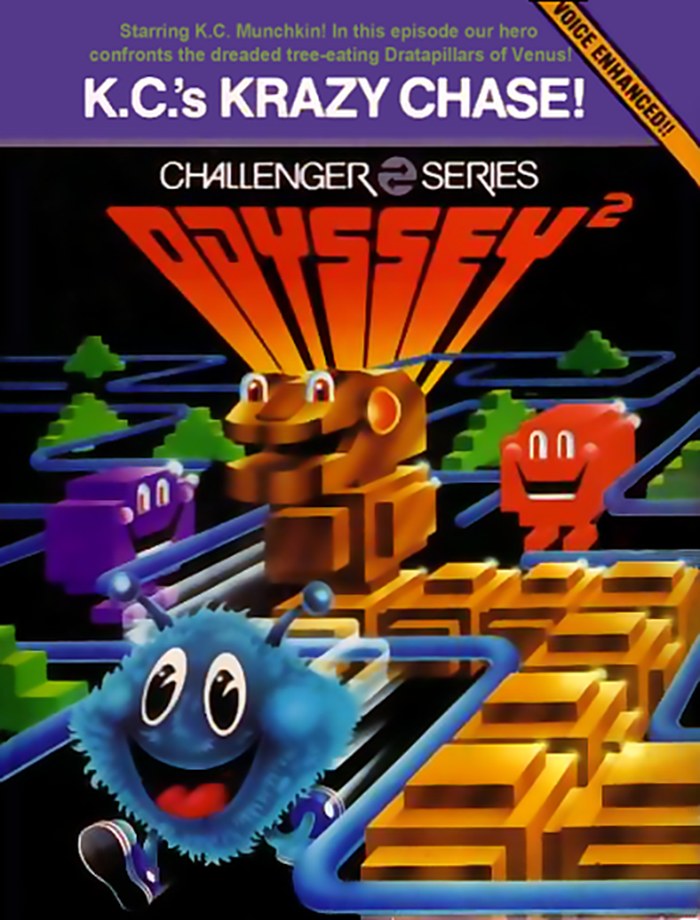
With the module, essential; without it, still a top-ten system cartridge. Buy the pair together when you can — Krazy Chase cartridges are common, the box art is glorious, and the first time K.C. gets shouted at by his own console, everybody in the room understands 1982 a little better.
Eight out of ten — a point below its predecessor, which is the most respectable defeat in this library, because K.C. Munchkin! is a nine and Krazy Chase was designed under legal duress to be different from it. What Averett produced instead of a diminished copy is a distinct game with its own tactics, its own target, and the loudest personality on the system: a maze chase narrated by a speech synthesiser with a game-show host’s timing. Its historical resonance is double — it closed the first great video game copyright saga with a flourish rather than a whimper, and it launched The Voice in the same season, giving the module its defining cartridge. Either distinction would earn a shelf slot; together they make it indispensable, and its actual play — the harvest, the herd, the head — earns the slot the history reserves. Complete the pair, fit the module, and let the sequel have the last word its lawyers never intended it to have. It shouts it, in fact. Repeatedly. Incredible.
In this series: K.C.’s Krazy Chase! is one of eighteen Odyssey 2 cartridges reviewed in this build-up of the system’s shelf, alongside features on The Voice, the Master Strategy Series, the keyboard and the Videopac years, a hidden gems list and a full buying guide. Read it with the flagship history, Odyssey 2 Forever, for the whole story of the keyboard console — and if you are choosing a first cartridge from the set, the scores in this series are the shortlist, with the buying guide’s hedged price ranges as the shopping list.
In Europe it was Crazy Chase, Videopac 44. Our verdict: A sequel with a legal brief for a birth certificate and a real game for a result. Essential with The Voice; strong without it.