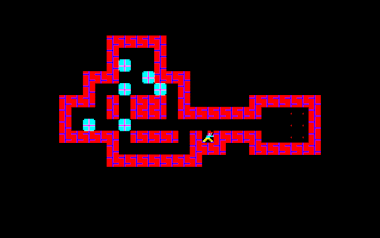
First, a correction, because it matters to everything that follows. When KHAN Games announced The Incident in June 2015, with a trailer premiered through Retro Game Network, the pitch that travelled around the homebrew scene framed it as an alien-invasion game — the kind of phrase that conjures descending invaders and a little cannon sliding along the bottom of the screen. The finished game is not that. There are no invaders to shoot and nothing descends. The Incident is a box-pushing puzzle game in the Sokoban tradition, starring a small warehouse robot, set in the far future, and containing more than a hundred levels of the purest, cruellest logic-puzzling the NES homebrew scene had produced up to that point. The alien framing was the wrapper. The warehouses were the game.
Meet Sam, Four Centuries Too Late
The premise, as KHAN Games eventually published it, is a small science-fiction mystery wrapped around a puzzle mechanic. The year is 2415. Humanity has evacuated the city, abandoning a once-busy commercial warehouse, and something — the incident of the title — wakes Sam, a box-pushing robot, model KSS-084, in the basement. Sam’s job, and therefore yours, is to work upward floor by floor, shifting crates onto their marks, edging one level closer to the outside and to an answer: what happened four hundred years ago, who caused it, and what it means for the humans who left. It is a lot of narrative ambition to hang on a robot moving boxes, and that is precisely the point. The story is delivered in the spaces between puzzles, a drip-feed of mystery that gives the hundredth warehouse room a reason to exist beyond its own difficulty.
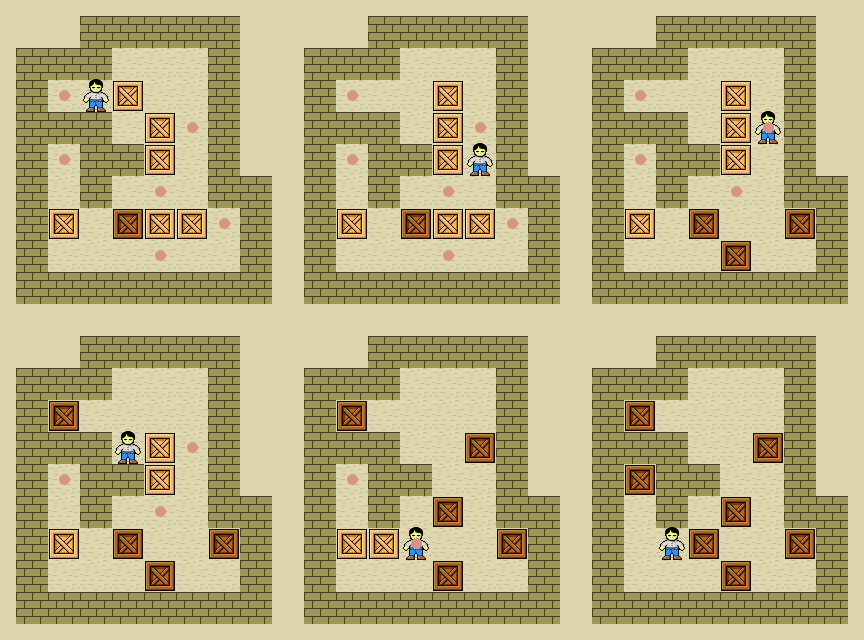
That structure — a humble mechanic, a hundred-plus rooms, a story that treats the puzzling as a journey rather than a menu — is what lifts The Incident out of the long line of Sokoban clones. Sokoban itself, created by Hiroyuki Imabayashi and first released in Japan in 1982, is one of the most cloned designs in history: push every crate onto a target square, one crate at a time, never pulling, with a single careless shove into a corner enough to make a room unsolvable. Its rules fit on an index card. Its depth has sustained four decades of level designers. What it rarely receives is a world. Hanley gave it one.
The Man Behind KHAN Games
KHAN Games is, to a first approximation, Kevin Hanley. His route into development is the NES homebrew scene’s classic origin story, and he has told it himself in interviews: he arrived at the NintendoAge collecting community in 2007 chasing a complete licensed NES library, discovered that people there were not only collecting old games but making new ones, and talked his way in through the side door — first as a composer, writing music for other developers’ projects at a time when few people in the scene were doing it, then, when Brian Parker’s retroUSB Nerdy Nights tutorials began teaching NES programming to anyone willing to climb the hill, as a programmer. He had, by his own account, no programming background at all. He learned 6502 assembly, the machine’s unforgiving native tongue, because that was the price of admission.
By the time of The Incident, Hanley was a veteran of that small world, with earlier KHAN Games releases behind him in several genres — the scene knew him as a developer who finished things and put them on real cartridges, which in homebrew is the whole reputation. That finishing instinct shows in The Incident’s shape. A hundred-plus hand-built Sokoban levels is not a tech demo or a jam project; it is a full commercial-scale puzzle game, designed, built and shipped for hardware whose manufacturer had moved on in the previous century.
One Push at a Time: The Design
Strip the fiction away and The Incident’s design problem is the one every Sokoban designer faces: how do you keep a mechanic with exactly one verb — push — interesting for a hundred rooms? The answers are in the level design rather than in added gimmicks. Room geometry does the work. Corridors one crate wide turn ordering into destiny: push the wrong box first and the right box can never reach its mark. Open floors look generous and are usually traps, because freedom means more ways to strand a crate against a wall. The difficulty curve across a hundred levels has room to teach, then to combine, then to demand the long, patient, backwards-planned solutions — working out, before the first push, where the last crate must end its journey — that separate Sokoban players from Sokoban finishers.
Wrapping that in Sam’s ascent matters more than it might appear. Each floor cleared is literal progress upward through the abandoned building, toward daylight and answers, so the game’s geography and its difficulty curve climb together. The mystery framing — what was the incident, why did everyone leave, what is outside — also gives the game an ending to aim at, something the arcade-puzzle tradition rarely bothered with. You are not pushing boxes for a high score. You are pushing them toward a door.
2015: The Scene It Landed In
Context flatters The Incident. The NES homebrew world of 2015 was past its novelty phase — the era when simply running new code on the old machine earned applause — and into its craft phase, when the question had become whether a new NES game could stand as a game, full stop. Annual competitions, a maturing toolchain, experienced cartridge producers and an audience of collectors who had seen everything meant a June announcement trailer was a claim that had to be backed up. Hanley backed it up the slow way: the game was developed across 2015 and into its physical release as a complete, boxed, real-cartridge NES title, sold the way homebrew was sold then — in limited numbers, to people who mostly already knew the developer’s name. It has held its standing since. In later community rankings of indie NES games, The Incident still places inside the top thirty of all time — a remarkable shelf position for a game about moving crates, and a fair verdict on its level design.
Why a Robot in a Warehouse Endures
There is a final, pleasing symmetry to The Incident that its 2015 announcement, with its invader framing, completely missed. Sokoban’s warehouse keeper was always, in spirit, a machine: a tireless worker executing perfect logic in a sealed room. Hanley simply made it literal, gave the machine a model number, a sleeping past and a reason to keep going, and set the whole thing four hundred years after the humans who built the warehouse had gone. The Incident is not really about an invasion, whatever the early pitch implied. It is about what is left behind when everyone leaves — and about a small robot in the basement, pushing one box at a time toward the light. For a hundred levels, that turns out to be more than enough.