
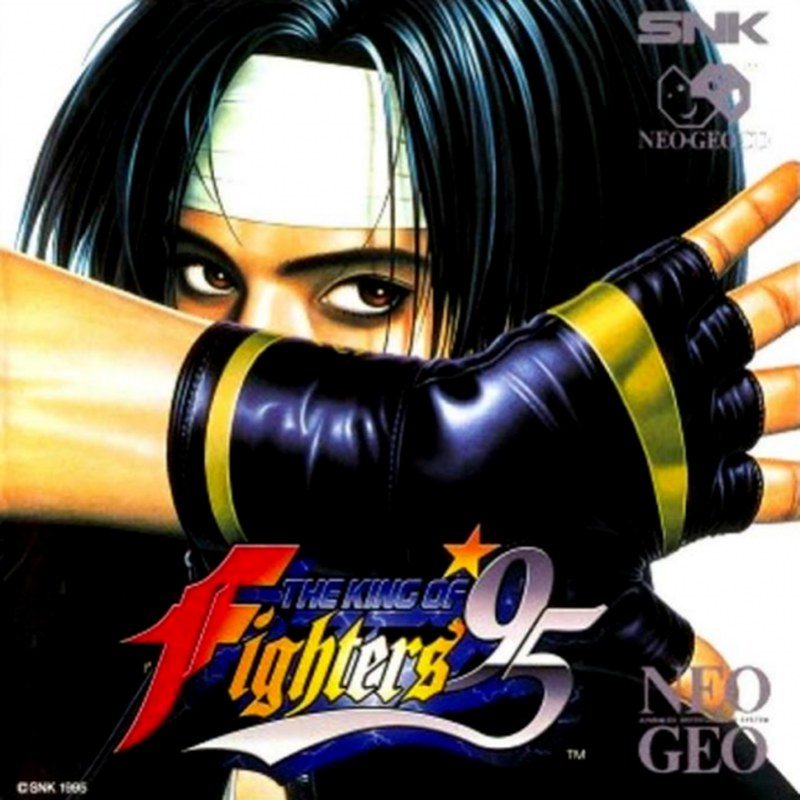
At a glance: The King of Fighters ’95 · Neo Geo CD · SNK, 1995 · Fighting · Score: 8.5/10
The King of Fighters ’94 invented the three-on-three team format but made you pick a pre-set national team and like it. ’95 (1995) handed you the keys: Team Edit lets you build any trio from the 24-strong roster, and with that single feature the series found its soul — your team became your statement. The roster itself is the strongest kind of sequel work: the Fatal Fury and Art of Fighting casts return sharpened, the Ikari Warriors bring military menace, and two debuts redraw the series’ map. Iori Yagami arrives as Kyo Kusanagi’s flame-wielding nemesis, all manic laughs and purple fire, and the boss pairing of Saisyu Kusanagi — Kyo’s brainwashed father — and Omega Rugal in his definitive form gives the tournament its Orochi-saga spine.
Mechanically this is vintage, demanding KOF: four-button SNK fighting with hops and rolls still young, guard-crush pressure, desperation moves that demand low health and full meter, and damage tuned high enough that rounds end in sudden, violent punctuation. It feels stiffer than the silky ’98 generation would, but the stiffness has character — this is a heavyweight’s game, footsies and commitment over flowcharts.

Fighting on a single-speed drive
Now the CD reality, because KOF is the genre the format served worst and ’95 demonstrates exactly why. A team fighter on cartridge holds the whole roster in ROM and swaps fighters instantly. On CD, the game lives in 7MB of RAM: your team and the CPU’s team load before the match — a wait in the tens of seconds, monkey included — and the disc must think again as new fighters step in. SNK’s engineers did sensible triage: stages and music stream efficiently, character data is packed tightly, and once a match is running the fighting itself is arcade-true, with no dropped frames or cut animation worth naming. But the rhythm of a team fighter — win, next challenger, momentum — is precisely what loading interrupts, and a full arcade ladder run accumulates minutes of watching the monkey that a cartridge owner simply never spends.
Practice changes the verdict somewhat. Versus sessions, where the same two teams reload repeatedly, suffer least after the first load; solo ladder runs suffer most. And there is an unexpected CD pleasure: the arranged soundtrack. ’95’s score — the ESAKA team themes, Iori’s Arashi no Saxophone lineage beginning here — gets the full CD arrangement treatment, and it is glorious, some of the best arranged music SNK ever commissioned.
What the disc keeps and what it costs
Content parity with the cartridge is effectively total: Team Edit, all 24 fighters plus the bosses unlockable, the same endings, the same hidden inputs. Animation survives intact — KOF ’95’s sprites are smaller than the series would later grow, which flatters the RAM budget — and the backgrounds, from the Neo Geo Land stage to Rugal’s ominous deck, lose nothing. If anything the CD’s audio makes the presentation grander than the AES original, trading immediacy for orchestration.
It is worth being fair about the era’s context. In 1995 a CD fighting game that loaded between matches was not a scandal; Saturn and PlayStation fighters loaded too, if faster. The Neo Geo CD’s single-speed drive was simply the slowest of the three, and ’95 sits in the middle of its catalogue for pain: worse than the small early games, far better than the giants to come. As a historical object it is honest work; as a way to play KOF ’95 today it asks for patience and rewards it with the real game, not a digest of it.

KOF ’95 invented the series’ identity. The CD version lets you own that invention — provided your team can wait for the disc between rounds.
The roster that redrew the map
Spend a paragraph on the cast, because ’95’s roster is its argument. The returning teams arrive sharpened — the Hero Team around Kyo, the Fatal Fury and Art of Fighting contingents at their mid-decade peak, the Ikari Warriors bringing Ralf and Clark’s military menace — and the women’s team, the sports heroes and the rival team fill out a 24-fighter field that still feels generous. Iori’s debut is the headline, but the structural debut matters more: Team Edit means the roster is a palette, not a menu, and the tier arguments, dream-team experiments and character-loyalty dramas that sustain KOF communities to this day all begin on this disc’s select screen. The bosses close the case: a brainwashed father as the penultimate grief, then Omega Rugal — the version of Rugal the series would chase forever — as the era’s defining SNK wall.
As a CD object, ’95 also marks the moment the format’s fighting-game pattern settled: big initial loads, honest fights, arranged music as the compensation, and a price a fifth of the cartridge’s. Thousands of players learned team fighting on exactly this disc, monkey and all, and the muscle memory of that generation — hops, rolls, desperation timing — was formed at this loading screen. Historical weight has a sound; here it is a CD seeking, then that ESAKA riff arriving in full arranged glory.
The CD version in 2026
Playing The King of Fighters ’95 on the format today sorts itself into three honest options. On original hardware, a CDZ halves the waits this review describes and is the connoisseur’s route; an SD-loader-equipped machine abolishes them and is the player’s. Emulation, meanwhile, preserves the arranged soundtrack and the complete game for sampling before you commit to a disc — this library’s discs remain sensibly priced enough that sampling usually ends in owning. Whichever route you choose, judge the game by what this review has tried to keep separate: the fighting itself, which is the full arcade article, and the disc’s rhythm around it, which is a period cost modern options can now refund. The game earned its reputation at full price in its era; on CD in 2026 it asks a fraction of that price and, for the patient or the loader-equipped, gives the whole of itself back.
The verdict
The King of Fighters ’95 is a landmark — the team-edit blueprint, Iori, the Orochi saga’s opening move — and its CD conversion is the affordable way to own that landmark on original hardware, arranged soundtrack and all. The loading between rounds and matches is a genuine tax on a genre built on momentum, and score reflects it; the fighting underneath, once loaded, does not disappoint. For patient players and series historians, this disc is where modern KOF begins.
Damage, drama and the desperation move
One mechanical note explains ’95’s enduring feel in the hands: its damage model believes in consequences. Single clean hits visibly move life bars, desperation moves — available only at low health with a full or flashing gauge — can reverse a round in one committed read, and the guard-attack and dodge systems reward nerve over volume. Matches therefore breathe in a way later, smoother KOFs sometimes flatten: long cautious probings ended by sudden violence. The CD version preserves the tuning exactly, which is the point of insisting on conversion fidelity — a port that ‘fixed’ this damage would be reviewing a different game.
It is also the last KOF whose roster fits an evening’s study whole, before the series’ casts ballooned into the thirties and beyond. Twenty-four fighters, three bosses, one edit screen: the complete strategic universe on one disc, at one loading screen per match. For players who find the later games’ abundance paralysing, ’95 on CD is the series in its most legible form — the year the blueprint was drawn, still perfectly readable.
Score: 8.5/10 — Where modern KOF begins — team edit, Iori, Orochi — taxed by the drive but never diminished as a game.