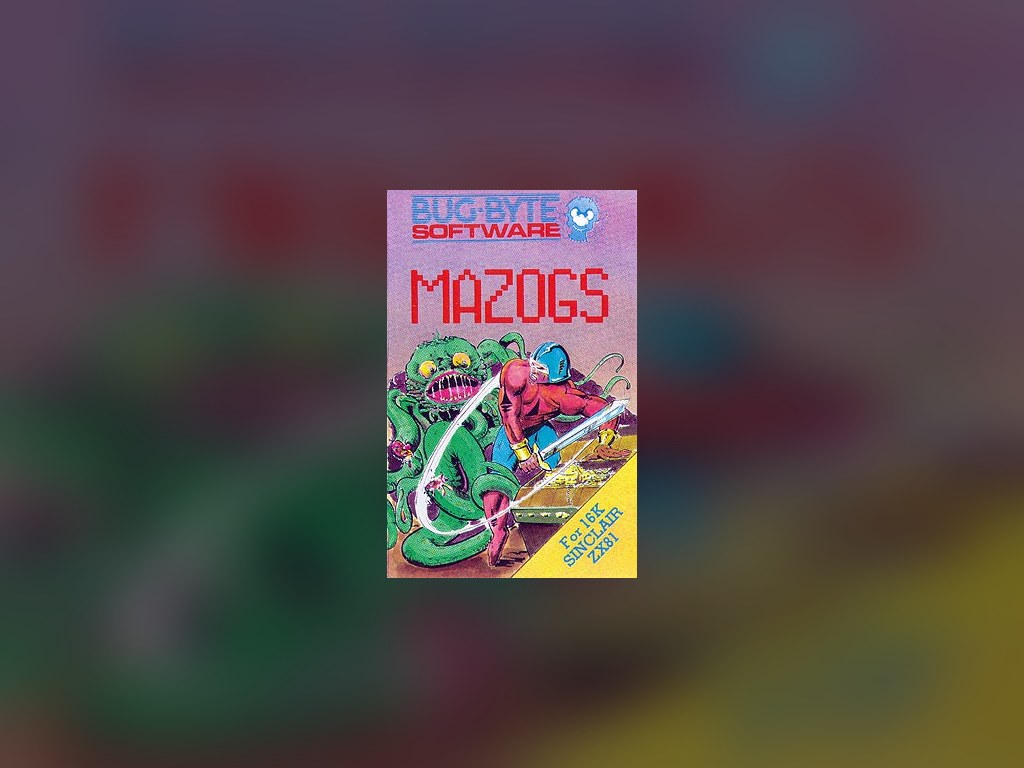
At a glance: Mazogs · ZX81 · Bug-Byte, 1982 · Maze adventure · Score: 9.0/10
If 3D Monster Maze is the ZX81 game that frightened Britain, Mazogs is the one Britain took home and lived in. Don Priestley’s maze adventure for the 16K machine — published by Bug-Byte in 1982, after its code had been dated the year before — sends you into a vast, randomly generated labyrinth to steal a treasure and carry it back out alive. Between you and the gold stand the Mazogs themselves: big, tentacled, purposeful monsters who patrol the passages and will kill you on contact unless you are carrying one of the swords scattered through the maze. One sword, one Mazog — win the fight and the blade is gone. It is an economy of violence measured out in single servings, and it turns every corridor into an accountancy problem conducted at sprint pace.
Priestley, a schoolteacher writing freelance for Bug-Byte, had a stated mission. He wanted, he said, to get away from games “which revolved around a dollar sign being chased by an asterisk” — the standard visual language of the 1K era, in which a letter of the alphabet fled from a punctuation mark and everyone politely called it a dragon. Mazogs was his answer: a full-screen, smoothly scrolling maze built from Sinclair’s block graphics, populated by creatures drawn large enough to have personalities. It was his first game to earn a full-page advertisement, and it became Bug-Byte’s first big hit — the Liverpool house’s calling card, and one of the tiny minority of ZX81 programs, as one contemporary reviewer put it, that every owner should possess.
Prisoners, swords and the long walk home
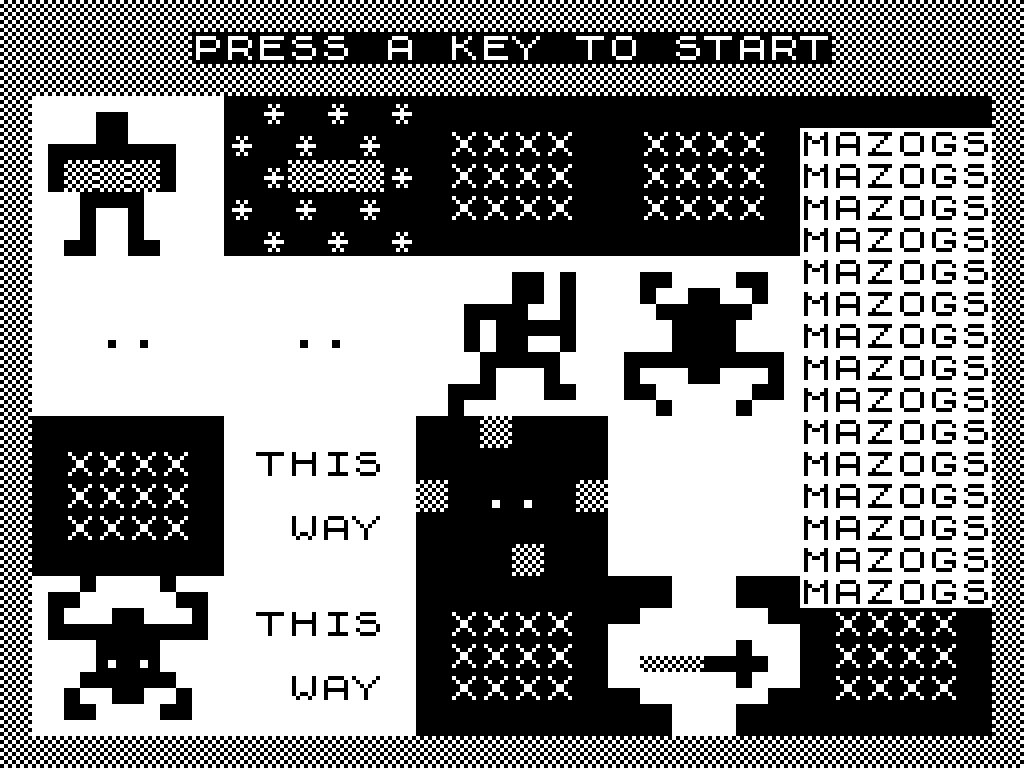
The design’s intelligence is in its aids and its cruelties, which are usually the same systems viewed from different ends. Locked in the maze are prisoners — blinking, sorrowful figures — who will, if you free them, show you the way toward the treasure or the exit, a glowing path laid out for a few precious seconds. It is a help system with a memory test attached: the route vanishes, and what remains is your recollection of it, in a maze deliberately too large to hold in your head. The treasure itself completes the cruelty. Carrying it, you cannot also carry a sword. The walk home — the whole maze again, in reverse, defenceless — is the game’s second half and its real exam, and every Mazog you declined to fight on the way in is waiting for the rematch.
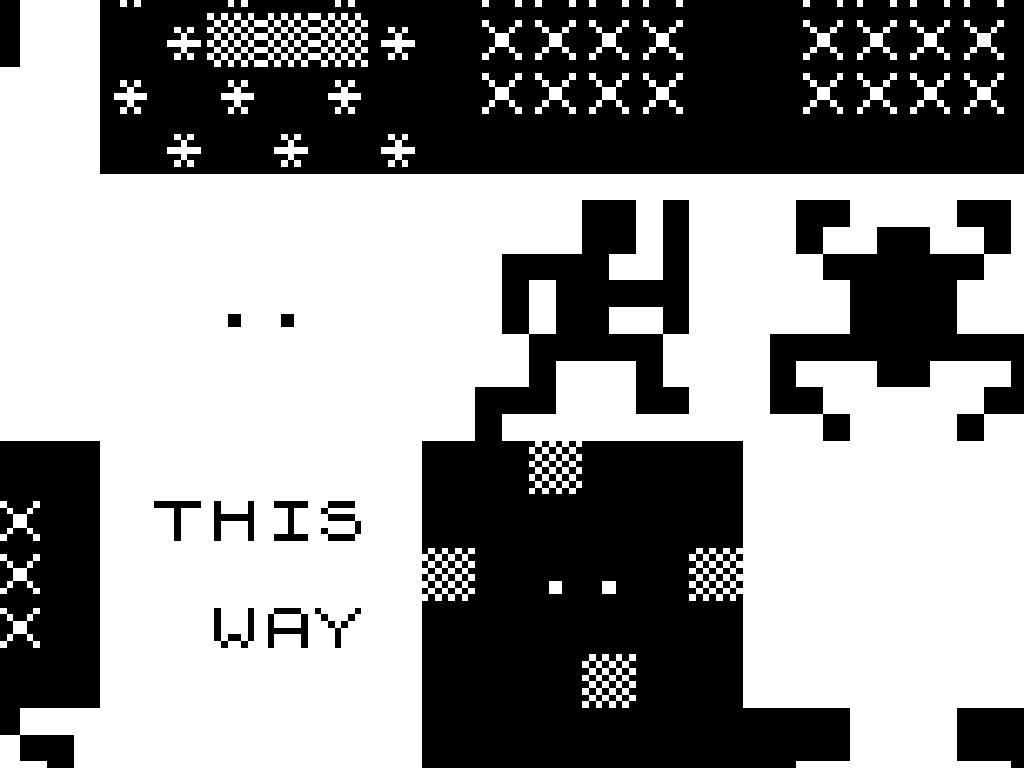
Difficulty levels adjust how purposefully the Mazogs hunt, and at the top setting they move with intent that feels personal. The maze scrolls quickly and the creatures are drawn with a chunky charm that has aged better than almost anything else on the machine: these are Priestley’s trademark big characters in embryo, the same instinct for scale and expression he would later take to the Spectrum in Maziacs — Mazogs’ own colour sequel, published by dK’Tronics in 1983 — and eventually to The Trap Door. You can watch a career start here, in black and white, in the way a monster’s tentacles are arranged in a 2-by-2 block of characters.
Getting the treasure is half the game. Carrying it home, with empty hands, past everything you ran away from on the way in — that is the other half, and it is the better half.
Reception and afterlife
The press understood immediately. Spectrum Computing’s archive preserves the verdict of reviewer Nick Pearce, who ranked Mazogs “alongside other such superb programs as J K Greye’s Monster Maze and Psion’s Flight Simulation” and called it the sort of software that would convert sceptics who saw the ZX81 as a toy. Sinclair User’s later retrospective agreed: fast-moving, very difficult at the highest level, with graphics “very large” and a maze that “scrolls quickly” — a classic, full stop. Compute!, reviewing the American release for the Timex Sinclair 1000 (licensed to Softsync in the US), called it “an excellent, single-player, treasure/maze game” making “excellent use of the Sinclair/Timex capability.” For a £10 cassette — premium pricing in 1982 — it had to be this good. It was.

What survives best is the structure. Random generation for replay value, a two-phase objective, single-use weapons, guides who help at a price in attention — Mazogs assembles, in 16K, a kit of ideas that action-adventure games would spend the decade rediscovering. It is also, not incidentally, enormous fun to play now: quick to start, quick to kill you, and fair in the way that matters, because every death can be traced to a decision you made three corridors ago about a sword you chose not to pick up.
The afterlife of a maze
Few ZX81 games have been loved as forensically as Mazogs. The specialist ZX81 site fruitcake.plus.com hosts a full commented disassembly of the program — the work of a modern analyst who saw the game as a boy, was amazed by its large animated graphics and its mazes that “appeared designed yet clearly must be generated at random,” and determined to discover exactly how it worked. The disassembly reveals a game written as a suite of independent routines in machine code, orchestrated by BASIC, with the options POKEd into memory for the game loop to read — and it records the abandoned experiments a great designer leaves in his code: an unused routine generating full-screen random patterns, another an abandoned attempt at a move-counter that would, the analyst notes, have made solving the maze easy, “which is presumably why it was left out.” Even Priestley’s offcuts were design decisions.
The same devotion produced conversions the original never asked for — the disassembly re-homed, by hand, on the ZX80 in flicker-free form, and on the Spectrum itself, re-assembled 16K higher with every USR, PEEK and POKE adjusted — a community treating a 1982 cassette the way scholars treat a manuscript. That afterlife is the final evidence for the prosecution. Games are not disassembled, ported by hand and colourised by volunteers for forty years because they were popular. They are treated that way because they were built well enough to reward the attention. Mazogs was.
Playing it in 2026
Mazogs is preserved on both sides of the Atlantic — Bug-Byte’s original and Softsync’s Timex edition — and remains the easiest ZX81 masterpiece to start and the hardest to put down cleanly. New players should start at the friendliest difficulty, learn the prisoner’s bargain early, and treat the first treasure recovery as a tutorial for the real game: the walk back. Everything Priestley built is in that walk — the economy, the memory test, the morality of the sword not taken. The maze regenerates. The lesson does not need to.
Verdict
Mazogs is the essential ZX81 maze game and one of the machine’s three or four indispensable tapes. Priestley took the hardware’s poverty — character blocks, no colour, no sound — and treated it as an art style rather than an apology, then built a genuine adventure inside it: a journey out, a theft, and a long, weaponless walk home through everything that hates you. Forty years on, the Mazogs are still in there, patrolling. Mind how you go.
Score: 9.0/10 — Don Priestley’s big-character debut: a treasure hunt with a sting in its tail.