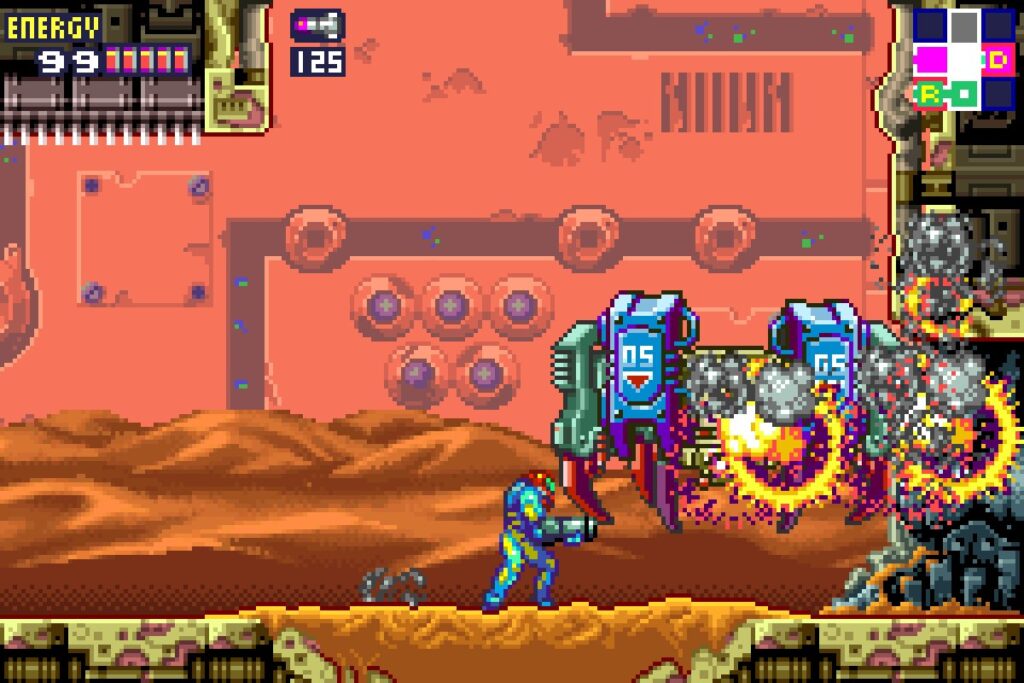
Most sequels give you back the hero you remember, stronger than ever. Metroid Fusion, released for the Game Boy Advance in 2002, does the opposite. It opens with Samus Aran infected by a parasite, her iconic Power Suit surgically cut away, her body fused with Metroid DNA to save her life — and then it sends what is left of her into a research station where something is wearing her old suit, hunting her. That something is the SA-X, and the twenty years of imitators since have not dulled how frightening, clever and quietly radical Fusion remains. This is not just the best Metroid on a handheld. It is the game that proved atmosphere could survive on a 240-by-160 screen.

A station, a parasite and a hunter in your own armour
The setup is the series’ boldest. The X parasites — mimics that absorb a host’s body and memories — have overrun the Biologic Space Laboratories station orbiting SR388. Samus, now part-Metroid and therefore the X’s natural predator, is sent in to clean house sector by sector, taking orders from a ship’s computer she nicknames Adam, after a fallen commanding officer. For the first time, Metroid has an explicit story told in dialogue and monologue, and for the first time the series risks annoying its own fans by locking its world behind mission orders. The risk pays off. Fusion’s linearity is the point: this is a survival story, not a sightseeing tour, and the station is meant to feel like a trap that is slowly being explained to you.
Then there is the SA-X. An X copy of Samus at full power — Ice Beam, Screw Attack, the works — it stalks specific set-pieces through the campaign, announced by a sound cue and a cold musical stab that still raises heart rates. You cannot fight it. You run, you hide under platforms while it patrols past, you freeze in the knowledge that one mistake means meeting the version of yourself you used to be. Survival-horror design inside a Metroid structure, years before that blend became fashionable.
Metroid, rebuilt bolt by bolt
Under the tension, the fundamentals are the tightest the 2D series had managed to that point. Fusion borrows Super Metroid’s skeleton and refines the feel of everything: Samus grabs ledges, climbs ladders, hangs and shimmies, and the controls carry a snap the earlier games only approached. Abilities return in disguised, story-driven forms — missiles, bombs and beams are ‘downloaded’ as data from the station’s rooms, a fiction that justifies the gating while the X themselves become your pickups, restoring health and ammunition as you absorb the parasites you kill. It is an elegant loop: the enemy is also the supply chain.
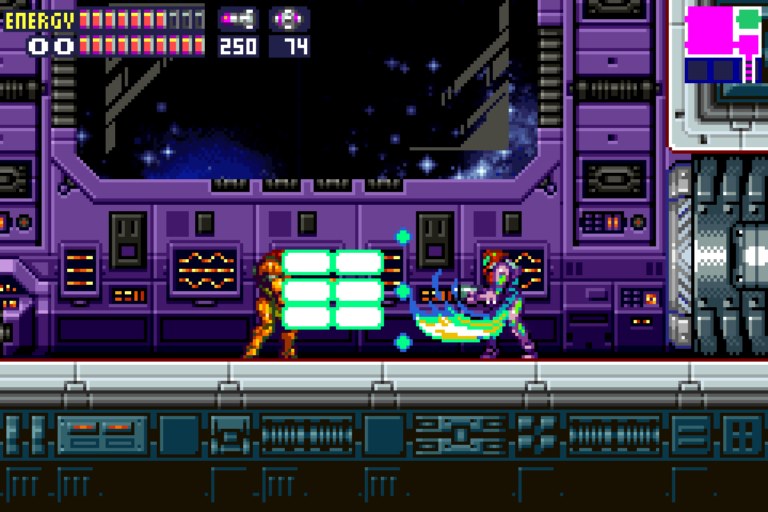
The six sectors give the station real range — the tropical overgrowth of Sector 2, the frozen stores of Sector 5, the aquatic depths of Sector 4 — each with its own X variants and hazards, and each revisited as your growing arsenal recontextualises old corridors. Boss design is a series high point: the hulking Security Robot, the Core-X fights that turn every major victory into a second, desperate scramble as the defeated boss sheds its shell and tries to escape, and a final confrontation that reframes the whole game. Difficulty is honest and occasionally stern — Fusion’s bosses punish button-mashing in a way Super Metroid rarely did — but checkpoints are fair and every failure teaches something usable.
The look and sound of dread, at pocket scale
Visually, Fusion is a masterclass in doing more with less. The palette leans cold and clinical — station whites, quarantine oranges, the sickly greens of the X — and Samus’s redesigned Fusion Suit, organic and asymmetric, still divides fans precisely because it looks wrong in a way that serves the story. Animation is superb: the SA-X’s slow, confident walk sells more menace than any cutscene. The soundtrack, by Minako Hamano and Akira Fujiwara, trades Super Metroid’s ambient sprawl for dread with a pulse — the environmental-disaster themes and the SA-X sting are among the most effective cues on the GBA, a system whose audio hardware rarely got this much respect.

The honest caveats
Fusion’s reputation does carry two fair complaints, and a review should own them. First, the structure really is linear: Adam’s orders and locked doors mean sequence-breaking, the hobby of Super Metroid veterans, is designed out rather than merely discouraged. Exploration happens inside the missions, not instead of them. Second, the storytelling, while effective, occasionally stops the game to explain itself — a small tax, but a noticeable one in a series built on silence. Both choices were deliberate, both serve the thriller Fusion wants to be, and neither survives contact with the SA-X as a serious objection. But players who want the free-roaming sandbox should know which Metroid this is.
Playing it today, and the low-percent lunatics
Fusion’s afterlife tells you how well it was built. It became a speedrunning staple precisely because its enforced linearity makes runs comparable — a fixed route, executed perfectly, against the clock the game itself keeps — while its completion percentages and ending screens (which grade you on time and items) turned thoroughness into a score attack. The 100% run is a genuine feat: several pickups sit behind late-game Shinespark puzzles, the GBA-era technique of storing a speed boost and spending it in impossible directions, that remain some of the most demanding execution challenges in the series. Newcomers should not be put off by any of this. A first, unhurried playthrough is a tight, tense evening-or-two of a game, and Fusion’s save stations and fair checkpointing respect your time in a way its horror atmosphere might not suggest.
It is also worth placing Fusion in its moment. It launched alongside the GameCube’s Metroid Prime in late 2002, and the two games could link: Fusion’s heroine, cross-pollinated with a console epic, in the same season Nintendo proved Metroid could survive both 3D and a complete tonal reinvention on a handheld. Of the pair, Prime gets the statues. But Fusion is the braver story — the one that wounded its heroine, questioned her orders and let her disobey them — and its final act, in which Samus defies the Federation’s plan to weaponise the X and accepts the consequences, gives the series its defining character moment. The SA-X was not the monster. It was the mirror.
One last mechanical note for players arriving from later entries: Fusion’s missile and beam economy is stricter than Dread-era generosity — ammunition is a real resource, the X are your resupply, and retreating to farm a corridor of parasites before a boss is a legitimate, intended tactic. The game also hides its hardest content in plain sight: the infamous early-game navigation rooms, the restricted laboratory’s secret, and a final escape sequence that tests everything at once. None of it is unfair. All of it is Fusion in miniature — a game that trusts you to rise to it.
Verdict
Metroid Fusion is the GBA’s defining action-adventure: a survival thriller wearing a Metroid suit — literally — with the series’ tightest 2D controls, its most memorable antagonist, and a story that dared to make Samus vulnerable and interesting at the same time. It plays beautifully today, lasts a lean, dense handful of hours with real replay value in its completion rankings, and it stands as proof that Nintendo’s handheld team could out-atmosphere most home consoles of its era. If the Game Boy Advance had produced nothing else, it would still be worth owning for this.
Score: 9.5/10