
At a glance: Halo 3 · Xbox 360 · Bungie / Microsoft Game Studios, 2007 · First-person shooter · Score: 9.5/10
Some games sell consoles. Halo 3 sold a moment. When it launched in September 2007, it was billed — accurately — as the biggest entertainment release in history to that point, and for once the hype had an honest core: this was the closing chapter of the trilogy that had defined the original Xbox, rebuilt for the 360 with everything Bungie had learned and a few things nobody else had thought of yet. “Finish the Fight” was the marketing line. The remarkable thing, playing it today, is how completely it still does.
The Ark and the Flood
The campaign picks up with the Master Chief falling to Earth and the war arriving home. What follows is nine missions of escalating spectacle: the jungle fighting of Sierra 117, the desperate defence of Crow’s Nest, a full-scale tank assault across the Tsavo Highway, and then the leap to the Ark — a vast installation outside the galaxy where the game stops holding anything back. Scarab battles you fight on foot, boarding the walking tanks and tearing out their cores. Aerial dogfights over a burning installation. A final Warthog run that consciously, joyfully restages the ending of the first game, except now the floor is quite literally falling away into space.

It is not a long campaign — seven or eight hours on Heroic — but it is paced like a band’s greatest-hits set, with barely a wasted minute. The story closes the Chief and Cortana arc of the trilogy with genuine feeling, and the supporting cast, from the Arbiter to Sgt. Johnson, all get their moment. If Halo 2’s cliffhanger left players furious in 2004, Halo 3 is Bungie’s apology, delivered in the best possible way: by finishing the fight properly.
Sandbox first, shooter second
Bungie’s design philosophy — the famous “thirty seconds of fun” repeated and remixed — reaches its purest form here. Every encounter is a sandbox of interlocking systems: Grunts panic, Brutes berserk, Jackals snipe, and you are handed an arsenal of counters. The equipment system, new for Halo 3, adds bubble shields, deployable cover, power drains and the gloriously stupid gravity lift, and the AI uses them against you as happily as you use them. Vehicles matter enormously: the Mongoose, the Brute Chopper and the returning Warthog fleet turn half the campaign into a combined-arms playground.
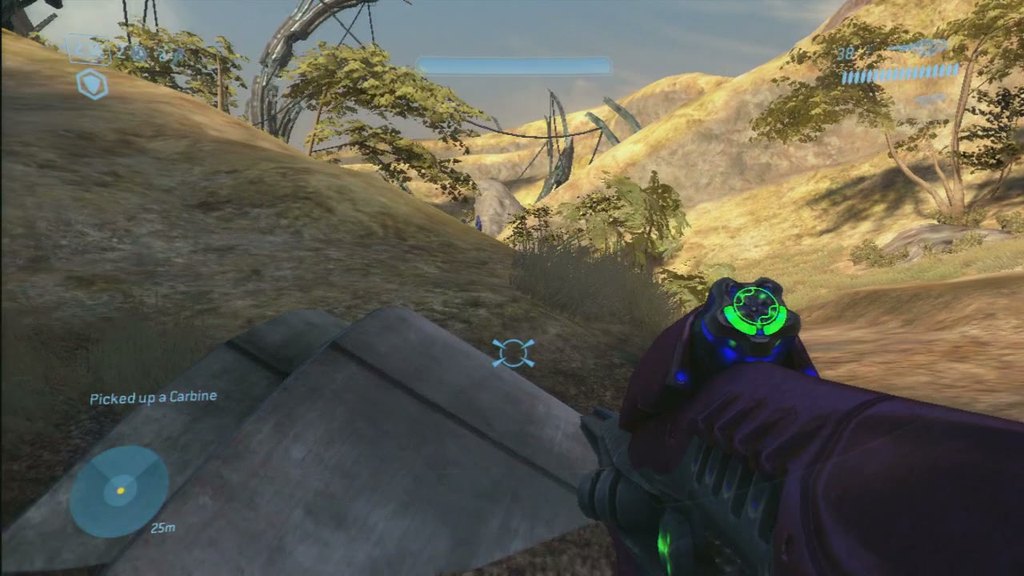
The 360 hardware is pushed hard for 2007. Bungie’s HDR lighting and huge draw distances still give the Ark levels a painterly scale, and the whole campaign runs in four-player online co-op — a first for the series, and the feature that quietly redefined what a shooter campaign could be. Two players was the old way. Four Spartans (well, two Spartans, an Arbiter and an Elite) rolling through Tsavo Highway in two Warthogs is Halo 3’s natural state.
The multiplayer that ate Xbox Live
It is difficult, now, to explain how completely Halo 3 owned Xbox Live. Eleven maps at launch, a ranking system that kept matches honest, and custom games that turned the rules into a toybox. But the two additions that outlasted everything were Forge and Theatre. Forge let players edit maps in real time — spawning weapons, vehicles, man-cannons — and accidentally invented whole genres of community mode. Theatre saved every match as a replayable film, letting anyone become a director: the screenshot and machinima culture that exploded around Halo 3 was born in that menu. Bungie’s website tracked it all, file shares and rendered clips included. Modern “share” buttons are Theatre’s grandchildren.

The shooting itself remains the series’ high-water mark for feel: the battle rifle’s three-round authority, the gravity hammer’s comedy physics, dual-wielded Spikers for the faithful. Matchmaking on the original servers is gone, and the Master Chief Collection is where the population lives now — but the 360 original, system link and split-screen included, remains fully playable in your living room, which is more than most 2007 online shooters can claim.
The night games became an event
It is worth pausing on what Halo 3’s launch meant, because no console game had ever occupied the wider culture like it. Midnight openings at thousands of stores. A marketing campaign that included a museum-grade diorama of the game’s battles, a “Believe” ad series shot like a war documentary with elderly veterans recalling the Master Chief, and the game’s logo on everything from soft drinks to a NASCAR stock car. It made over $170 million in America in its first day — more than any film or album had ever managed. For one week in 2007, a science-fiction shooter sequel was simply the biggest thing in entertainment, and the Xbox 360 was its only home.
That context could have crushed a lesser game. Instead it bought Halo 3 a permanent place in the culture: “Finishing the Fight” entered the language, its midnight queues became the template for a decade of launch events, and an entire cohort of players dates their gaming lives from that September. Games are rarely allowed to be both the blockbuster and the critics’ choice. Halo 3 was — 94 on Metacritic in an era when that score still meant consensus, and a competitive scene that ran for years on the strength of MLG’s adoption of it.
Why the 360 original, today?
The Master Chief Collection is, of course, where most players now live — it adds 60fps performance, the full map catalogue and a live population. So why keep the 360 disc? Three reasons. Split-screen: the original supports four-player local multiplayer and two-player co-op on one screen with a simplicity the collection complicates. Authenticity: this is the game as 2007 experienced it, lighting, physics quirks and all. And permanence: everything on this disc that matters works offline, forever, on hardware you own — a virtue that grows more pointed every time a server-dependent remaster stumbles. Collectors should also know the disc is common and cheap; there has never been a better time to own the real thing.
One more run
And the simplest truth last: Halo 3 is fun in a way that refuses to date. The encounters are short, legible and endlessly remixable; the skulls let you bend the campaign into comedy or cruelty; the score attack and meta-game scoring layered into the 360 release keep even the solo run competitive. Pick it up for an evening with no plan beyond the first two missions and you will find, as millions did in 2007, that the evening has become a trilogy run. Some games you respect. Halo 3 you revisit — annually, some of us — the way you revisit a favourite record, knowing every note and hearing new ones anyway.
The verdict
Halo 3 is not just the trilogy’s ending. It is the moment the Xbox 360 became the centre of gaming culture — and the game still earns that place every time the Warthog run starts.
Measured purely as a package — a spectacular campaign, four-player co-op, era-defining multiplayer, Forge, Theatre, split-screen — Halo 3 is one of the most complete shooters ever shipped on a disc. The visuals have inevitably aged around the edges, and the Flood’s return in the Cortana mission still tests goodwill. But the bones are perfect. Finish the fight? Nearly twenty years on, players still are.
Score: 9.5/10