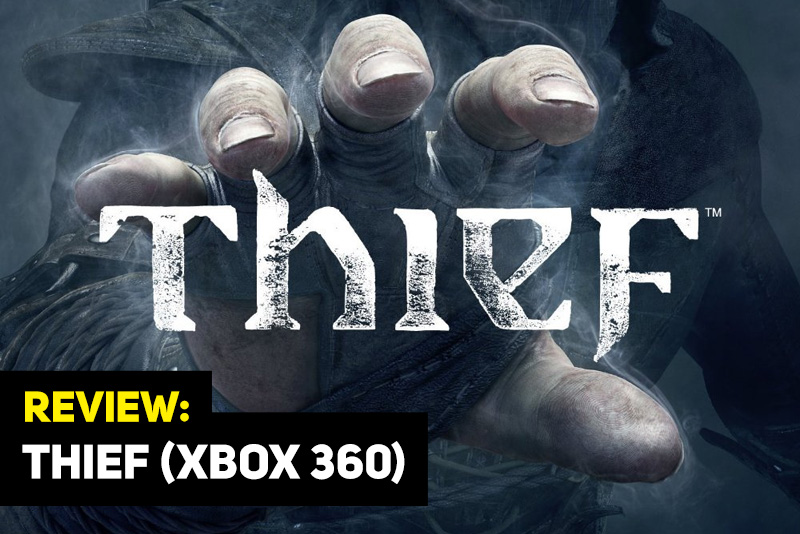
At a glance: Platform: Xbox 360 (also PS3, PS4, Xbox One, PC) · Developer: Eidos-Montréal · Released: February 2014 · Genre: first-person stealth · Playtime: roughly 15–20 hours
There is a special kind of pressure that comes with reviving Thief. Looking Glass Studios’ 1998 original did not just launch a series; it more or less codified first-person stealth — light and shadow as systems, sound as a resource, a protagonist who was hopeless in a fair fight. When Eidos-Montréal’s reboot arrived in February 2014 after a five-year, publicly troubled development, it was asked to satisfy purists who treat The Dark Project as scripture, while also selling to an audience raised on action games with stealth sections. It pleased neither camp entirely. A decade of distance, though, lets us ask a fairer question: judged as a stealth game rather than a sacred text, how does Garrett’s last outing — specifically in its Xbox 360 incarnation — actually play?
The City and its thief

You are Garrett, master thief, returned to the plague-rotted sprawl of The City after a job gone wrong cost him a year of his life and his protégée, Erin. The story that follows — ancient energies, a sinister Baron, a populace squeezed between sickness and oppression — is the game’s weakest garment, told in cutscenes that strain for gravity the script cannot quite supply. The bigger loss for series veterans is vocal: Stephen Russell, Garrett’s voice since 1998 and one of gaming’s great performances, was replaced by Romano Orzari. Orzari is fine in the abstract, but Russell’s dry, sardonic growl was Garrett, and its absence hangs over every scene.
What works is the act of thieving itself. The City is stitched together from hub districts dense with windows to slip through, apartments to burgle and guards to ghost past, and the game is at its best when it simply lets you prowl. Garrett’s hands — forever in frame, gripping ledges and easing open cabinets — sell the physicality wonderfully. Loot is everywhere and gloriously petty: scissors, wine glasses, a lady’s hand mirror. No other stealth series makes the simple business of stealing feel this tactile.
Focus, swoop and compromise
The reboot’s headline additions were clearly designed to make stealth legible to newcomers. Focus vision highlights loot, traps and climbing points in blue; the Swoop move lets Garrett dash between shadows. Both are useful, both are optional, and both slightly sand down the series’ defining tension — in the old games, information was something you earned by looking and listening, not something a button disclosed. Purists can disable the training wheels in the admirably granular custom difficulty settings, which deserve real credit: turning off Focus, markers and even the ability to be spotted cheaply gets you noticeably closer to 1998.
Level design tells the same story of two minds. The open City missions and set-piece infiltrations — a jeweller’s shop, a brothel, the bank — are genuinely good sandboxes. The celebrated asylum chapter, The Forsaken, is a legitimate series highlight: a dread-soaked hour that proves the team understood horror as well as thievery. But too many story missions funnel you down corridors with a single sanctioned route, contextual climbing that only works on approved surfaces, and scripted escapes that wrestle control away at exactly the moment a Thief game should hand it over. Development history peeks through here: announced in 2009 as “Thi4f,” the project shed creative leads and systems for years — an XP system for kills was publicly abandoned after fan outrage at E3 2013 — and the finished game wears its compromises openly.
What the old games still do better
None of this is to pretend the ancestors are untouchable. The Dark Project and The Metal Age remain the high-water mark for systemic stealth: their levels are clockwork sandboxes where a rope arrow and a shadow could rewrite the whole plan, and their sound design — footsteps changing on tile, carpet and metal — still humiliates most modern games. The reboot flattens some of that. Its AI is less curious, its climbing less free, its missions less willing to let you get gloriously lost. Where it quietly advances the formula is in the moment-to-moment business of being a thief: emptying a noble’s study drawer by drawer in Thief (2014) is a pleasure the Looking Glass games, for all their genius, never quite delivered, because their Garrett looted with a single context-free key press.
The score below reflects that balance honestly. Strip the name away and this is a good stealth game — better than several louder contemporaries — with two or three missions that belong in any conversation about the genre. Keep the name, and it is the weakest of the four mainline Thiefs, a bronze medal in a family of golds. Both things are true, and the second does not cancel the first.
The jobs nobody made you do
Buried in the City hub are the game’s finest hours, and they are entirely optional. Two fences — the inventor Ector and the oleaginous Vittori — hand out client jobs: self-contained burglaries in bespoke locations, with no plot armour and no cinematic ambitions. Robbing a pawnbroker’s trapped safe room, or slipping through a manor while its owner sleeps, the game strips away its focus-group machinery and simply asks how good a thief you are. These bite-sized sandboxes are where the Looking Glass DNA expresses itself most clearly, and they reframe the main campaign around them — a flawed blockbuster wrapped around half a dozen small, perfect stealth levels. If you play one version of this game in 2026, play it for the jobs. The story will end when it ends; the memory you keep will be a window latch clicking open in the dark, and a room full of somebody else’s silverware.
The Xbox 360 version
On 360, this is a creditable downport rather than a disaster. The fog and shadow that do so much atmospheric work survive the transition; what you lose is surface detail — textures go muddy up close, loading between City districts is slower, and busy scenes can chug. Crucially, nothing mechanical is cut: the stealth sandbox, the AI routines and the level layouts are the same game. In 2014 terms it meant last-gen owners were not buying a husk. In today’s terms, it means the 360 disc is a perfectly legitimate way to experience the game — and, the reboot never having been ported forward beyond its original platforms’ stores, increasingly one of the more practical ones.
“A compromised reboot with a master thief’s hands and a committee’s heart — but when it shuts up and lets you steal, the old magic is still in its fingers.”
Verdict: Thief (2014) is neither the catastrophe of its launch reputation nor a worthy heir to Looking Glass. It is a mid-tier stealth game with an A-tier sense of touch, dragged down by focus-tested systems and a story nobody needed, then lifted — mission by mission — by some of the most satisfying burglary ever put in a controller. Franchise faithful will mourn what it is not. Everyone else will find a moody, flawed, frequently excellent night’s work. Some of us still check the shadows for Garrett’s return. On the evidence here, flawed as it is, he has earned one.