
At a glance: Mole Attack · VIC-20 · Commodore, 1981 · Action · Score: 6.0/10
Mole Attack makes no pretence of depth, and that is its charm. Commodore’s first-wave cartridge is the fairground whack-a-mole game translated to the VIC-20 with cartoon directness: a grid of holes, a cheerful animated mole popping up at random, and you — armed with a mallet and a joystick — trying to bop him back underground before he vanishes. Score for hits, lose ground for misses and hesitation, and face waves in which the moles get faster, cheekier and less willing to stay bopped. It is the simplest game in Commodore’s launch line-up, aimed squarely at the youngest players and the family audience the friendly computer was courting — and four decades on, its honesty is refreshing. Mole Attack knows exactly what it is. What it is, is fun in ninety-second bursts.

Nine holes of escalating cheek
The VIC-20’s hardware serves the concept better than you might expect. The moles are big, characterful character-graphic creations — they pop, they grin, they mock — and the mallet’s movement is quick enough that failures feel like yours rather than the joystick’s. As waves progress the appearance windows shrink and the pattern of pop-ups grows less merciful, and the game develops the fairground original’s defining quality: the transition from amusement to genuine, laughing panic as your eyes start darting faster than your hand can follow. There is a score, there are levels of a sort, and there is very little else — no power-ups, no modes, no narrative beyond mammal versus gardener. For a launch-window cartridge designed to be understood by a six-year-old in ten seconds, that focus is a feature.
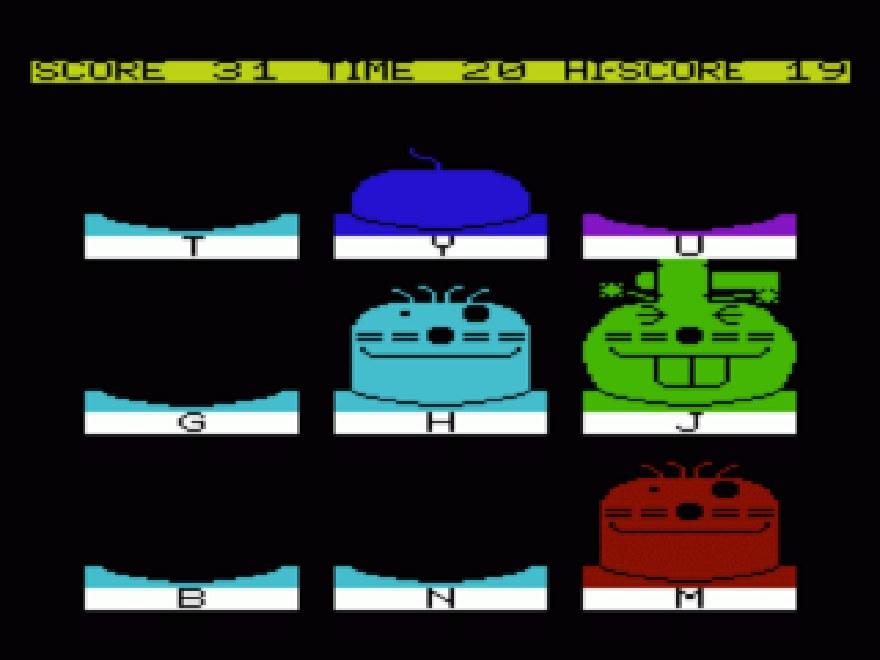
Judged as a VIC-20 program, its technical modesty is also its reliability: it never slows, never flickers, never confuses. The VIC chip provides cheerful effects, the colours are the machine’s brightest, and the whole thing has the polish of a program that was finished — playtested, tuned, done — rather than merely shipped. Compare the dozens of forgotten VIC action games that attempted complexity and achieved muddle: Mole Attack attempts one joke and lands it cleanly, every time, for as many rounds as your reflexes hold out.
A small game, honestly made
Its limits are obvious and should be recorded without cruelty. Mole Attack will not hold an experienced player for an evening; its pleasures are measured in minutes, and its depth is the depth of a reflex. But the VIC-20’s library — like the machine itself — was always a broad church, and the launch line-up’s inclusion of a game for the youngest computer owners in the house was part of Commodore’s whole argument for the friendly computer. Revisited today, it also works beautifully as a party cartridge and as a child’s first retro game: the rules are the game, visible at a glance, and grandparent and grandchild can compete on genuinely equal terms within a minute of plugging in.

Collectors will find it cheap and everywhere, which is correct — Mole Attack belongs in the world in quantity. File it beside Avenger as the launch line-up’s light relief, and bring it out when the room needs a laugh and a mallet.
In defence of the small game
Every library needs its small games defended, because posterity is unkind to them: history remembers the ambitious, the technical, the genre-defining, and forgets the cartridge that simply made a room full of people laugh in 1982. Mole Attack’s defence rests on execution. The animation of the moles — the pop, the look, the vanishing cheek of them — is character work of a high order at character-graphic scale; the difficulty curve is tuned with a fairness that many grander VIC games never achieved; and the whole production has the finish of a team that playtested its joke until the joke landed every time. Small is not the same as slight. A game that does one thing perfectly, for the exact audience it was built for, at the exact moment its machine needed it, is a success by every measure except word count.
It is also, quietly, one of the best-preserved pieces of the VIC-20’s social history. The big cartridges were played by enthusiasts; Mole Attack was played by everybody — siblings, parents, the neighbour who did not ‘do’ computers — because its rules could be absorbed from across the room. The friendly computer’s friendliness was not a slogan. In cartridges like this, it was a design specification, met.
In the slot today
There is one more audience for Mole Attack that deserves naming, because it may be the audience that kept the cartridge in print in spirit: grandparents. The VIC-20 was marketed across generations — the friendly computer for the whole household — and Mole Attack is the title that household could genuinely share, the one where a lifetime of fairground reflexes counted for more than a teenager’s joystick hours. Retro gaming in 2026 talks a great deal about accessibility, and here is a 1981 cartridge that achieved it completely, by design, for the people the industry usually forgot. That is not a small thing. That is, arguably, the friendliest thing the friendly computer ever did.
So the mallet stays in the starter box, beside the chess and the grid wars and the vampire’s castle, and the VIC-20’s first wave stays what it was: a library for everybody in the house. The moles, who never asked for any of this, continue to pop up and be bopped, unbothered by history, which is exactly as it should be.
And if the mallet needs one final character reference, take it from the machine’s own catalogue strategy: Commodore, the most unsentimental company in the business, kept Mole Attack in its first-wave company alongside chess programs and arcade conversions because it understood the living room better than its critics did. The mole game sold the computer to the person in the house who had not asked for a computer. That is not a trivial achievement; it is the entire friendly-computer thesis, proved with a cartoon and a hammer. Hold the cartridge to that standard — the standard of the household it was built for — and Mole Attack is not the launch line-up’s lightweight. It is its ambassador.
Mole Attack attempts one joke and lands it cleanly, every time, for as many rounds as your reflexes hold out.
The simplest cartridge in the VIC-20’s first wave is also one of its most honest: a cartoon reflex game, finished properly and tuned with care. It scores on charm and execution rather than depth, and it remains the machine’s best game for very young players. Small, silly, and worth its slot.
Verdict: the moles are winning. They were always winning. Bop responsibly.
So the moles keep their six, and wear it proudly: a perfectly made small game in a library of bigger ambitions. Some evenings call for Sargon. Some call for the mallet. Wisdom is knowing which evening you are having.