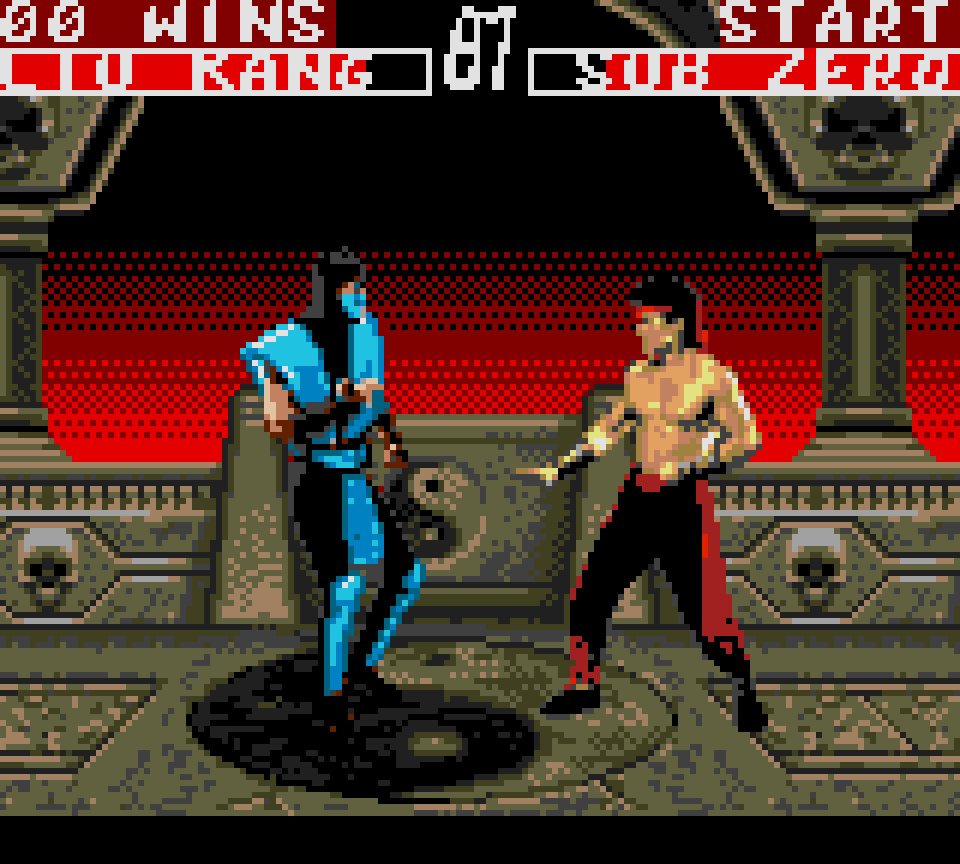
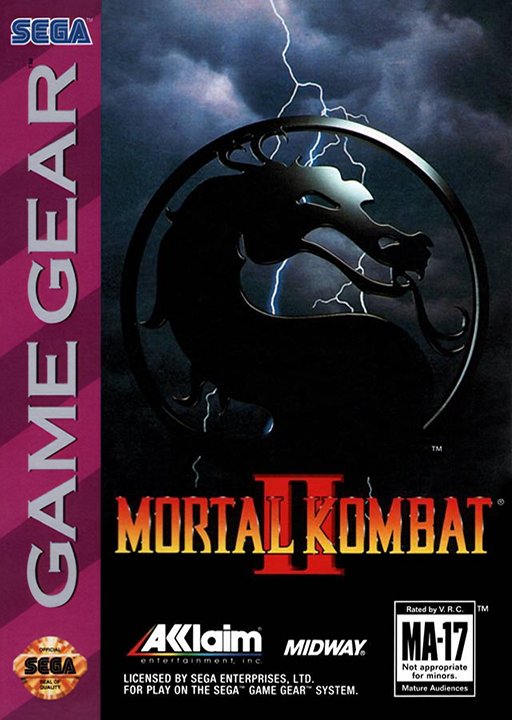
At a glance: Mortal Kombat II · Game Gear · Probe / Acclaim, 1994 · Fighting · Score: 6.5/10
Mortal Kombat II was the fighting game of 1994 — the arcade phenomenon whose digitised warriors, Fatalities and playground mythology defined a year of gaming. The Game Gear version, converted by Probe alongside its Master System sibling, faced the steepest demake in the system’s library: a game whose entire identity was photographic spectacle, rebuilt from sprites a fraction of the size on hardware a generation older. The result is a cartridge that deserves more respect than its reputation suggests — a fast, feature-conscious little fighter that keeps the tournament, most of the roster’s spirit and even a measure of the gore — and one that also demonstrates, fight by fight, exactly where 8-bit ambition ran out of road.
The tournament structure survives: a ladder of mirror-dark Outworld battles rising through Kintaro to Shao Kahn, with the character roster trimmed to fit the cartridge. The Game Gear edition fields a reduced cast — series mainstays including Liu Kang, Sub-Zero, Scorpion, Raiden, Kitana, Mileena, Jax and Shang Tsung in adapted form, with the boss tier intact — and the cuts are the sensible ones, preserving the ninjas and the fan favourites at the cost of the wider bench. Stages are likewise a greatest-hits selection, the Living Forest, the Dead Pool and Kahn’s Arena among them, redrawn in miniature with their personality legible.
Fighting in miniature
Probe’s engine is the same one that powered the first Mortal Kombat’s 8-bit conversions, refined: two attack buttons plus block economy, special moves entered with the familiar directional taps, and the full finishing-move theatre — Fatalities, Babalities and Friendships — present in scaled-down form. Blood, after the first game’s famous sweat-code saga on Nintendo hardware, is simply here in Sega’s 8-bit editions, red and unapologetic within the limits of the sprites. The fighting itself is brisk and readable; combos are simpler than the arcade’s, the AI climbs from obliging to spiteful in classic ladder fashion, and two-player versus via the link cable gives the cartridge its best mode, as with every fighter on the system.

Now the honest comparison, Game Gear against Master System, because the two share a design and differ in the usual ways with an unusual twist. The Master System shows more of each arena and gives the fighters more room to breathe; the Game Gear’s cropped frame tightens every exchange, which in a fighter built on spacing is a real cost — projectiles arrive sooner, jump-ins are harder to judge. In return, the handheld’s palette gives Outworld a richer gloom, and the portability and link play made this the version schoolyard tournaments actually ran on. Neither 8-bit edition is the way to discover MKII’s greatness; both are minor miracles of compression.
What the cartridge couldn’t hold
The losses itemise themselves: fewer fighters, fewer stages, digitised voices reduced to chirps, animation frames cut until some specials read as gestures, and a general sense that the spectacle — the thing MKII was — has been summarised rather than staged. Shao Kahn’s challenge retains its cruelty, at least, and Kintaro remains a wall of a boss. The single-player ladder is a modest evening’s entertainment; the cartridge’s longevity was always versus play, and versus play depended, as ever, on a friend, a cable and two sets of batteries.
A summary rather than a spectacle — but a skilful, gutsy summary of the biggest fighter on Earth, in your pocket, in 1994.
Context rescues the cartridge from condescension. In 1994, a portable Mortal Kombat II that played this recognisably — with Fatalities, with the ladder, with link-cable versus — had no rival on any handheld; the Game Boy’s own MKII was a lesser thing in monochrome. Probe’s conversion was the best portable edition of the year’s biggest game, and it sold and was played accordingly. Judged by the standards of its moment and its machine, it did its job with honour.
The modern replay
Today, the cartridge is a curiosity with charm: the sprites are characterful, the engine is honest, the chiptune renditions of the arcade’s dread are better than they need to be, and a linked versus session still raises the blood pressure. Nobody should choose it over the arcade or 16-bit editions to learn the game. Everybody collecting for the Game Gear should own it as the document it is — proof of how hard the 8-bit handhelds punched above their weight in the fighting-game years.

The ladder, honestly climbed
A word for the single-player experience on its own terms. The difficulty curve follows the arcade’s philosophy — a gentle on-ramp, then a wall with Kintaro’s name on it — and the reduced animation does not stop the fights from reading clearly: spacing, jump-ins and special-move punishes all work, and the special moves themselves, from Sub-Zero’s freeze to Scorpion’s spear, land with their identities intact. Fatalities are entered with the arcade’s combinations in adapted form, and pulling one off on the little pad, with the dragon logo looming, delivered in 1994 exactly the transgressive thrill the series sold. The mirror matches, the hidden-fighter teases, the whole mythology is present in miniature.
Set beside its direct rival — the Game Boy’s Mortal Kombat II — the Game Gear edition’s advantages were the system’s advantages: colour, a bigger stage picture relative to the hardware, and link play that did not require squinting at spinach. The playground verdict of 1994 was not close, and it was correct. Time has demoted both to curiosities, but if one 8-bit MKII deserves the collector’s shelf space, it is this one, and the gap is not small.
Sound closes the case for the defence: the announcer is gone, the digitised screams are chirps, and yet the music — those dread-laden arcade themes re-voiced for the little chip — does an outsized share of the atmosphere’s work, and does it well. Fighters live on atmosphere as much as mechanics, and Probe’s audio team clearly knew which half of their inheritance they could still deliver in full. Play it through headphones, as its first owners did on buses, and the miniature Outworld still manages its small, grisly spell.
Its place in the Probe story deserves the last word before the verdict. The studio’s 8-bit Mortal Kombat conversions were a cottage industry of compression — the same engine philosophy carried across the Master System and Game Gear editions of both games — and whatever their limits, they were built by people who played the arcade original closely enough to know which corners could be cut and which were load-bearing. The fatalities stayed. The ladder stayed. The attitude stayed. On hardware that had no business hosting the tournament at all, that triage is the whole art of the demake, and this cartridge is a textbook of it.
Verdict
Mortal Kombat II on Game Gear is a competent, courageous demake: the tournament, the finishers and the versus soul survive; the spectacle, inevitably, does not. A trimmed roster, a tight frame and summary animation hold it to the library’s middle tier, but its historical standing — the best portable MKII of its day — is secure. Collectors, yes; kombat completists, absolutely; newcomers, start with the arcade and visit this afterwards, respectfully.