
Every games console can be explained by one number. For the Neo Geo CD it is 150 — kilobytes per second, the transfer rate of its single-speed CD-ROM drive, the same specification as the drives in the first multimedia PCs. Against it stood the games: SNK’s mid-nineties productions ran to hundreds of megabits, designed for cartridges that delivered their data instantly, in parallel, for free. The CD had 7 megabytes of RAM — generous for 1994 — into which those cartridges had to be poured, 150 kilobytes at a time, through what players came to think of as a drinking straw pointed at a reservoir.
Do the arithmetic the way a 1995 fighting-game fan did. A 200-megabit game is 25 megabytes of data. Even with clever packing — and SNK’s engineers were clever — you are asking a player to wait through the better part of a minute to load a match, and to wait again when the cast changes. The Neo Geo CD’s history, its library’s shape, its reputation and its eventual cult are all footnotes to that arithmetic. This is the story of the wait itself: what SNK put on the screen while it happened, what designers did to survive it, and why, thirty years on, the wait is what a surprising number of owners remember most fondly.

Enter the monkey
SNK’s first decision was the inspired one: do not show a progress bar. Show a monkey, juggling. The loading screen of the Neo Geo CD — a small simian entertainer bouncing balls beneath the words NOW LOADING, the count of balls rising with the seconds — became the format’s mascot, its screensaver and its punchline. The monkey did psychological work no percentage could: it gave the wait a host. Players timed loads in monkey-juggles the way earlier generations timed them in tape-counter numbers. Fan culture adopted him wholesale; he is on shirts, in emulators’ loading skins, in the dreams of anyone who played King of Fighters ’98 on a stock CD unit, where a full team match could hold him on stage for the better part of a minute.
It is worth saying plainly that the monkey was also an admission. Nintendo and Sega built their CD rivals’ marketing around speed claims and video; SNK, stuck with a drive chosen to keep the machine’s price survivable, chose charm instead. The juggle is an apology performed as entertainment, and like all the best apologies it worked better than the excuse would have. Nobody who owned the machine hates the monkey. Many who never owned it know him anyway — he outlived the format’s commercial life by decades.

How 150KB/s designed the library
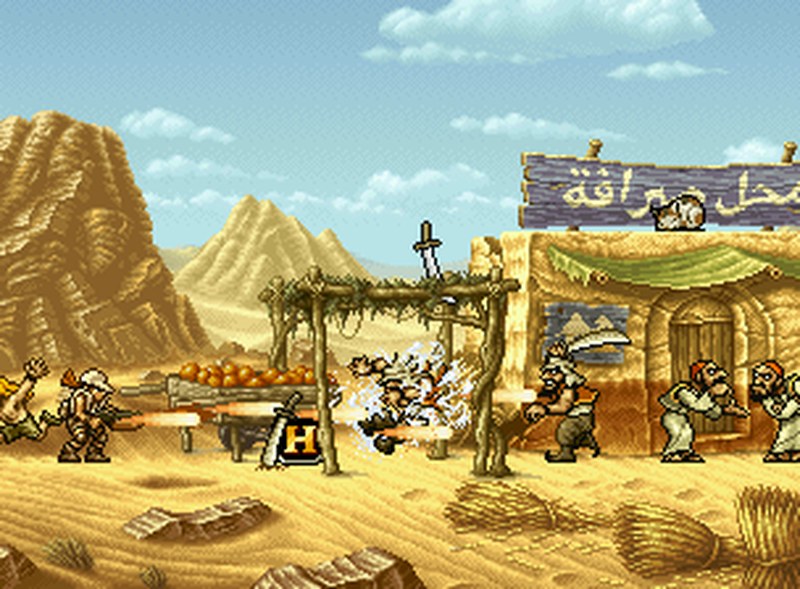
The drive’s real legacy is visible in which games the format wears well, because designers — at SNK and its licensees — quietly sorted themselves by load tolerance. Mission-based games thrived: Metal Slug loads per mission and plays uninterrupted, its structure inherited from coin-op pacing that already thought in chapters. Stage-streamed shooters like Pulstar and Aero Fighters 2 fit the same mould. Golf loads a course and then flows for twenty minutes. Puzzle games barely load at all. The catalogue’s happiest conversions are, without exception, games whose natural chapters are longer than the monkey’s act.
The fighters show the strain in ascending order of data. One-on-one games with mid-size sprites — Samurai Shodown II, Fatal Fury Special — fit the RAM so comfortably that loading reduces to a pre-match formality. The team fighters are where the straw meets the reservoir: The King of Fighters must stream whole teams, and the series’ growth from ’95 to ’99 tracks the format’s decline almost exactly, each year’s bigger roster pouring more slowly. SNK’s engineers responded with real craft — compressed data, streamed music and stages, characters packed in match order — but craft could not repeal arithmetic, and by 1998 the CD versions of the flagship fighters were exercises in patience that the market, now offered the Dreamcast’s speed, declined to keep practising.
The deepest design response was the exclusives. Ironclad and Samurai Shodown RPG were built knowing the drive’s rate and the RAM’s size from the first design document: Ironclad’s branching map turns loads into journeys; the RPG’s structure of towns and battles — whatever its encounter-load friction — assumes a disc as its native medium in a way no conversion could. The lesson generalises beyond this console: constraints do not just limit libraries, they author them. The Neo Geo CD’s library, with its chaptered shooters, its patient fighters and its disc-native experiments, is a portrait of 150KB/s drawn in software.
The afterlife of waiting
Two postscripts complete the story. The first is the CDZ, SNK’s 1996 answer: a revised machine whose drive and cache roughly halved loading times — proof the company understood its number’s cost, arriving, characteristically, a little late and at a little too high a price to change the plot. The second is the modern scene: SD-card loaders and emulators that abolish the wait entirely, pouring the reservoir at modern speeds. Owners who install them report a strange bereavement alongside the liberation. The monkey was the intermission, the breath, the moment you planned your next stage or poured your drink; a library designed around pauses feels subtly different — not worse, but re-timed — when the pauses are deleted.
Which is perhaps the honest verdict on the loading era. It was a flaw, commercially fatal and frequently maddening, and it was also the last time a major console asked its players to wait together, watching the same small performer, in the same rhythm, all over the world. Now loading. The balls are in the air. The game, when it arrives, is the real thing — that was always the deal, and the monkey never once dropped his part of it.
The monkey in the modern world
The monkey’s second career began when the format’s owners grew up and got internet forums. He became the community’s shared memory made visible — avatar, mascot, in-joke — precisely because he was the one piece of the Neo Geo CD experience every owner on earth had in common, more universal than any single game. Emulator front-ends skin their loading screens with him; the SD-loader scene, having abolished his job, commemorates him in boot graphics; fan merchandise from shirts to stickers trades on a juggling silhouette that SNK’s designers drew as a courtesy. There is even a small literature of load-reduction patches and drive mods whose benchmarks are quoted, universally, in seconds of monkey saved.
Set him beside his contemporaries and his singularity sharpens. The PlayStation had its piracy-era loading jokes, the Saturn its RAM carts, the PC its install bars — but no other machine gave its waiting a face, a species and an act. That was not a marketing plan; it was a sound team and a sprite artist solving a human problem with the tools on the desk. The lesson the industry eventually learned — that loading is a design surface, that games from the Souls series to modern open worlds now hide their streaming behind doors, elevators and squeezes — was demonstrated first, in public, by a monkey with three balls and all the time in the world. He was never the problem. He was the apology, and apologies this good become emblems.