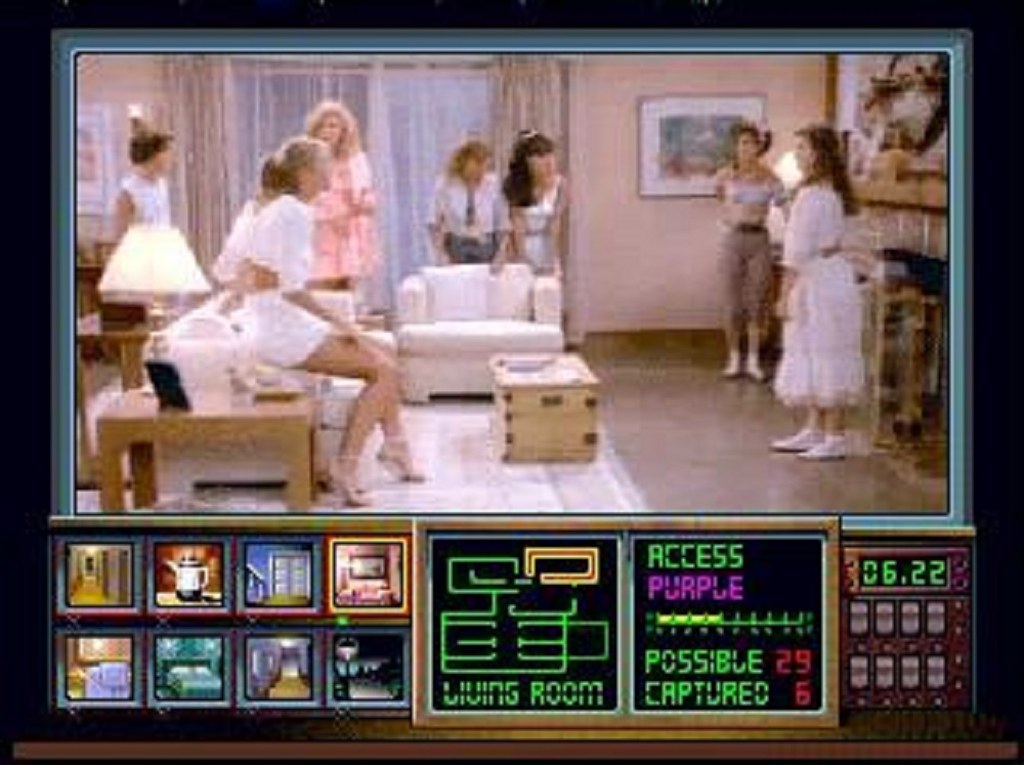
There is a small ratings label on the front of every game sold in North America, and the strangest part of its origin story is this: it exists largely because of a game in which nothing happens that would trouble a TV censor before watershed. Night Trap — Digital Pictures’ full-motion-video surveillance game, released for the Sega CD in 1992 — became, within a year, the most argued-about piece of software in America. It was debated in the United States Senate, pulled from major retailers’ shelves at the height of Christmas, and held up as evidence for the prosecution in the trial of an entire industry. This is the story of how a campy B-movie game about trapping burglar-vampires in a winery owner’s house helped invent the ESRB — told, as the senators never quite managed, by someone describing the game that actually exists.
The game itself: what Night Trap actually is
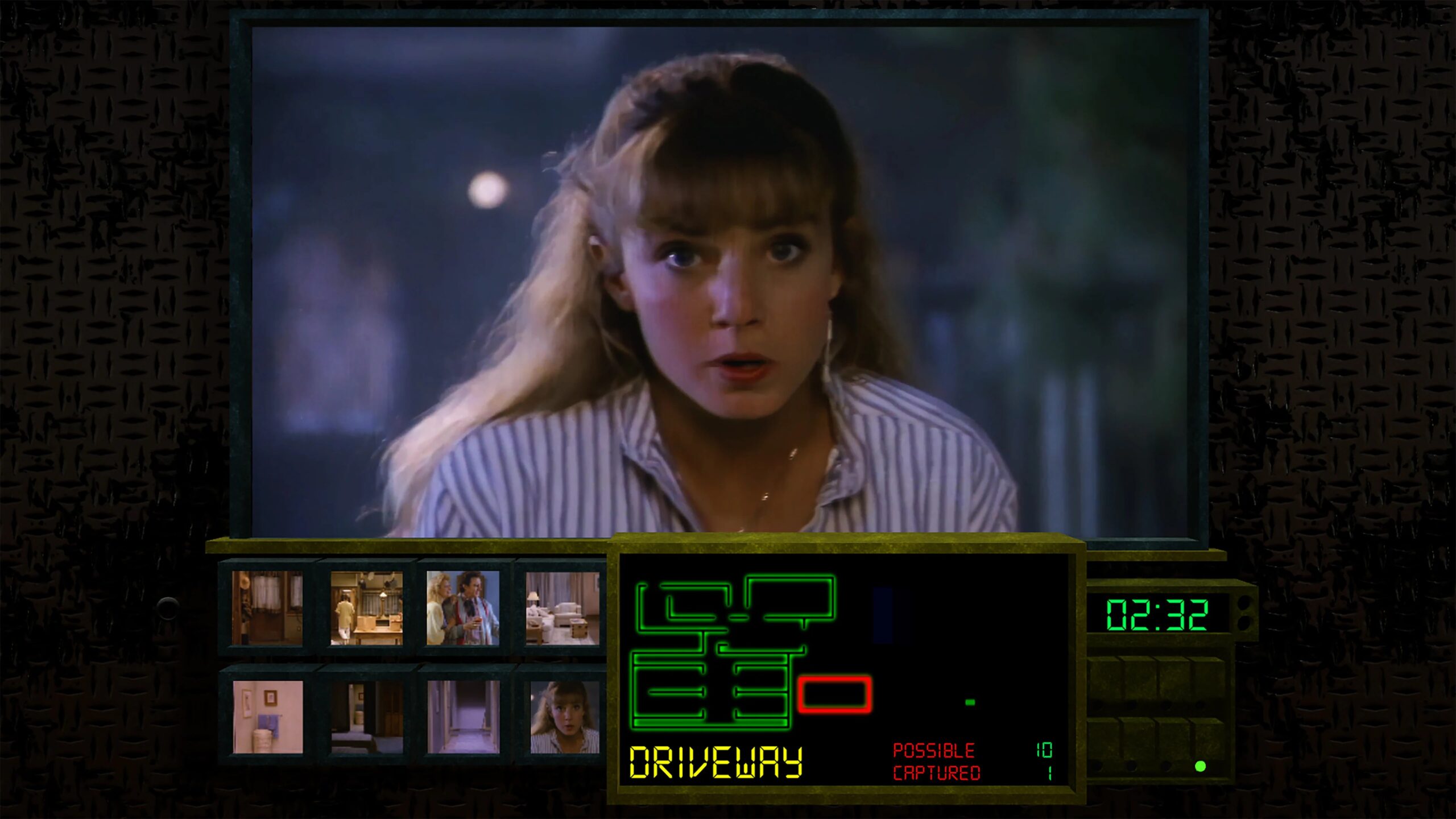
Strip the notoriety away and Night Trap is a goofy, good-natured trap-’em-up dressed as a haunted-house movie. A group of teenage girls is staying at a lakeside house owned by the Martin family; five teenagers have already gone missing there, and you play an operative of S.C.A.T. — the Sega Control Attack Team, in the Sega CD version’s gloriously on-the-nose renaming — watching the house through eight hidden cameras from a control room. Your job is to monitor the feeds, listen for the Martins changing the security code, and spring traps on the Augers: shambling intruders in black who are, in the plot’s logic, harvesting blood from the house’s guests for the vampire family that owns it. Star Dana Plato, of Diff’rent Strokes fame, plays undercover agent Kelly, who feeds you information from inside and whom you must protect to reach the true ending.
Here is what is actually in it, because the historical record needs it said plainly. The violence is pantomime: Augers are caught by trapdoors, spring-loaded chairs and collapsing beds, and exit the plot like stagehands in a farce. The supposed sexual content that inflamed the debate amounts to teenagers in nightwear talking at a sleepover — a scene played for cheesecake by 1992 standards and for pure camp by any later one; the player, notably, is punished with failure if they linger on it instead of doing the job, because the game is won by watching the boring rooms where the Augers actually enter. It is a game about surveillance discipline wearing a horror costume. Its creator’s oft-repeated defence — that the game was designed so that trapping the intruders, not watching the girls, was the only way to win — is verifiable by anyone who plays it for twenty minutes. Almost nobody in the ensuing scandal did.
December 1993: the hearings
The context was a genuine moral panic with genuine politics inside it. Arcade and home games had grown more violent and more visible — Mortal Kombat’s digitised gore was the other exhibit in the case — and in late 1993 Senators Joseph Lieberman and Herbert Kohl convened hearings on video game violence, calling the industry to account in front of cameras. Night Trap was presented, in excerpted clips, as a game about violence against women; the famous sleepover scene was described in terms that bore little resemblance to its content; and the claim that the game’s object was to trap and kill the girls — the precise opposite of its actual objective — entered the record and the news coverage. Retail consequences were immediate: major toy retailers pulled Night Trap from shelves in the Christmas season, a commercial punishment delivered before any regulation existed.
The industry read the moment correctly, which is to say politically. Legislation was openly threatened: if the games business did not regulate itself, Congress would do it for them. Sega, to its credit as a matter of institutional self-defence, had already launched its own Videogame Rating Council — the VRC — in 1993, rating its games GA, MA-13 and MA-17, and Night Trap itself carried an MA-17. But a patchwork of rival systems, with Nintendo refusing ratings entirely and every publisher grading its own homework, was never going to satisfy the senators. The hearings’ real product was momentum.

What the scandal built: the ESRB
In 1994, the industry formed the Interactive Digital Software Association and, under it, the Entertainment Software Rating Board — an independent body that would rate every game with the now-familiar letters: EC, E, E10+, T, M, AO. The ESRB was announced to the same congressional audience that had threatened legislation, and the threat receded. Whatever one thinks of ratings systems, the structure that emerged from the Night Trap winter was the industry’s own, administered at arm’s length, and it has governed North American game retail ever since. Every black-and-white box on every game case is a descendant of those hearings — which makes Night Trap, a game whose content would comfortably earn a mild rating today, arguably the most consequential Sega CD disc ever pressed, entirely by accident.
The ironies stack up honestly. The game was developed originally for Hasbro’s cancelled Control-Vision/NEMO system in the late 1980s — the footage was shot years before its release, for a machine that never shipped. It was designed, by its makers’ account, partly as a demonstration that FMV games could be about timing and attention rather than titillation. And its reputation as filth was constructed from clips by people who, as the hearings’ own record shows, had not understood — or had not been told — what the player is actually doing on screen. Night Trap is not a misunderstood masterpiece; as a game it is a charming, shallow, replayable oddity, as our era’s reappraisals have settled. But as a historical document it is unmatched: the game a medium’s growing pains were projected onto, at the exact moment the medium got big enough to be worth a Senate hearing.

The revival: camp, reappraised
Time has been kind to the thing itself. Night Trap received modern re-releases beginning with a 25th-anniversary edition in 2017, bringing the original footage — lovingly restored, documentary extras and all — to contemporary platforms, where a new audience met the game the scandal had hidden from them and reached the obvious conclusion: this? The revival leaned into the camp, included material about the hearings themselves, and sold the game on its true merits as a period piece — a perfectly preserved slice of early-90s FMV ambition and teen-movie cheese, with Dana Plato’s warm, game performance at its centre finally reviewable on its own terms.
Sega’s VRC: the road not quite taken
One subplot deserves rescuing from footnote status. Sega’s Videogame Rating Council, launched months before the hearings peaked, was a genuine first: a platform holder rating software for its own system, with age tiers and content descriptors, printed on the box. Night Trap’s own MA-17 label meant the Sega CD copy a senator might wave at a camera already carried the strictest warning Sega offered — a fact that sat awkwardly beside claims that the industry sold such games to children without a word of guidance. The VRC did not survive as the standard, because a ratings regime run by one combatant in a console war convinced nobody of its neutrality; the ESRB’s independence was the hearings’ true design lesson. But the VRC matters historically as proof that the industry’s self-regulation did not begin under congressional duress — it began, imperfectly and self-interestedly, in the marketplace, and the Senate’s contribution was to make it universal, uniform and independent rather than to invent it from nothing.
Why it still matters
Every argument games have had since — about content, about children, about who decides what a medium may say — rehearsed its lines in the Night Trap winter of 1993. The hearings established the template: excerpted clips, sincere parental anxiety, political theatre, an industry scrambling to self-regulate, and a ratings system as the negotiated peace. Playing Night Trap today is therefore a double experience: a silly, likeable trap game on the surface, and underneath it, the fossil record of the moment video games grew up in public — whether the public, or the Senate, was ready or not.