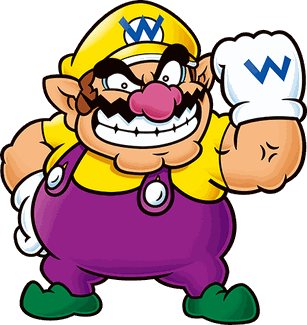
Everybody knows how Super Mario Bros. goes. A plumber in red runs from left to right, flattens Goombas, cracks open question-mark blocks and rescues a princess who has a talent for being in another castle. It is the most familiar journey in video games, which is exactly why flipping its cast is so much fun. Super Wario Bros. takes that journey and hands the overalls to the other guy: Wario, the greedy, garlic-loving mirror image Nintendo invented to give Mario a rival worth booing. The result is a small hack with a big idea behind it, because Wario’s whole career is the story of a villain who refused to stay in the boss room.

What Super Wario Bros. actually is
Super Wario Bros. is a fan-made modification of the original Super Mario Bros. for the Nintendo Entertainment System, credited to the prolific hobbyist hacker who works under the name Googie. Listings for the hack trace its first version back to 2004, making it an early example of the character-swap tradition rather than a product of the modern, tool-rich hacking scene. It is classed as a complete hack, and the changes go well past a fresh coat of paint on the hero. Mario’s sprite is replaced by Wario, most of the colour palettes are changed, the graphics loaded into each area are reworked, enemy and object designs are redrawn across the board, and the backgrounds are altered to match the new star’s brasher personality. A later update, circulated decades after the original release, pushed the presentation further still, with upgraded graphics, tweaks to how the tiles fit together, edited levels and even a clock tucked into the corner of the screen.
Coverage of the hack resurfaced in the summer of 2015, which is how it reached a wider audience of retro players who had never browsed a hacking forum. The appeal was easy to explain in a single sentence: here was the defining platform game of the 1980s, re-skinned around the one Nintendo character who would absolutely be doing all of this for the money. Nothing about the underlying quest changes. The pipes, pits and flagpoles are where they always were. What changes is the story your eyes tell you while you play, and that turns out to be more than enough.

A villain built backwards
To understand why the swap lands, it helps to know how deliberately Wario was engineered as an opposite. He first appeared in 1992 as the main antagonist and final boss of Super Mario Land 2: 6 Golden Coins on the Game Boy, where he had seized Mario’s castle while its owner was away saving somebody else’s kingdom. His designer, Hiroji Kiyotake, imagined the relationship in cartoon terms, describing Wario as a Bluto figure to Mario’s Popeye. The name does similar work: it fuses Mario’s name with the Japanese word warui, meaning bad, and the visual design follows the joke through, flipping the M on Mario’s cap upside down to make a W.
There is a workplace comedy buried in the character’s origins, too. Wario was created at Nintendo R&D1, the team responsible for the Super Mario Land games, and accounts of his creation often note that the team relished inventing a character of their own inside a series built around somebody else’s mascot. Wario is Mario exaggerated in every unflattering direction: broader, louder, stronger, and motivated almost entirely by treasure. Where Mario rescues kingdoms because that is what heroes do, Wario would like to know what is in it for him, preferably in writing, preferably in gold.

From final boss to leading man
Nintendo itself wasted little time promoting its new villain. Just two years after his debut, Wario headlined Wario Land: Super Mario Land 3 (1994), a Game Boy platformer that sent him raiding Kitchen Island for enough loot to buy a castle of his own. The game sold more than five million copies and quietly rewrote what a Mario spin-off could be. Wario does not bounce politely through his levels. He shoulder-charges through blocks, stuns enemies, picks them up and throws them, and treats coins not as a route to extra lives but as actual currency to be hoarded, gambled and spent.
The Wario Land sequels kept pushing that antihero identity. Wario Land II (1998) made him effectively indestructible, turning enemy attacks into transformations — flattened, burnt, inflated — that double as puzzle mechanics. Wario Land 3 (2000) and Wario Land 4 (2001) deepened the treasure-hunting structure, Wario World (2003) took him into 3D on the GameCube, and Wario Land: Shake It! (2008) wrapped him in hand-drawn animation on the Wii. Alongside the platformers, the WarioWare series, launched in 2003, recast him as the scheming founder of a game company churning out five-second microgames, a second career that cemented him as a comic lead rather than a threat. Add regular seats in Mario Kart, Mario Party and Super Smash Bros., and the supposed antagonist became one of Nintendo’s most employable stars.

Why character-swap hacks endure
ROM hacking has always had a soft spot for recasting. In the earliest days of the hobby, changing a game’s graphics was the most accessible form of authorship: tile editors let anyone redraw a sprite, swap a palette or rewrite a title screen, long before the tools existed to rebuild levels or rewrite code. The character swap is the purest expression of that impulse. Replace the hero and you change the fiction of every jump, even when the jump itself is identical. A swapped game becomes a small piece of fan theatre, asking what this world would look like if somebody else had shown up to save it — or to loot it.
The genre grew up in stages. Simple graphics hacks redrew the star and called it a day. More ambitious projects, like Googie’s own later work on a Wario-fronted hack of Super Mario Bros. 3, added edited levels, new text and running jokes. At the far end sit total conversions that rebuild a classic game so thoroughly that only its engine betrays it. Super Wario Bros. sits in the characterful middle of that spectrum: mechanically faithful, visually committed, and carried entirely by the charisma of its replacement lead. That is not a criticism. It is the same trick Nintendo pulled officially, after all. Wario Land is, at heart, a Mario-style platformer whose entire personality changes because the man in the middle thinks with his wallet.
The joke Nintendo made official
That is why this modest NES hack still reads as more than a novelty. Wario was never really built to be a final boss. He was built to be Mario with the brakes off, and both Nintendo’s designers and the hacking community reached the same conclusion independently: a character that funny, greedy and physical deserves to be playable, and deserves levels arranged around his appetites. Super Wario Bros. simply runs the experiment inside the most sacred text in platform gaming. The Mushroom Kingdom survives the change of management just fine. It just ends up considerably poorer in coins.