Some homebrew announcements vanish quietly. A handful of screenshots appear, a release window gets mentioned, excitement builds for a week, and then nothing more is ever heard. Awaken, from Spanish studio Oniric Factor, looked for a while like it might belong to that familiar category. Teased at the start of 2019 with a first-quarter launch in mind, the MSX2 action adventure slipped past that early target, changed its name slightly along the way, and then did the thing so many announced projects never manage: it actually shipped, on a real cartridge, for real hardware. This is the story of a wolf, a shotgun, a poisoned garden, and one of the more ambitious Spanish MSX releases of its year.
A January Tease and a First-Quarter Promise

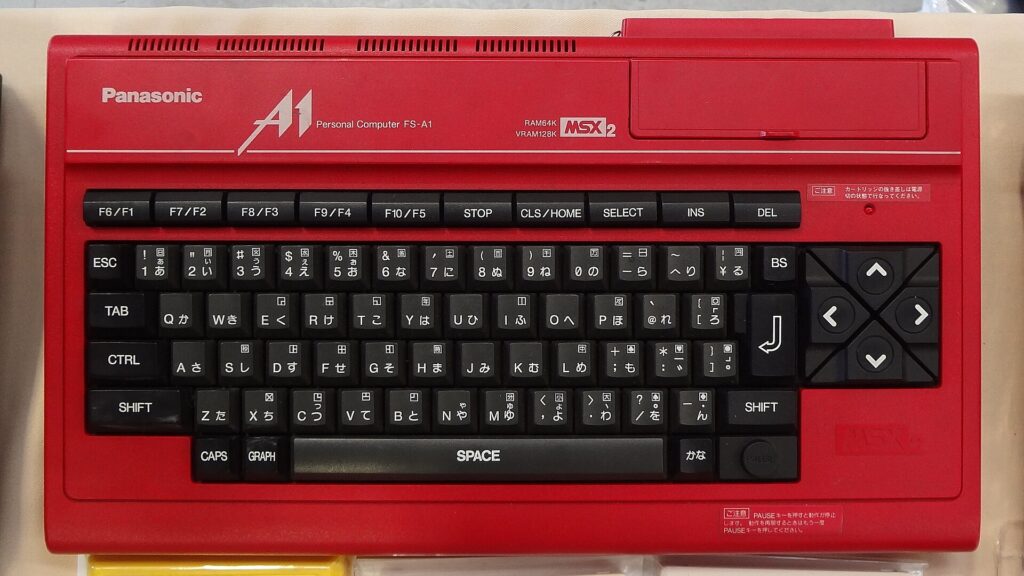
A Panasonic FS-A1, a Japanese MSX2 machine of the kind Awaken was built to run on. Photo: Wikimedia Commons.
When word of the project first circulated in January 2019, it arrived under the short title Awaken. Coverage at the time described an action adventure in development for MSX2 machines fitted with 128K of RAM, expected to land within a few months. Our own original report, published on 23 January 2019, framed that expectation as a Q1 2019 release, which was a fair reading of how close the game was being presented. Early screenshots showed overhead exploration and combat across a series of colourful outdoor and interior screens, and the response in the MSX community was immediate. New software for the standard still appears regularly, but a large, story-led adventure aiming at cartridge release was a bigger proposition than the small arcade diversions the scene also loves.
That first-quarter window, in hindsight, was optimistic rather than dishonest. Homebrew timelines are written in pencil at the best of times, because the people involved are usually building everything in spare hours around day jobs, family life, and the practical headaches of manufacturing physical media. Oniric Factor, led by Jorge Romero and based in Spain, still had an ending to write and music to add as spring arrived. Rather than quietly abandon the date, the studio kept publishing progress updates, showed the work in public, and let players watch the finish line move in plain sight. For anyone following along at the time, the delay was frustrating but transparent, and transparency counts for a great deal in a small scene built on trust and pre-orders.
Not Quite the Fantasy Quest It First Looked Like
Those early write-ups sometimes filed the game under fantasy, and at a glance that is understandable: forests, a talking animal hero, and a quest structure borrowed from classic overhead adventures. Spend any time with the studio’s own description, though, and a stranger, more interesting setting emerges. Oniric Factor called it a bucolic-apocalyptic world, a phrase that captures the strange mixture in play. Long after some unspecified catastrophe, a people descended from wolves live in burrows inherited from their ancestors, surrounded by the metal and concrete leftovers of an older civilisation, surviving through unity and cunning in territory that now belongs to mutants.
You play Feroz, a soldier whose name translates roughly as the Big Bad Wolf, which is a neat joke that also tells you something about the tone. This is a fable wearing post-apocalyptic clothing. Armed with a shotgun, Feroz leaves the safety of the burrows and crosses what the introduction calls the forgotten garden, hunting for the terminals needed to trigger something called the Icarus protocol. Nobody, at the outset, really knows what that protocol will do. Finding out is the point of the journey, and the awakening promised by the title belongs to Feroz’s whole people, not just to one hero levelling up in the woods.
Two Hundred Screens, a Geiger Counter, and Very Little Shelter

A Philips NMS 8250 MSX2, one of the European MSX2 machines common in Spanish homes and collections. Photo: Wikimedia Commons.
Scale was the headline feature long before anyone discussed the story. The finished design spans more than 200 screens, taking in broad stretches of forest, scrubby wasteland, and underground bunkers. That is a substantial map for an 8-bit home computer, and it shapes everything about how the adventure plays. This is not a tight little arcade loop you finish between cups of coffee. It is an expedition, closer in spirit to the exploratory overhead adventures MSX owners grew up admiring, where learning the geography matters as much as winning any single fight.
Two systems keep that expedition tense. The first is combat against the mutants who roam the garden, handled at shotgun range and frequent enough that wandering carelessly has a cost. The second, and arguably the cleverer idea, is radiation. Much of the map is toxic to one degree or another, your Geiger counter warns you as conditions worsen, and lingering in the worst zones steadily eats away at Feroz’s health. It turns empty screens into decisions. Do you cut straight through a hot area because the route is short, or take the long way round and risk more mutant encounters on safer ground? Add a day-and-night cycle, which changes both the look of the world and how exposed you feel crossing it after dark, and a fairly traditional overhead adventure gains a survival edge that suits its ruined setting beautifully.
The objective threading all of this together stays admirably clear. Scattered across the map are four terminals. Reach them, activate the Icarus protocol, and the story moves towards its conclusion. Simple to explain, difficult to execute, and exactly the kind of structure that lets a big map feel purposeful instead of padded. Every detour has a reason, even when that reason is simply that the direct road would leave you glowing.
Hardware With Opinions: MSX2, 128K, and an FM-PAC
Oniric Factor made no attempt to squeeze this design down to the humblest hardware. Awaken, released as The Awakening, requires an MSX2 with 128K of RAM and an FM-PAC sound cartridge. That specification was stated plainly from the pre-order stage onwards, and it tells you who the game was for: committed MSX2 owners, the core of the modern Spanish scene, rather than casual passers-by. The FM-PAC requirement in particular is a statement of intent about music. FM sound was always one of the pleasures of well-equipped MSX setups, and building a large adventure around it gave the project a richer voice than basic PSG bleeps alone could offer.
The physical edition matched that ambition. The game shipped on a 2-megabit cartridge, the studio’s first release in that format, with cover artwork by cartoonist and fellow MSX enthusiast Sergio Cabanillas. Cartridge production explains much of the schedule, too. Boards, shells, printing, and assembly all have to be funded, ordered, and put together by tiny teams, which is why the launch was organised around a pre-order list with a minimum number of buyers before manufacturing could begin in earnest. When that minimum was comfortably passed, the project stopped being a promising demo and became a product with dates attached.
Who Are Oniric Factor?

A Canon V-20, an earlier MSX1 machine, representing the first-generation hardware many Spanish developers first coded for. Photo: Wikimedia Commons.
By 2019, Oniric Factor was already a known name to anyone following Spanish MSX development, though the studio’s catalogue is broader and odder than a single genre label suggests. Indie coverage of the Awaken announcement name-checked Lost Wind, Spring Warrior, and Dribol as calling cards. Lost Wind, sometimes styled LostWind, was the heavyweight of that list: an MSX1 adventure that grew into an elaborate collector’s edition, complete at one point with an accompanying board game, and a project whose production troubles Romero discussed with unusual candour, eventually donating proceeds from the run to charity. Earlier work stretched back to titles such as Ninja Love in 2013, while Grey Wolf and Oniric Kung Fu showed the studio happily jumping between mecha action and an affectionate nod to Konami’s Yie Ar Kung-Fu.
What happened after The Awakening confirms it was no one-off flourish. The studio opened its own online shop in early 2020, pushed the interactive fiction adventure Tantalos out that same winter, and followed with Diana Cave Adventure, Crazy Factory, and Jumping Llama, among others. Later announcements, including the action platformer Souls Keeper and further work under the Oniric Kung Fu name, kept the same pattern going: modest teams, physical editions for collectors, digital versions for everyone else, and a very Spanish scene infrastructure underneath it all, built around user meetings in Seville and Barcelona. Romero was also involved in founding the Asociacion SUR MSX, a southern users’ association formed to preserve the standard and support new development, which gives you a sense of how deeply this studio sits inside its community rather than merely selling to it.
So Did It Ship? Yes, Just Later and Under a Longer Name
Here is the honest timeline, because the headline question deserves a straight answer. The Q1 2019 target passed while the game was still being finished. An early demo had already been playable at the 54th Barcelona MSX users’ meeting, where visitors could try the game at the studio’s stand and offer feedback. By 16 April 2019, Romero described the project as entering its final stage: essentially complete, apart from building a proper ending and adding some songs. Pre-orders for the limited cartridge run opened on 24 April, initially priced at 33 euros for collection in Seville or Barcelona, 37 euros shipped within Spain, and 42 euros shipped internationally, with a digital copy included for every physical buyer.
In May, with the minimum order comfortably exceeded and support from the LERSOR initiative trimming three euros from each copy, the studio fixed official dates: the order list would close on 12 May, and launch day was set for 29 June 2019. Final cartridge prices settled at 30 euros collected, 34 euros shipped nationally, and 39 euros internationally. By 4 August, Romero could report that the remaining units of the first run were ready to send out, describing the road as long, winding, and full of last-minute obstacles, which anyone who has followed a small physical release will recognise instantly. So yes, it shipped: a proper launch on 29 June 2019, in the second quarter rather than the first, under the fuller title The Awakening.
The story did not end with that first run, either. Demand kept arriving after the cartridges sold through, so in November 2019 a second run opened alongside cheaper formats the community had asked for. Alongside the cartridge at its original prices, buyers could choose a 3.5-inch disk edition for 10 euros collected, 14 euros within Spain, or 18 euros internationally, or pay 5 euros for an early digital edition. As with the studio’s other games, the plan was for the digital version to be released freely roughly a year later, with physical buyers receiving it as part of their purchase from the start. That tiered approach, deluxe cartridge first and affordable disk and digital options after, became something of an Oniric Factor signature, balancing collectors who want an object on the shelf against players who simply want to explore the garden.
Why This One Still Matters
Judged purely as a news item, Awaken could have been a footnote: a January announcement, a missed quarter, a June release. Judged as a piece of MSX history, it deserves better. It captures a moment when the Spanish scene, one of the most productive corners of modern MSX development, was professionalising its physical releases without losing its homemade character. Pre-order funding, community discounts, hand delivery at user meetings, second runs driven by forum requests: none of that resembles how games were sold in 1985, yet all of it exists to keep machines from 1985 alive with genuinely new adventures.
It also remains, simply, a good idea executed at unusual scale. A wolf soldier with a shotgun, a clicking Geiger counter, four mysterious terminals, and 200 screens of forest, ruin, and bunker make for a premise that would stand out on any platform. That it was realised on an MSX2, with FM sound, day turning to night over a poisoned garden, is exactly why computer homebrew deserves the same attention as its console cousins. Awaken woke up a little late, and under a slightly longer name, but it woke up, shipped, and earned its place on the shelf.