
At a glance: Pick Axe Pete! · Odyssey 2 · Magnavox, 1982 · Platformer · Score: 9.0/10
Pete stands in the Misty Mountain Mine, three floors of ladders and platforms, as boulders come rolling out of the doors at the top of the screen. Smash a boulder with your pick and it pays out points — sometimes gold. Miss, and the boulder that gets past you is not the problem; the one that lands on your head is. Every so often a key drifts through the mine, and grabbing it lets Pete slip through a door to a fresh screen with a new layout. That is the whole game, and it is completely addictive: a one-screen platformer built from risk, timing and greed.
How it plays
Ed Averett designed this one with his wife Linda, and it shows a designer’s confidence. Pete is quick — quicker than the era’s most famous platform hero — and he can jump while swinging, which turns defence into movement. The boulders do not roll in Donkey Kong’s polite straight lines; they bounce, carom off platforms and drop through gaps at angles that keep changing the safe ground under you. Standing still is a decision, and usually the wrong one. The skill is in reading trajectories two floors ahead while a key you desperately want floats past on the far side of the mine.
The keyboard earns its keep before the game even starts: ten selectable variations change the mine’s layout and pace, which was generous variety for a 1982 cartridge. Scoring rewards aggression over survival — camping a ladder and waiting for a quiet screen scores almost nothing, while a Pete who charges the boulder streams, snatches keys early and exits fast racks up the numbers that mattered when this game became a competition title. Magnavox ran a national Pick Axe Pete Pick-Off at the 1982 World’s Fair in Knoxville, and ten-year-old Tony Scardigno of Weehawken, New Jersey won a pound of gold at it. A pound of gold, for a high score, in 1982.
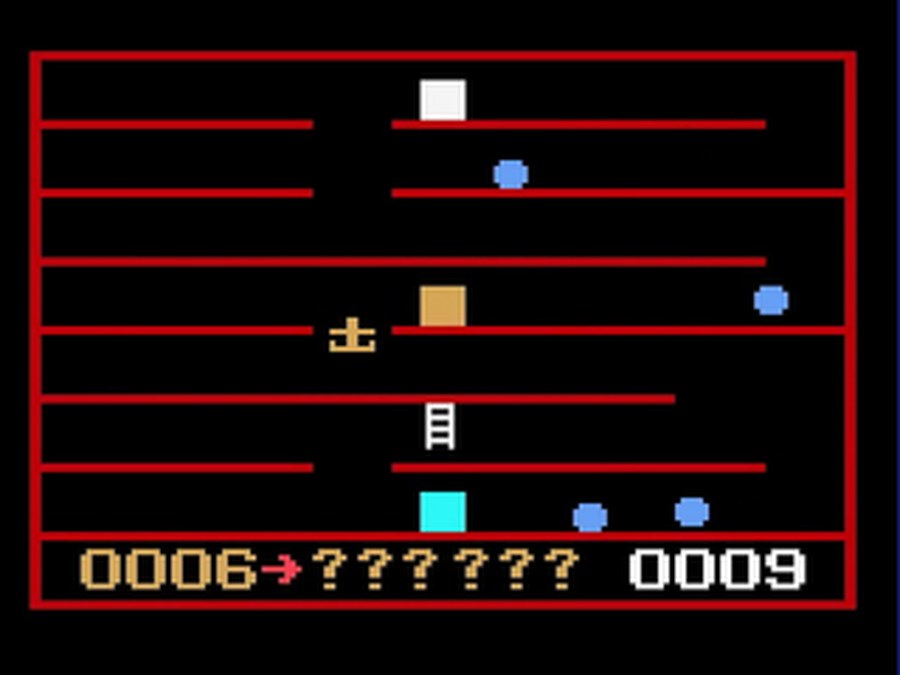
A platformer where standing still is the most dangerous move on the screen — Pick Axe Pete! turns three floors and a pickaxe into pure, bouncing panic.
The details that decide it
Visually it is clean rather than busy: Pete is a proper little character with a swing you can read across the screen, the mine’s floors are colour-coded so your eye always knows your level, and the boulders have real weight in their bounce. Sound is the usual Odyssey 2 beeper fare, functional rather than memorable. The difficulty, though, is the thing veterans talk about — late screens throw boulders at a density that turns the mine into a pinball table with you as the ball, and the game never pretends otherwise.

The longer game
The skill that separates scores is door discipline. Every exit through a door resets the mine with a new layout and a faster tempo, so the temptation is to grab the key the instant it appears. Resist it — partially. The richest boulder streams arrive while a key is still drifting, and the champion’s play is to keep smashing for points while tracking the key’s path, leaving through the door at the last safe moment. The game’s ten keyboard variations change that calculus: some layouts favour ladder control, others turn the top floor into a shooting gallery of bouncing rock, and learning which floor is safe in which variation is the knowledge the World’s Fair finalists were really competing on.
It helps that Pete himself is never the problem. The controls are as honest as the era offered: Pete runs, climbs, jumps and swings at the speed your hand asks, and deaths are almost always trajectory misreads — the boulder you watched, not the one that dropped behind you. That fairness is why the game survived its comparisons. Donkey Kong’s shadow produced a hundred platformers that copied its furniture; Pick Axe Pete! took the furniture — ladders, platforms, falling hazards — and built a different sport on it, one about interception rather than ascent.
Playing it today
Tactically, the mine rewards a doctrine: own the middle floor. The centre platform sees boulders from both upper doors within a swing’s reach, offers ladders up and down without commitment, and keeps the key’s likely paths in view. Beginners camp the bottom and react; the score table belongs to players who treat the middle as a patrol beat, striking boulders early in their bounce — when their trajectories are longest and most predictable — and who treat every key as a timer rather than a trigger: the question is never whether to take the door, but how much gold the current screen still owes you before you do. On the fastest variations that judgement compresses into instinct, which is exactly what a tournament game should demand of its finalists.
The Averetts’ design economy shows in what the game omits. No lives system beyond the honest one, no power-ups, no second screen to memorise — one mine, endlessly re-dealt. That purity is why the game teaches so quickly and lasts so long: within five minutes a new player understands everything except how to be good at it, and the distance between those two states is the whole game. It is the same purity the system’s other classic, K.C. Munchkin!, is built from, and it is not a coincidence that the same programmer stands behind both.
If you buy one cartridge to learn what the Odyssey 2 was, this is the safest nomination: common enough to be affordable in American or European form, deep enough to hold a household rivalry for a season, and historical enough — gold medal, world’s fair, ten-year-old champion — to anchor the shelf’s story. Pete has been waiting in the mine since 1982. The boulders have not slowed down.
Verdict
If the Odyssey 2 had a mascot platformer, this is it — the cartridge collectors demonstrate the system with, the one that converts sceptics who assume the library is all sparse sports and shooters. It has never needed its Donkey Kong comparisons; it plays differently, faster and meaner, and the resemblance ends at ‘man, ladders, falling rocks.’
On the shelf, the cartridge is a mid-priced staple rather than a rarity, with the European Pickaxe Pete offering the additional curiosity of its Videopac+ reissue, where owners of the G7400 get enhanced background scenery behind the same mine. Either version demonstrates the same truth to a first-time player within ninety seconds: this quiet, keyboard-topped console hid one of the early platform era’s sharpest games, and it is still sharp now.
Score it plainly: this is a nine because the gap between understanding it and mastering it is measured in months of household rivalry, and because no other Odyssey 2 cartridge converts a sceptical visitor faster. The reservations are real but small — the visuals are functional rather than lush, the sound is the system’s usual beeper economy, and a player who dislikes trajectory-based hazards will dislike the whole mine. None of those survive the first genuinely good run, the one where the boulders start arriving as opportunities instead of threats and the key’s appearance reorganises the whole screen around a decision only you can make. Pair it on the shelf with K.C. Munchkin! and you own the system’s twin peaks: the maze and the mine, Averett at his purest in both. Add the World’s Fair story — a national tournament, a ten-year-old champion, a pound of gold — and the cartridge becomes the rare game that is simultaneously a sport, a history exhibit and a party piece. If the Odyssey 2 is ever granted the mascot it never officially had, Pete, pick in hand, mid-bounce between two boulders and one bad decision, is the only serious candidate.
In this series: Pick Axe Pete! is one of eighteen Odyssey 2 cartridges reviewed in this build-up of the system’s shelf, alongside features on The Voice, the Master Strategy Series, the keyboard and the Videopac years, a hidden gems list and a full buying guide. Read it with the flagship history, Odyssey 2 Forever, for the whole story of the keyboard console — and if you are choosing a first cartridge from the set, the scores in this series are the shortlist, with the buying guide’s hedged price ranges as the shopping list.
In Europe it was Pickaxe Pete, Videopac 43, later reissued with enhanced Videopac+ backgrounds. Our verdict: Joint-best game on the system. Fast, fair, endlessly replayable, and historically certified: they literally gave away gold for playing it well.