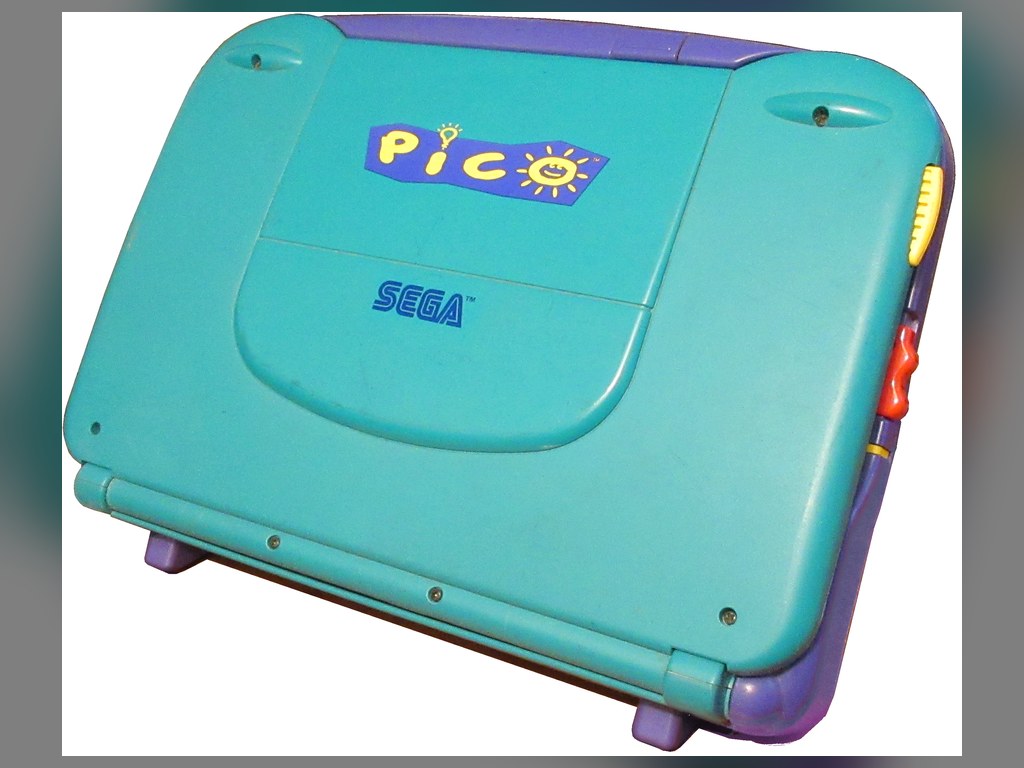
Every games console is defined by its controller, and the Sega Pico is defined by two of them at once: a pen, and a book. The Magic Pen was a chunky, crayon-like stylus tethered to a laptop-shaped console, used on a drawing pad built into the machine’s base. The Storyware was the cartridge — not a plain plastic slab but a picture book, with real pages, a hard spine and a connector along its bottom edge that plugged into the console. Turn a page and the television changed scene. Touch the pen to the book’s final page and the picture answered. In 1993, when the Pico launched in Japan as the Kids Computer Pico, nothing else in a toy shop or a games shop worked like this, and very little since has tried.
A book that knows what page it is on
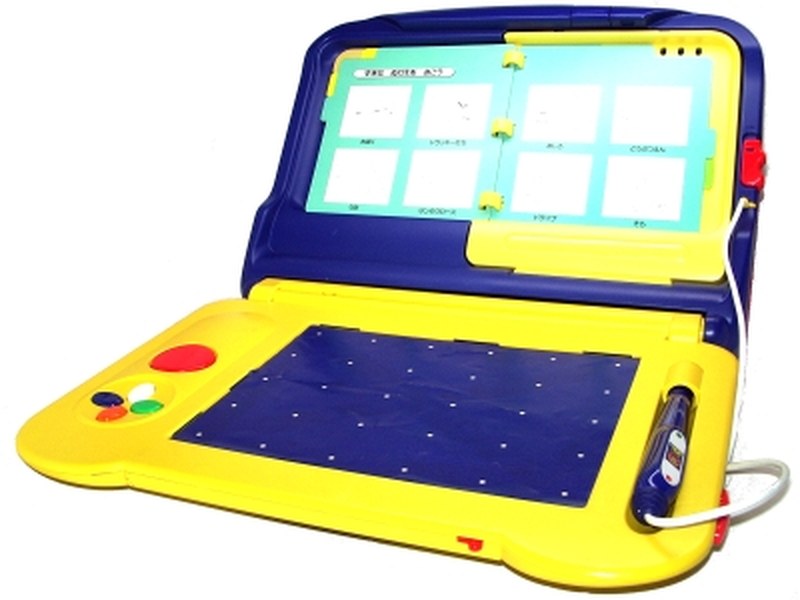
The mechanism was elegant rather than magical, which is why it was robust enough for three-year-olds. Each Storyware book carried its program in a chip in the spine, and the book’s pages were registered by the console as they turned, so the software always knew which spread was open. That single fact shaped all Pico design. Games were not levels but spreads. Progress was not a password but a bookmark. A child who lost the thread could literally flip back. Designers learned to write for the form: a story page to set a scene, an activity page to practise inside it, a creative page at the back — the last spread doubled as a second touch surface — where the book handed its own characters and backgrounds to the child as drawing materials.
The pen and the pad
The Magic Pen itself deserves its reputation as the friendliest input device of its decade. It was big because its users’ hands were small and their grip was a fist. It worked like a mouse on the console’s touch pad — point, tap, draw — years before the Nintendo DS made a stylus normal and long before tablets put touch in every child’s hands. The coordination it taught was subtle and real: eyes on the television, hand on the pad, two places at once, exactly the split attention a computer mouse would soon demand of the same children. Sega was, without quite saying so, training mouse hands for the PC decade, inside a toy that thought it was a book.
Why speech mattered as much as touch
The third leg of the technology was sound. Pico hardware, derived from the Mega Drive, paired its familiar processor with a sampled-sound chip that let Storyware speak — really speak, in recorded voices, on every page. For an audience that mostly could not read, speech was not a luxury feature but the interface itself: instructions, encouragement, character, story. A Pico book could be used alone by a four-year-old because nobody needed to read it to her. That combination — book, pen and voice — is the complete Pico idea, and every one of the hundreds of Storyware titles is a variation on it.
What the form could not do
The limits were built in too. A book has a fixed number of pages, so Pico games were short by cartridge standards and leaned on repetition — which young children love and reviewers, then and now, keep mistaking for a flaw. The pen-and-pad set-up needed a television, a power supply and a table, so the Pico was never portable in the Game Boy sense. And the drawing resolution of a pad designed for fists was never going to satisfy an older child for long. The Pico’s answer was always the same: it was not for older children. The form had a perfect audience, roughly ages three to seven, and served it with a completeness few consoles have matched for any audience.
The idea after the Pico
The Pico’s descendants are everywhere once you look. LeapFrog’s LeapPad, launched at the end of the decade, put a pen and interactive books in millions of homes on a strikingly similar plan. The DS normalised the stylus. Tablets normalised touch and voice for pre-readers completely. Sega’s own successor, the Advanced Pico Beena, kept the book-and-pen form alive in Japan into the smartphone era. The Magic Pen and Storyware were not a dead end in input design; they were an early, sturdy branch of it that happened to wear primary colours. Pick up a Pico today and the surprise is how modern the ritual feels: open the book, take up the pen, turn the page, and the screen obeys the story.
Paper, plastic and the senses
There is a tactile argument here that modern touchscreens quietly lost. A Pico page has weight and texture; turning it is a whole-hand event with a beginning and an end, and the slight resistance of a thick Storyware board page tells a small child, physically, that something has changed. The pen, too, is an object rather than a fingertip — it can be held wrongly, corrected, mastered. Developmental specialists call this kind of feedback proprioceptive; children call it nothing at all, because it simply feels like a book. Sega’s designers, working from the picture-book tradition rather than the arcade one, understood that for a four-year-old the interface is the body first and the screen second. The television picture is almost the reward; the work, and the learning, happen in the hands.
Preservation’s page problem
The form also created a preservation problem the cartridge world never faced. A Mega Drive game survives if its board survives; a Storyware survives only if its book does — every page present, legible and correctly ordered, its spine connector intact, its final touch page unscored by thirty years of determination. Libraries and collectors are now the custodians of a medium that is half software, half children’s literature, and it degrades like the second while being catalogued like the first. That fragility is worth stating in a technology feature, because it explains the urgency collectors feel about this system in particular: when the last tired copy of a minor Storyware finally loses its pages, something closer to a book burning than a bit-rot happens, and the work is gone in both of its natures at once.
Handling a Storyware today
Pick up a Storyware in 2026 and the technology still communicates before the power is even on. The book is too thick for its page count, because its spine is a computer; the pages are board-book stiff, because their reader was three; the artwork is printed at a size that reads across a room, because its screen was a family television rather than a private display. Every one of those physical decisions is a design specification you can hold. Modern children’s technology hides its specifications in chips and update notes. The Pico wears its specifications in its shape, which is why handling one teaches the system faster than any specification sheet — and why this feature keeps returning to the object itself. Pen, pad, page, voice: four nouns, one idea, and a complete answer to the question of how you make a computer a small child can love.