PLAYSTATION 4 · ROLE-PLAYING GAME · RETROSPECTIVE REVIEW
Developer: WaterMelon · Publisher: WaterMelon · Released: December 20, 2010 (Mega Drive original) · September 30, 2014 (HD, PlayStation 4) · Genre: RPG
A forum in-joke that grew into the biggest cartridge the Mega Drive ever held — and, a decade on, a PS4 remake beautiful enough to make you forgive almost every one of its 1992 edges. Almost.
Every retro revival claims to be a love letter. Pier Solar and the Great Architects is the rare one that can prove it was written at the time. In December 2010 — sixteen years after the Mega Drive’s commercial obituary — a brand-new role-playing game shipped for Sega’s 16-bit machine on a physical cartridge: not a reissue, not a translation, but an original adventure built from nothing by volunteers, on the largest cartridge the system ever carried. Four years later, Kickstarter money rebuilt it in high definition for the PlayStation 4. This review covers that HD edition — the version most people will ever play — and it has to be judged twice: once as a remake, and once as the thing it so faithfully impersonates, a 16-bit RPG that simply arrived twenty years late.
Born in a Tavern
The story starts on June 8, 2004, on the message boards of Eidolon’s Inn, a Sega homebrew community whose forum was called The Tavern. The plan, such as it was, was a small Mega CD role-player starring the forum’s own members — Tavern RPG. The joke outgrew itself. By 2006 a core team of eight had a real engine, real ambitions, and a problem: CDs were cheap, but the team wanted the romance of a cartridge. So they switched to the Mega Drive and engineered a 64-megabit cartridge — the largest the hardware ever held, five times the size of a typical release — and, in a trick Polygon’s history of the game calls a first, wired it to exploit the Mega CD anyway: dock the cartridge with the CD add-on attached and the game plays an enhanced CD soundtrack instead of the chip tunes.
It nearly died anyway. A Christmas 2008 release was announced, pre-orders opened, Retro Gamer gave the project a two-page spread — then a departing team member withdrew the graphics he had contributed, and the date evaporated. What saved Pier Solar was stubbornness. It finally shipped on December 20, 2010, in proper period dress: clamshell box, printed manual, soundtrack CD, in Classic, Posterity and Reprint editions. The entire first run had already sold out on pre-orders; more than 6,000 copies eventually sold — for a Sega Genesis game, in the twenty-first century. The cartridge was no curiosity, either: Retro Gamer scored it 84%, France’s Jeuxvideo gave the original 18/20, and 1UP filed it among the homebrew games genuinely worth playing. The HD version had a legend to live up to.
Three Friends and a Sick Father

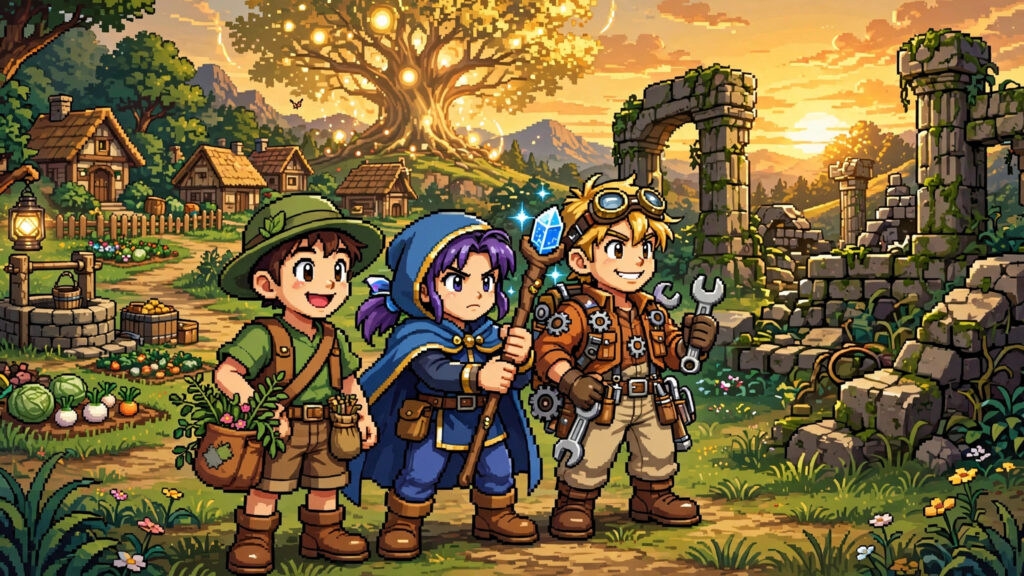
The game opens in Reja, a green and peaceful town where three best friends are wasting their youth in the correct way. Hoston is a young botanist, taught by his father; Alina, adopted young and desperate for her own father’s approval, is the responsible one holding the trio together; Edessot, a rich family’s mechanics prodigy, is the comic relief — a boy whose first instinct in any crisis is lunch. When Hoston’s father falls dangerously ill, the three slip into the forbidden caverns of Reja hunting a rare herb that might cure him. They find the herb, of course. They also find the loose thread of a much older story — Hoston’s father’s past, a vanished civilisation’s architects, and a man who intends to remake the world to his own design.
As plotting goes it is deliberately, almost defiantly conventional — Phantasy Star by way of Lunar, with the fetch quest that becomes a world-saving epic. The writing wobbles: genuinely warm scenes between the three friends sit a screen away from jokes that were old when the Mega Drive was new, and contemporary reviewers who called some of the dialogue eye-rolling were not wrong. But the emotional priority is right. This is a story about friendship first and cosmology second, and Alina’s quiet, unrequited need to be wanted by someone gives the back half a heart the cartridge era rarely bothered with.
Gather, Strike, Grind

Combat is turn-based in the pure old style, with the party eventually growing to five. Its one real idea is a good one: Gather. Instead of attacking, a character can spend a turn banking energy, then spend that charge to supercharge a spell or technique — a risk-and-tempo system that turns routine fights into small wagers. Do you heal now, or gather and trust the front line to survive one more round for the big cast? Add counter-attacks and a wide spell book and there is a genuine battle engine here, descended from Phantasy Star IV and proud of it.
And then there is the grind, and it is not a garnish — it is the main course. Random encounters arrive at a rate that would have embarrassed a 1991 localisation team. Spell animations are lengthy and unskippable in spirit. Difficulty spikes ambush you at dungeon doors and send you back out to walk in circles, levelling, exactly as your ancestors did. The HD edition’s single greatest mercy is buried in its settings: battle-speed and encounter-frequency options. Turn the frequency down and the game keeps its soul but drops its worst habit; leave it at default and you are playing 2010’s idea of 1992, with everything that implies. Whether that is authenticity or obstinacy depends on the player. Around the third identical cave fight in ten steps, this reviewer had a word for it, and the word was not authenticity.
Pier Solar does not imitate a lost 1994 classic. It is one — it just took the long way round to reach us.
The Biggest Little World
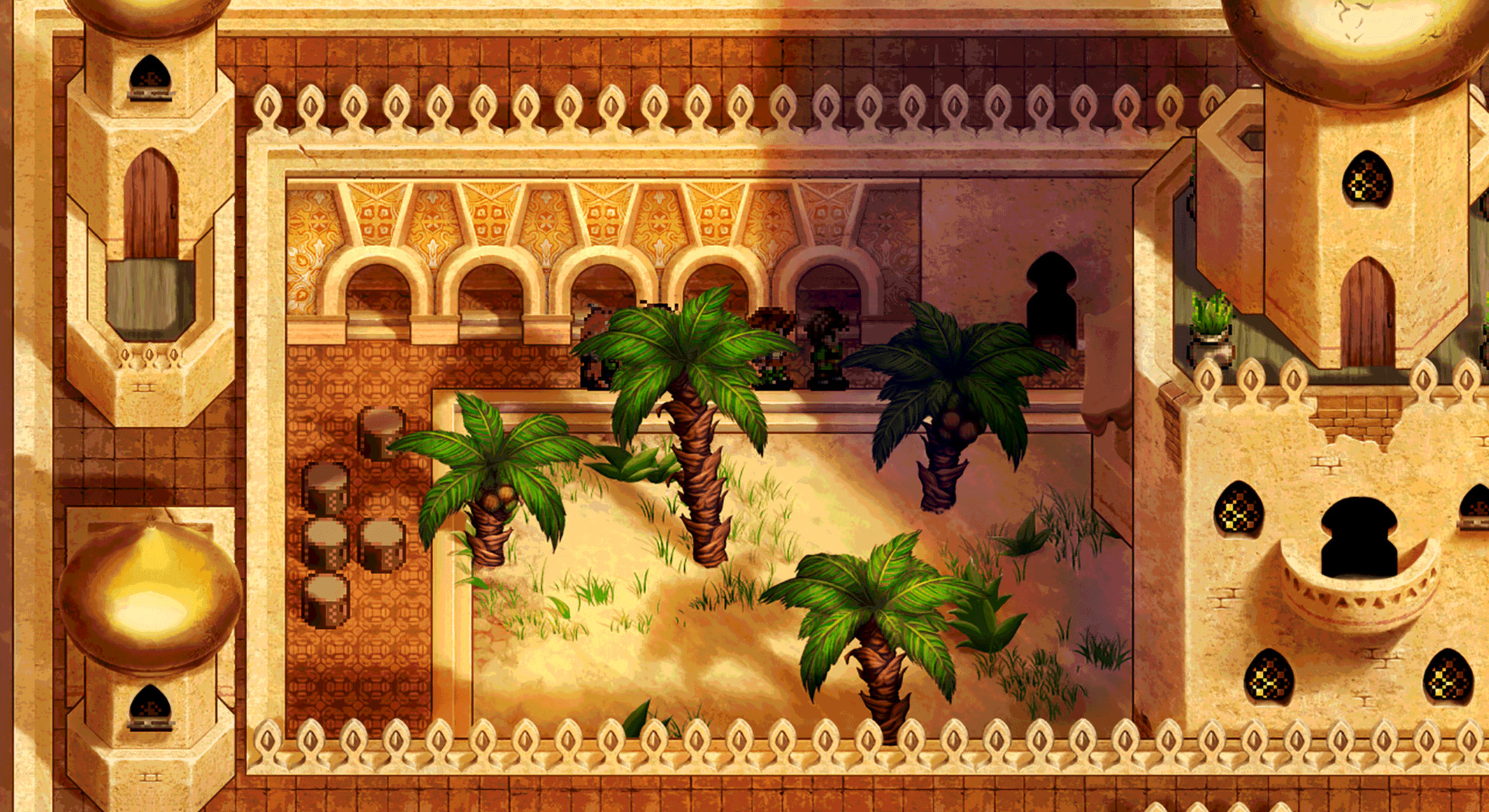
WaterMelon’s own numbers for the world — three hundred locations, eight hundred NPCs, nearly five hundred treasure chests — are marketing arithmetic, but the substance underneath them is real. Reja alone feels lived-in, and the journey keeps changing its wallpaper: sun-baked desert palaces, torch-lit caves, brick industrial towns, temples with machinery older than the plot. On a cartridge this density was a flex; redrawn in HD it is simply beautiful, lush with colour and crammed with incidental detail in a way that upscaled emulation never achieves.
The catch, noted by nearly every critic at the time, is navigation. Areas sprawl into mazes, exits hide behind foliage and foreground art, and more than one dungeon becomes an exercise in hugging walls. RPGFan’s reviewer called the design labyrinthine, and a decade of quality-of-life progress has not made the word less accurate. Pier Solar’s world is a pleasure to look at and, too often, a chore to cross — a sentence that could serve as the review of the whole game.
The HD Rebirth
The remake exists because of a Kickstarter. Launched in November 2012 with a $139,000 goal, the campaign cleared it with room to spare and funded a genuine director’s cut: expanded story material and locations that could never have fit the cartridge, the Japanese translation the original had to drop, newly drawn cutscene artwork, and a three-minute animated opening by the game’s character designer, Armen Mardirossian. On PS4 it arrived on September 30, 2014, as a cross-buy title with the PS3 version.

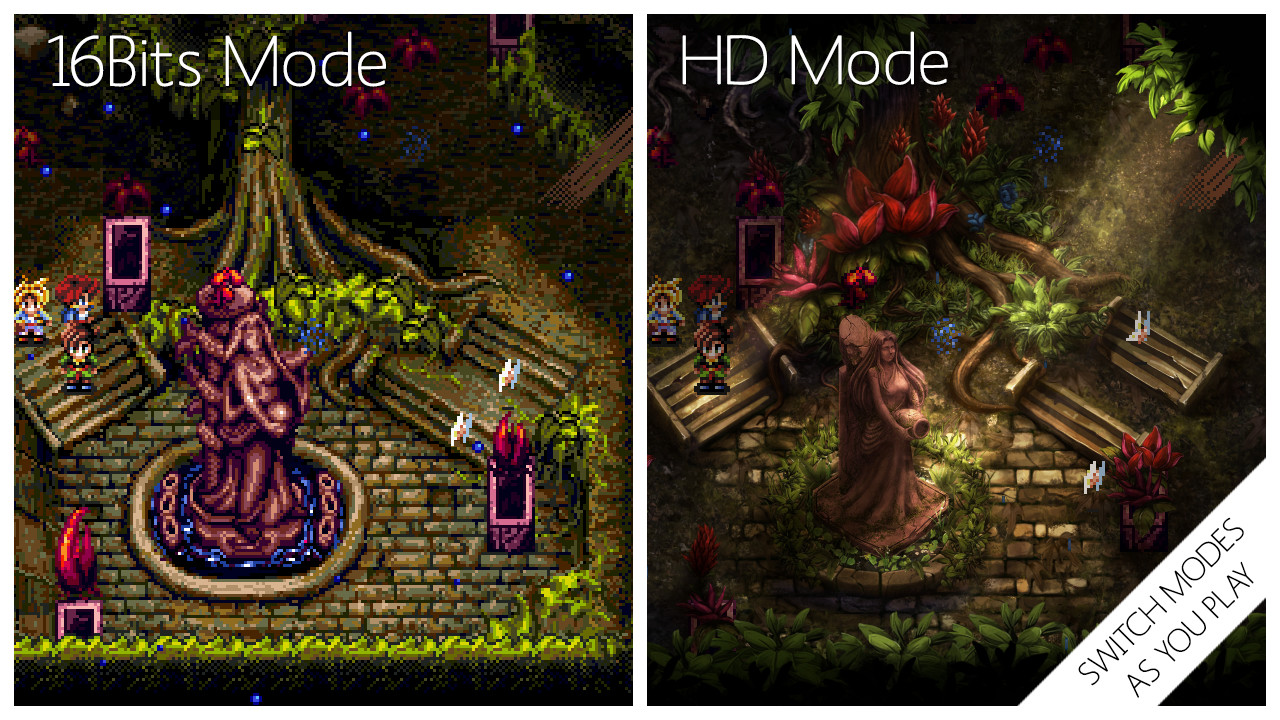
The headline feature is choice. Every screen can be flipped between the redrawn HD art and a 16-bit mode that recreates the cartridge’s look, live, as you play — and there is a third way, an HD+ smoothing filter, which like all smoothing filters exists mainly to be switched off. The redraw is the right default: it honours the original layouts while giving them the colour depth the Mega Drive could only gesture at. And presiding over all of it is the soundtrack by Zable Fahr, Tiido Priimägi and Tulio Adriano — the one element every single critic, friendly or hostile, agreed on. Game Informer, in a 7/10 review, called it absolutely fantastic; Hardcore Gamer called it a triumph. On the cartridge it justified the Mega CD trick all by itself. It is one of the great 16-bit scores, full stop — it merely had to wait for a 16-bit that never was.
The PS4 reception, all the same, was cooler than the cartridge’s: a 69 on Metacritic, 6/10 from Push Square, against the original’s warmer welcome. That gap is the review in miniature. Judged against other Mega Drive games, Pier Solar is a miracle. Judged on a 2014 console against 2014’s RPGs, its reverence for the old ways reads, in places, like a refusal to learn anything since.
Verdict
So who is the PS4 version for? If your shelves hold Phantasy Star IV and Lunar, if you have ever defended a random-encounter rate with the words “that’s how it was,” this is a homecoming — buy it, set the encounter frequency low, and settle in for one of the most sincere adventures of the retro era. If your patience for the genre’s old habits died somewhere in the PlayStation 2 years, no amount of beauty will save this for you, and the beauty is considerable.
There is a sad postscript. WaterMelon never escaped the gravity of its troubled follow-up, Paprium, and in 2021 the studio announced it was selling its intellectual property — Pier Solar included. This HD edition is, in all likelihood, the game’s final form: a forum joke that became the biggest cartridge a dead console ever held, still on sale, still gorgeous, still stubbornly itself. Some love letters get lost in the post. This one arrived — twenty years late, in high definition, demanding you grind for it. It earns the effort more often than it wastes it.
Score: 7.5/10. A beautiful, big-hearted time capsule — sublime music, hand-crafted art and a real adventure, wrapped around a grind only the faithful will finish. The most authentic 16-bit RPG of the modern age, for better and for worse.