SUPER NINTENDO · 2D PLATFORMER · RETROSPECTIVE REVIEW
Base game: Speedy Gonzales: Los Gatos Bandidos · Developer: Sunsoft · Publisher: Acclaim Entertainment (1995) · Hack by: Twin Eagles Group (unlicensed, c. 1996) · Platform: SNES
In 1996, Sega’s mascot starred in a Super Nintendo game. Sega didn’t make it, Nintendo didn’t license it, and the mouse who was supposed to be in it got edited out. This is the story of the most audacious cartridge of the console war — and what it’s actually like to play.
Understand what Sonic was for. He was not merely a mascot; he was a weapon, designed in 1991 with one job — to make the Super Nintendo look slow, square and yesterday. Sega built a whole identity on the hedgehog pointing at Nintendo and smirking. Of all the places on Earth Sonic the Hedgehog could not officially appear in 1996, the top of the list, underlined twice, was a cartridge that slotted into Nintendo’s machine. And yet here we are, reviewing one.
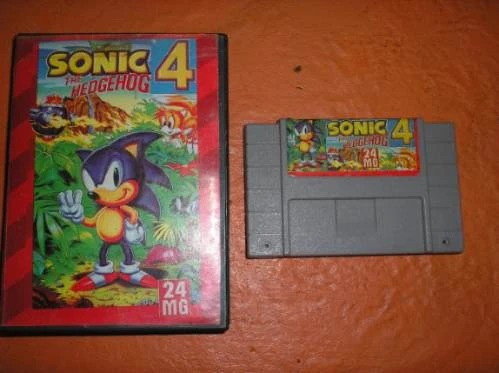
Nobody involved had permission. A Peruvian scene group called Twin Eagles Group took Sunsoft’s Speedy Gonzales: Los Gatos Bandidos, replaced the fastest mouse in Mexico with the fastest hedgehog in gaming, replaced the mice he rescues with Mario, and sent the result out into the world on grey plastic. It was sold as Sonic the Hedgehog, as Sonic the Hedgehog 4, occasionally even as Sonic & Knuckles. Everything about it is stolen. That is not a reason to dismiss it — it is the reason it matters, and the reason it still gets written about thirty years on.
Sonic on Nintendo, By Way of Peru
Twin Eagles Group were not amateurs who stumbled onto a ROM. Founded in 1989 by Lobsang Alvites, better known in the scene as Mr. Byte, they began on the Commodore 64 and are counted among the very first computer sceners in Peru. By the mid-nineties they were the region’s specialists in a particular craft: taking a finished SNES game and re-skinning it into a different, more sellable one. Their catalogue is a pirate’s film festival — 101 Dalmatas, Men in Black, Tarzan, football hacks stuffed with South American teams. Sonic, though, was the masterpiece of the form, and by most accounts it reached cartridges in 1996; Sonic Retro dates the Peruvian release to that September.
The choice of victim was inspired, because Sunsoft had already done the hard part. Los Gatos Bandidos was, even in 1995, openly a Sonic-style game wearing a Looney Tunes licence. Twin Eagles didn’t force the hedgehog into a game that couldn’t hold him. They found the one SNES platformer already built in his image, and simply completed the impersonation.
The Mouse Underneath
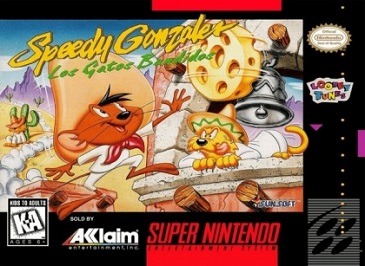
The original game, developed by Sunsoft and published by Acclaim in August 1995 (a planned European release was cancelled), is a better platformer than its obscurity suggests. The bandit cats of the title kidnap every mouse in the village during a fiesta; only Slowpoke Rodriguez escapes, and sends for his cousin. What follows is fast, slopey, momentum-driven platforming that plainly studied Sonic’s homework: Speedy tears across fields, up slopes and through tunnels, bounces off mousetraps like springboards, collects wedges of cheese, kicks enemies in the face, and frees caged mice on his way to bosses including Sylvester and Robocat. Bottomless pits and spikes kill on contact, and getting caught in a cage costs a life — it has teeth.
It also has one of emulation’s most famous bugs. Late in the game, in stage 6-1, sits a button that locked up emulators for years because of the unusual way the game’s code handles it — a glitch eventually documented and explained by Near, the author of the higan emulator, as a masterclass in why perfect SNES emulation is so hard. Keep that button in mind. The hack inherited the family curse.
Anatomy of a Swap
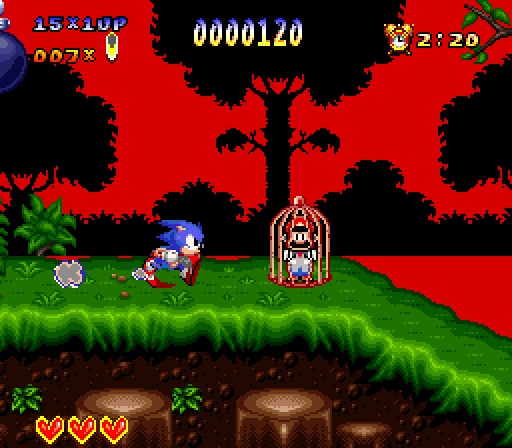
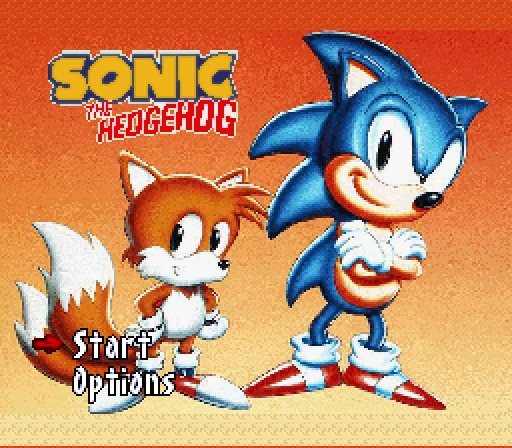
So what did Twin Eagles actually change? Start with the star. Speedy’s sprites were replaced with Sonic’s, lifted mainly from Sonic the Hedgehog 2 on the Mega Drive, with the carrying animations taken from Sonic 3 — which is why this may be the only game where Sonic visibly shoplifts his own sequel. The caged mice became caged Marios, and freeing one doubles as a checkpoint. The cheese became rings, counted on the HUD in proper Sonic fashion. But the disguise slips at the bottom-left corner of the screen: your health is three hearts, inherited intact from Speedy. Rings here are just points wearing a costume. Sonic collects them, and they do nothing to protect him — a sentence no official Sonic game has ever allowed.
The hackers recorded their own voices, too. Free Mario and he yells “Mario!” in a home-recorded sample (the voice credit in the hack’s own credits goes to one Mongrut); grab the speed shoes and Sonic shouts “Sonic, Sonic!” Speedy could kick, so Sonic kicks — coverage of the hack ever since has delighted in calling it Sonic’s brand-new ability, which is one way to describe a mouse’s move with a hedgehog standing on it.
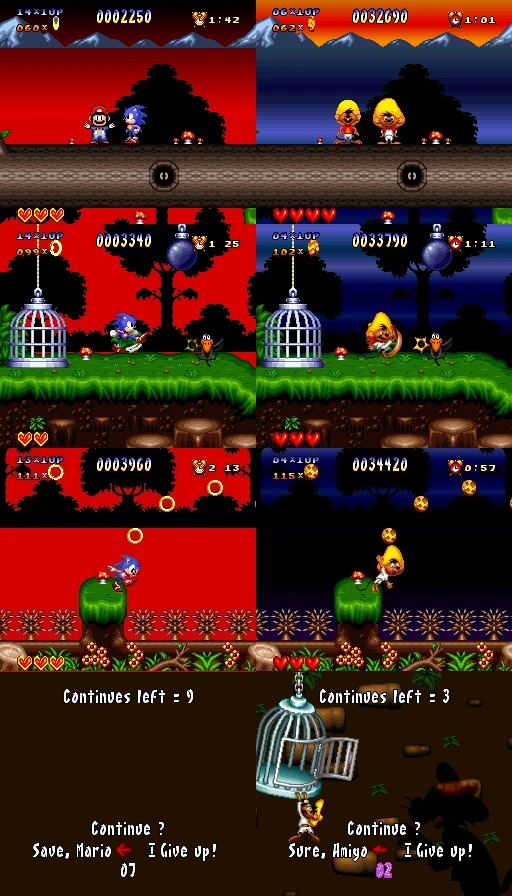
Then there is the damage. The backgrounds did not survive the operation: in level after level the scenery renders as a flat, disjointed red gradient, a sky the colour of a warning light, only snapping back to normal during boss fights. The level order was shuffled — the forest stage, Surely Woods, second in the original, now opens the game, presumably because it is the fastest and most Sonic-like of the set. Three of the original’s stages were cut entirely and are reachable today only through savestate tricks, the subject of patient lost-levels archaeology at Sonic CulT. The soundtrack was gutted: open the music test and most of the original’s tunes are gone or swapped, leaving a single boss theme to do duty across almost the whole game. Even the level-complete screen is haunted — a running Sonic rendered in a glitchy palette that is probably Speedy’s, presiding over a tally that no longer bothers to count your rings, your time, or your rescued Marios. And yes, the curse travels: hit a switch in the third level and the game can crash, just as its parent could, though the crash can be dodged; on some emulators, the whole thing locks up after four levels no matter what you do.
Strip away the stolen sprites and what remains is a time capsule of the console war as most of the world actually experienced it — not in licensed shops, but in market stalls.
Sold Everywhere, Licensed Nowhere

Twin Eagles’ business model explains the chaos of surviving copies. Many of their hacks were commissioned work: the group supplied a master ROM to resellers around the world, who pressed and distributed their own cartridges. There was never one official fake, so there are dozens of unofficial ones — Sonic Retro’s archive documents label variant after label variant. There are carts in Super Famicom shells, a nine-in-one multicart with Sonic 4 third on the menu, Brazilian rental boxes with cover art stolen from genuine Sonic games, and at least one pressing brazen enough to print a fake “Licensed by Nintendo” line on the label of a game whose entire existence was a licensing violation. The group returned to the well, too: a second SNES outing, Sonic the Hedgehog 2, built this time on a hack of Sparkster, and the Game Boy’s Sonic 6 is another Speedy Gonzales hack that Sonic Retro suggests may be the same hands at work.
For the record, Sega’s name did officially touch Nintendo’s 16-bit hardware exactly once: as the BootlegGames Wiki notes, a Super Famicom version of Columns, published by Media Factory, is the only SNES-family game ever to carry Sega’s real licensing. Sonic’s SNES career, meanwhile, was entirely criminal — and considerably better distributed.
Sonic Loves Nintendo, Mario Loves Sega
Finish the hack and it signs off with the most honest sentence in the whole pirate canon: “Sonic loves Nintendo, Mario loves Sega.” In 1996 that was a joke about a stolen game. Read it now and it plays like prophecy — within five years Sega was out of the console business, and within a decade Sonic was a regular guest on Nintendo hardware, Mario and Sonic were sharing Olympic billing, and the war this cartridge treated as a wall to be climbed had become a border to be crossed with a handshake. Twin Eagles got there first, with a hex editor.
The wider world caught up in the late 2000s, when the hack surfaced through Gamesniped and Kotaku and 1UP retold its history; when Sega announced the real Sonic the Hedgehog 4 in February 2010, Engadget’s joke wrote itself — a game called Sonic 4, they noted, had already been floating around for fourteen years. Historians and collectors care about this cartridge because it is primary evidence. In much of South America, official games were expensive imports and pirate carts were simply what video games were; for thousands of kids, this was Sonic on the SNES, not a footnote to him. The console war had an unlicensed front, and this is its best-preserved dispatch.
Verdict
Judged purely as a game, this is Sunsoft’s decent, speedy platformer with a hedgehog pasted over the mouse and several self-inflicted wounds: broken skies, a looted soundtrack, missing stages, a crash waiting at a switch. Play it today and the first ten minutes are pure joy — the sheer impossibility of the thing carries it — after which the jank starts billing you by the level. Judged as an artifact, it is close to priceless: a Peruvian scene group’s master ROM, pressed onto grey carts on several continents, that put the console war’s biggest rivalry inside one cartridge a half-decade before the lawyers allowed it. Our score grades the game. The artifact, we’d put in a museum.
Score: 5.5/10. A competent mouse platformer in a hedgehog costume — fast, funny and quietly falling apart, with broken skies and a gutted soundtrack. As a game it’s a curiosity; as a piece of console-war history, it’s essential.