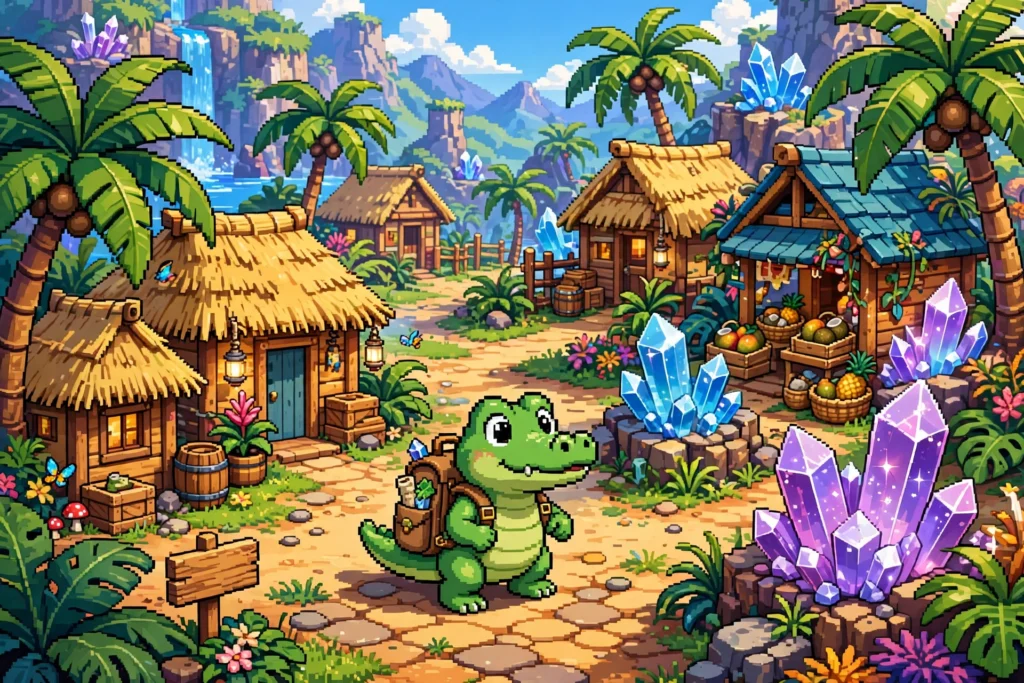
Yahoo, as a certain little crocodile never quite said but probably should have. Croc 2: Kingdom of the Gobbos is out today, Thursday, October 29, 2026 — digitally, right now, on Nintendo Switch, PlayStation 5, PlayStation 4, Xbox Series X|S, and PC via Steam and GOG. Argonaut Games, the revived British studio behind the original, is publishing, and the remaster itself was developed with Titanium Studios — the same partnership that brought back the first game last year. No download-and-wait-for-a-patch drama, no staggered regional rollout to decode: if you grew up tail-spinning Dantinis on a grey PlayStation, your sequel is sitting in the store of your choice this morning.
That sentence alone would have sounded like fan fiction three years ago. Argonaut was gone. Croc was a trivia answer. Then Croc: Legend of the Gobbos came back in 2025 with its Crocipedia museum tucked inside, and did the one job that remaster really had to do: prove there was still an audience. Now, as the centrepiece of a month of Croctober announcements, the sequel gets the same treatment, only bigger. Because Croc 2 was always the bigger game. Whether it was the better one is the argument we get to have all over again, starting today.

Why the sequel left Gobbo Valley
The story setup is pure Saturday-morning stuff, and I mean that as a compliment. Croc is playing on the beach in Gobbo Valley when he finds a message in a bottle — and the message says his long-lost parents are looking for him. The parents he never knew. The ones who lost him before the Gobbos found him in a basket and raised him as their own. So he leaves. He heads for the mainland, because that is where the answers are, and almost immediately everything goes wrong in the most Croc way possible: the Dantinis have resurrected Baron Dante, the villain Croc defeated in the first game, and Professor Gobbo — the inventor who witnessed the resurrection — has been captured for seeing too much.
It is a smarter premise than the first game’s rescue-the-Gobbos loop, because it gives Croc somewhere to go. The original was a chain of islands, level after level, charming but contained. Croc 2, released in 1999 for the PlayStation, opens the structure up. There is a mainland. There are people — well, Gobbos — living in proper settlements, with jobs and problems and shops. Croc is a traveller now, not just a rescuer running a circuit. For a sequel from a studio founded by Jez San, a team that had been playing with 3D since the Super FX days, that ambition matters. Argonaut always wanted to push the room bigger. Here, they actually did.
Bigger, weirder, and happily distracted
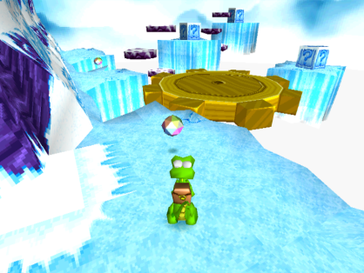
The numbers first: more than 40 levels, spread across four Gobbo villages. There is the coastal Sailor Village, all docks and sea air; a snowbound village; a prehistoric village; and a mountaintop village — each one a hub, each one handing out missions instead of just gating you through a linear list. Help a Gobbo, rescue a Gobbo, chase down whatever the Dantinis have stolen this time, and gradually unlock the boss that moves you on to the next settlement. It is open-ended in the way late-nineties platformers were learning to be open-ended: not an open world, but a place that lets you wander, pick your next job, and feel like you live there for a while.
And then there is the shopping. Crystals are currency now, not just health in disguise, and you spend them at Swap Meet Pete’s shop — on gadgets, on help, on the little quality-of-adventure purchases that made Croc 2 feel, in 1999, oddly grown-up next to its predecessor. A platform hero with a wallet and a regular shopkeeper is a small thing, but small things are what sequels are for.
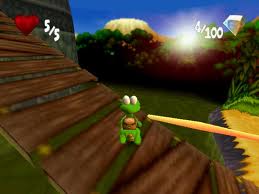
The moveset grows, too — though one growth is new for 2026, so hold that thought for a moment. In the original you had the jump and the tail spin, the stomp, the climb, the swim, that wiggly, determined little run. What the sequel really added was vehicles, and it added them with the enthusiasm of a team emptying its ideas drawer. Minecarts. Cars. Speedboats. A hang glider. A wooden airplane. A snowball, if memory and the level list are to be trusted, deserves its own dishonourable mention. Not every vehicle section was good — we will get to honesty shortly — but the variety was the point. Croc 2 never lets one idea run long enough to get tired before it throws you into something on wheels, wings or water.
First, a word for the original
A quick confession of where I stand: the first Croc is the one on my shelf, the one whose chunky little islands feel like a place I actually visited as a kid. It sold millions and reviewed respectably. The sequel reviewed more roughly — reviewers liked the graphics and scope, then complained about the camera and the difficulty. Both reputations are earned, and the remaster has to answer for both: the fondness and the frustration.
What’s actually new in the remaster
Start with the title itself. The full development title, Kingdom of the Gobbos, is restored and up front — the game is Croc 2: Kingdom of the Gobbos now, not just Croc 2 with the subtitle living in the manual. Then the expected, welcome stuff: enhanced visuals, cleaning up a 1999 PlayStation game for modern screens without sanding off its low-poly charm, and a round of quality-of-life improvements. Argonaut and Titanium learned their lessons publicly with the first remaster — modern controls and a modern camera were headline features there — and the sequel is being sold in the same spirit.
The one change I keep circling, though, is the triple jump. Croc now gets a genuine new move on top of the classic jump and tail spin: a triple jump, giving him extra height and, in theory, a more forgiving way through platforming that in 1999 simply sent you back to try again. Purists can grumble — somebody always does — but I am for it, with a condition. A new move in a remaster earns its place if the levels feel like they were quietly re-checked with it in mind, rather than it being a cheat code stapled to the inventory. We will know within an hour of playing. That is the honest position on launch morning: it is a promising change, not a proven one.
Practical notes, because launch day is also shopping day. This is a digital-only release at launch. Physical editions are real but not today — details have been promised for later this year, so collectors who want a boxed Croc next to the boxed first remaster should either double-dip knowingly or sit on their hands. And a version for Nintendo Switch 2 has been promised for 2027 — reported as part of the Croctober slate — so Switch owners are buying the Switch version today on the understanding that the newer hardware gets its own edition down the line.

The Croc2pedia is the real story
Here is the section where I stop being a neutral news reporter, because the Croc2pedia is, to me, the most important thing in this entire release. Built into the remaster is a digital museum: never-before-seen development materials, 3D models of cut content, original design documents, promotional and marketing assets from the era — and the centrepiece, the Croc2mentary, a roughly 90-minute documentary featuring interviews with both the original team and the remaster team.
Ninety minutes. For Croc 2. Sit with that. The games that usually get this treatment are the canonised ones, the Marios and Zeldas whose every sketch is already in a coffee-table book. B-tier platformers — and Croc was B-tier, hold on, I am coming to that — usually get nothing. Their design documents get skipped, literally thrown in skips, when a studio closes. Argonaut did close, for twenty years. That this material survived, and that a revived Argonaut has decided its second-division crocodile deserves a museum and a feature-length documentary, is game preservation doing exactly what its advocates always promised: not just saving the ROM, but saving the story of the making.
The Croc2pedia treats a B-tier mascot platformer like it matters — development documents, cut models, a 90-minute documentary. That is preservation for the games history usually forgets, and it is the best reason this remaster exists.
The first remaster’s Crocipedia pointed the way; Argonaut appears to have listened and doubled the bet. If you care about how British games were actually made at the end of the nineties — the compromises, the cut levels, the artwork that never shipped — the museum alone may be worth the price of admission, with a 40-level platformer attached as a bonus. In ten years, the documentary will be harder to replace than the game.
Honest caveats before you buy
Right. The cold water, because this site does neither hype nor hatchet jobs. Croc was always a B-tier mascot platformer. Next to Mario, next to Spyro and Crash — who were doing this on the same hardware, in the same years, with bigger budgets and tighter controls — Croc was the plucky runner-up: cuter than he had any right to be, charming to a fault, and never, ever top tier. The charm is real. So is the tier. Anyone selling you a forgotten masterpiece is selling you something.
The specific 1999 complaints were the camera and the controls, and they were fair. Croc turned like a boat, the camera had opinions of its own, and the sequel’s bigger, more open levels gave both problems more room to hurt you. Argonaut says quality of life is improved, and the first remaster genuinely did modernise its controls and camera — but claims are claims. Until the pad has been in enough hands for a verdict, treat ‘fixed’ as ‘promised’. If you bounced off Croc in 1999 because of how he handled, that — not the resolution, not the museum — is the question today is actually asking.
Who should buy day one, and who should wait
Buy it today if: you played the original to death and have waited 27 years to go back to the villages; you bought last year’s remaster mainly for the Crocipedia and want the documentary even more than the game; or you collect digitally and happily. For you, this is not a gamble, it is a reunion.
Wait if: you are a physical collector — editions are promised, patience will be rewarded; you are a Switch 2 owner who would rather buy once, in 2027, on your actual hardware; or you never had patience for the original’s handling and want to hear, from players rather than press releases, whether the camera and controls have truly been tamed. None of those is a no. All of them are a ‘let the first weekend speak’.
Me? I am downloading it tonight, documentary first, minecart second. A little green crocodile in a backpack just got his sequel back, his parents’ story back, and his studio back from the dead to tell it. In a year full of remasters nobody asked for, this is one a specific, devoted audience asked about for decades. Welcome back, Croc. Mind the camera.