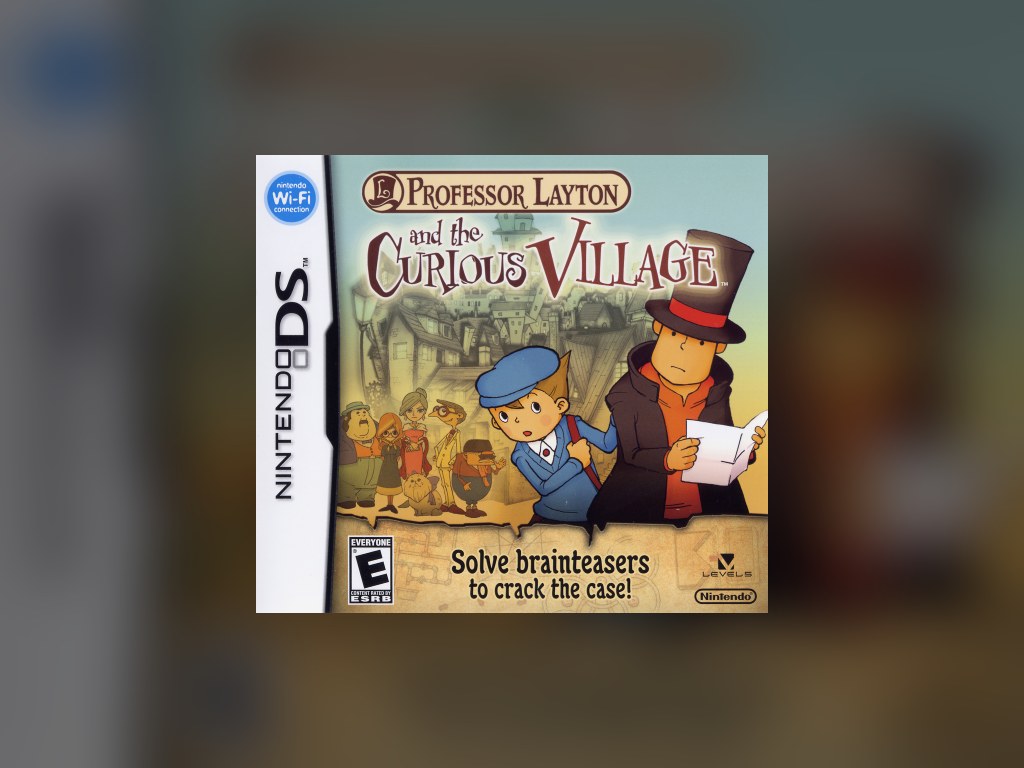
At a glance: Professor Layton and the Curious Village · Nintendo DS · Nintendo, 2007 · Puzzle adventure · Score: 9.0/10
Professor Layton and the Curious Village arrived from Level-5 in 2007 (reaching the West in 2008) as something the games industry had no shelf for: a point-and-touch adventure in which progress is gated not by inventories or reflexes but by over 130 standalone puzzles — logic problems, sliding blocks, optical traps and lateral riddles — wrapped in a hand-drawn mystery story about a village where everyone, from the innkeeper to the ferryman, thinks in brainteasers. It became a phenomenon, launched one of Nintendo’s defining DS franchises, and made a top-hatted archaeologist in a orange-banded hat into an unlikely superstar.
The story is a model of storybook economy. Professor Hershel Layton and his apprentice Luke are summoned to St. Mystere, where the late Baron Reinhold’s will promises his fortune — the Golden Apple — to whoever solves the village’s secret. A murder follows, a mysterious girl flits across rooftops, and the village’s odd inhabitants keep steering every conversation, however grave, into ‘this reminds me of a puzzle’. The tone is gentle, whimsical and quietly melancholic, animated in lovely Studio-Ghibli-adjacent cut-scenes with full voice acting that was a genuine luxury on a DS cartridge.

Every puzzle is worth ten picarats
The puzzles themselves, adapted from Professor Akira Tago’s bestselling Head Gymnastics books, are the real cast. Each is presented by a character, worth a currency of picarats that falls with every wrong attempt, and answered by stylus — circling, tapping, sliding, drawing. The range is the joy: a two-minute chocolate-and-teeth logic problem sits beside a twenty-minute knight’s tour that will consume your notebook’s margins. A hint system of three purchasable clues per puzzle (paid for with coins hidden in the village’s scenery, rewarding compulsive tapping of every barrel and window) keeps the difficulty humane without ever solving anything for you.
Crucially, almost nothing is missable: puzzles you skip migrate to a shack at the village edge where Granny Riddleton collects them, so completionists can finish the story and mop up afterwards. The adventure scaffolding — exploring St. Mystere by tapping where to walk, interviewing villagers, chasing the plot’s genuinely touching late turns — is light, and deliberately so. It exists to deliver you, smiling, to the next problem. Even the meta-systems conspire toward charm: assembling gizmos, furnishing the heroes’ inn rooms and completing a painting fill your trunk with diversions between chapters.

A gentleman’s presentation
Few DS games look or sound this composed. The village is rendered in watercolour storybook style, all crooked chimneys and golden lamplight; the animated sequences are properly directed, not slideshowed; and Tomohito Nishiura’s accordion-led score is so perfectly judged — wistful, Parisian, faintly sad — that the series still uses its themes as a signature. Voice acting, sparse but well cast in the Western release, sells Layton’s unshakeable courtesy: the fantasy here is not power but competence and kindness, a hero who opens doors by being clever and polite.
A true gentleman leaves no puzzle unsolved — and in St. Mystere, every lamppost, innkeeper and ferryman is determined to test that creed.
Honest criticisms are few and small. A handful of puzzles lean on trick wording that can feel unfair rather than lateral, the story’s central twist will be guessed by sharp players an hour early, and the adventure elements are undeniably a frame rather than a game in themselves. But the frame is load-bearing: context, characters and picarat stakes transform what could have been a bare puzzle book into an experience players remember as a place they visited. Weekly downloadable puzzles extended the cartridge’s life long after release, another DS-era first done right.
The village and its afterlife
St. Mystere itself deserves analysis as a piece of design. It is small — a dozen screens of crooked streets — but it is built like a puzzle-box in its own right, with every barrel, chimney and inn-sign tappable and a meaningful fraction of them hiding hint coins, hidden puzzles or Gizmos for the wind-up dog you assemble across the adventure. That compulsive interactivity reframes exploration: the village is not a hub between puzzles, it is the largest puzzle in the game, and the story’s late revelation about its nature retroactively makes the whole place ache with meaning. Few adventure settings earn their twist as honestly.
The difficulty architecture is equally considered. mandatory story puzzles skew gentle; the village’s optional problems — and the fiendish post-game Layton’s Challenges, unlocked by completing the painting, the gizmo and the inn — are where Professor Tago’s source material shows its teeth. The picarat economy creates a soft pressure (your final total is a score, never a gate), the three-tier hint system prices help in a currency earned by curiosity, and the journal and ‘story so far’ recaps respect the handheld rhythm of play-in-gaps. It is a game designed by people who understood exactly when and where it would be played: everywhere, in pieces, with great affection.
The phenomenon that followed — five more mainline games, a film, a crossover with Phoenix Wright, a successor series under his daughter — all flows from this village and its 135 puzzles. Level-5 became a powerhouse on its back. Replaying the original today, what surprises is not the scale but the confidence: a new IP, in a new genre, on a new kind of machine, behaving from its first screen like a classic. It was one.
A practical note for modern buyers: the Curious Village is the most affordable entry point into the series by a wide margin — it sold enormously and loose copies remain common — which makes its quality almost unfair as a value proposition. It is also the gentlest on-ramp: no prior knowledge required, no reflexes needed, a story complete in itself. Start here, and know that the village’s particular mixture of melancholy and manners only deepens across the trilogy that follows. A gentleman, the Professor teaches us, always finishes his tea. He also always starts at the beginning.
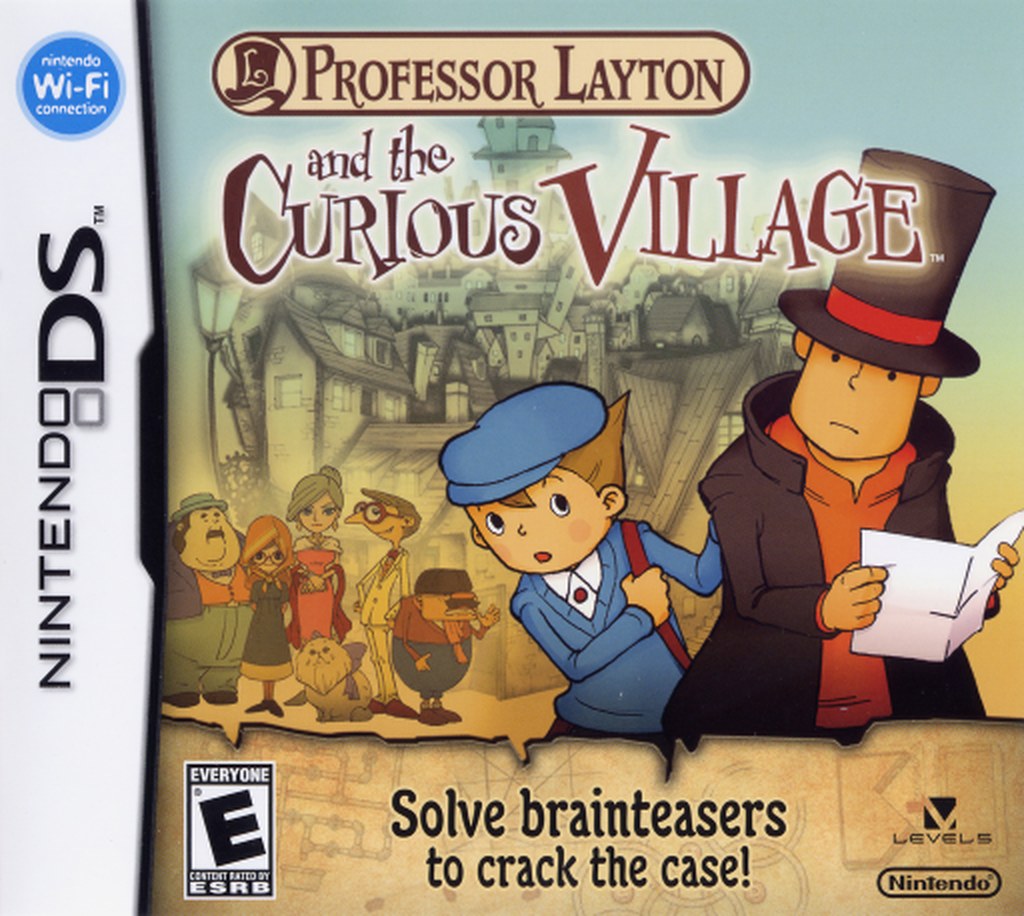
Playing it today
One practical grace note: the game’s structure — self-contained puzzles, a journal that recaps the story, a hero who never hurries you — makes the Curious Village the ideal bedside-table cartridge, perfectly happy to be played in ten-minute sips across a month of evenings. Its downloadable weekly puzzles belong to a retired service, but the 135 on the cartridge are the complete work. Millions of players have a Professor Layton story; most of them begin in this village, with a inheritance, a golden apple and a man in a tall hat insisting that every problem, properly looked at, is a puzzle. He has never been wrong yet.
Verdict
The Curious Village is one of the defining DS games: a perfect marriage of hardware and concept, in which the stylus, the two screens and the handheld moment all serve a single warm idea. Its puzzles remain excellent, its story still charms, and its hero is one of gaming’s great gentlemen. Later Laytons added scale and spectacle; none beat the purity of the first village. Essential, in the way only a handful of games per system ever are.