
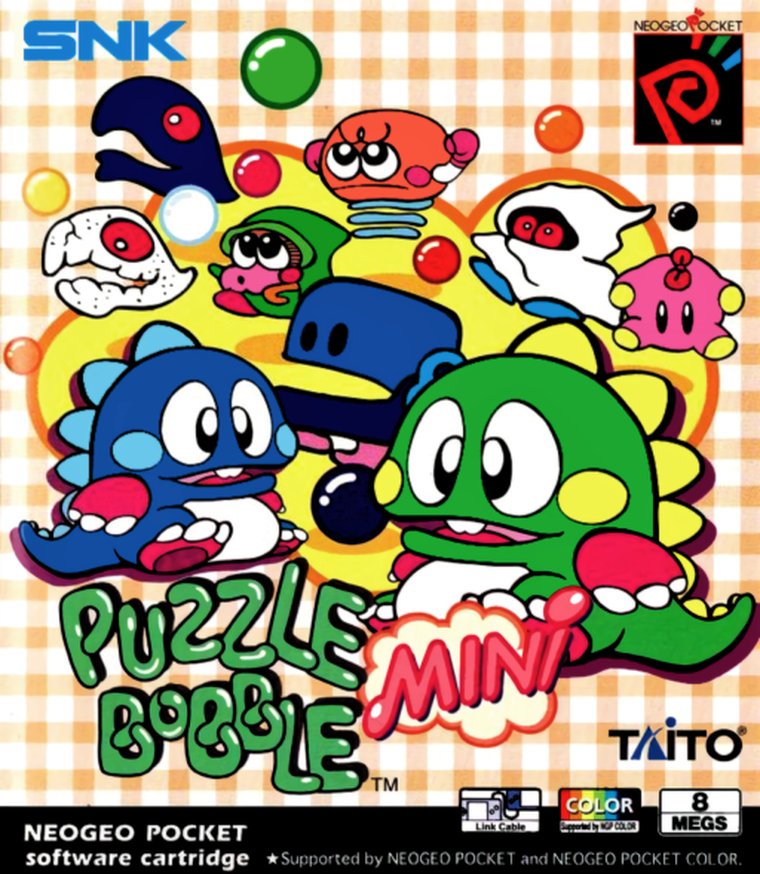
At a glance: Puzzle Bobble Mini · Neo Geo Pocket Color · Taito, 1999 · Puzzle · Score: 8.0/10
Puzzle Bobble is one of those designs that feels discovered rather than invented: aim a bubble, fire it, match three, watch the cluster fall. Taito’s arcade series had already conquered every platform it touched by 1999, and its arrival on the Neo Geo Pocket Color — as a launch-window title in the West, where it was called Bust-A-Move Pocket — gave SNK’s machine an instant puzzle credential. The mini in the title refers to the machine, not the game: this is the full Puzzle Bobble experience, pocketed.
Bub and Bob, the bubble dragons, man the cannon at the foot of the screen while the ceiling of coloured bubbles descends. Your job is the eternal one: bank shots off walls, build clusters, and let gravity do your dirty work by dropping bubbles stranded beneath a cleared match. The NGPC version reproduces the arcade feel with care — the launcher’s aim is precise, the wall-bounce geometry reads clearly on the small screen, and the bubbles’ colours are distinct enough that the limited palette never causes the misreads that sink lesser ports.

Modes and manners
The mode suite is generous for a launch title. A puzzle mode runs a long ladder of set stages across a world-map structure in the series tradition, a versus mode pits you against the CPU in the competitive format — where dropped bubbles rain onto your opponent’s screen — and link-cable play offers the same duel against a friend, which is where this design has always drawn blood. A survival-flavoured endless option rounds things out. Progress is saved to the cartridge, so the puzzle ladder works as a weeks-long companion rather than a single sitting.
What elevates Puzzle Bobble, here as everywhere, is the skill ceiling hiding inside a game a child can start. Banked shots, cluster engineering, setting up drops three moves deep — the little screen shows you the whole board, and the whole board is a chess problem wearing a party hat. The NGPC’s stick proves surprisingly apt for fine aim adjustments, its clicks metering out degrees.
A chess problem wearing a party hat: the whole board on one small screen, and a skill ceiling that keeps rising the longer you stare at it.
The small print
Honesty corner: this is Puzzle Bobble, faithfully done, and it invents little. Players who owned the series on other formats in 1999 were buying convenience, not novelty. The versus CPU can feel spike-prone on higher stages, the soundtrack loops its cheerfulness at you without much variation, and the ceiling’s descent speed in later puzzle stages will teach you the particular despair of the nearly-cleared board. None of these are faults of the conversion; they are the series’ own weather.
As a piece of the NGPC’s launch argument, though, Mini mattered. It told puzzle players — the Game Boy’s Tetris constituency — that this machine respected their genre, and it gave the library a game with literally unlimited replay value at a moment when the fighters, for all their quality, asked for commitment. Every library needs its forever game. The NGPC’s arrived at launch, wearing bubbles.

The design that never ages
It is worth pausing on why this particular puzzler, of all the NGPC’s puzzle shelf, became the system’s evergreen. Puzzle Bobble’s genius is information: the entire board is always visible, every consequence of your shot is calculable, and every failure is legible — you can see the exact moment a game was lost, three shots back. That transparency makes it the rare puzzle game that feels fair at its hardest and generous at its easiest, and it is why the same design has been re-sold on every platform for thirty years without anyone calling it a cynical re-release. It is not a product. It is a folk game now, like patience or dominoes.
The NGPC edition’s specific pleasure is its fit. The stick’s fine clicks suit the launcher’s fine angles; the screen shows the whole puzzle at the exact size the design wants; the cartridge saves your ladder position like a bookmark. If the system had shipped with one game soldered inside, the fighters would have made the louder argument — but Mini would have made the longer one.
The versus mode merits one more paragraph, because it is where Mini quietly becomes a competitive game. The drop-table — the pattern by which your clears send bubbles to your opponent — follows the series’ rules faithfully, which means the deep skills transfer: setting up overhangs, timing a drop to land mid-opponent-combo, surviving a flooded board by one banked shot. Link-cable duels on NGPCs were a genuine schoolyard and office scene in the system’s brief life, and the game’s balance — aggressive play rewarded, stalling punished by the ceiling — holds up under modern scrutiny.
Practically, Mini is also the library’s best battery citizen in a library of misers: there is no wrong moment to stop, no session too short to count, and the puzzle ladder’s saved progress means the cartridge can live in the machine for months as your default five minutes. Some games demand your evening. This one asks for your queue, your commute and your kettle’s boil — and gives you a masterpiece in exchange for all three.
For parents and gift-givers, a footnote the game’s age makes charming: this is the rare vintage cartridge that needs no content warnings, no series knowledge and no instructions beyond ‘match three’ — and yet it has occupied strategy-minded adults for three decades. The all-ages puzzle game that is actually for all ages turns out to be a short list, and Mini is on it.
Which is the final word on the system’s forever game: it was there at the launch, it will be there at the collection’s end, and in between it asks only that you aim carefully and trust the bounce. Bub and Bob have never asked for more. Neither should we.
The last thing to praise is the cartridge’s manners as software: instant boot, instant restart, no friction between you and the next board, progress kept without ceremony. Puzzle games live on frictionlessness — the distance between ‘one more go’ and the go itself — and Mini’s distance is zero. That is not a small thing. It is, across three decades of re-releases on ever-fancier hardware, the thing none of them have improved: you cannot get to the bubbles faster than this cartridge already does.
Match three. Trust the bounce. The ceiling can wait one more shot — it always could.
Verdict
Puzzle Bobble Mini is not the NGPC’s most ambitious cartridge, but it may be its most durable: a perfect puzzle design, faithfully converted, endlessly replayable, and as good on a bus in 2026 as it was in 1999. Own the machine? Own this. The bubbles are non-negotiable.