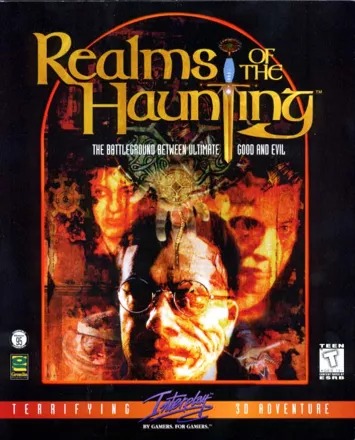
At a glance: Realms of the Haunting · DOS · developed by Gremlin Interactive · published by Interplay · Europe December 1996, North America March 1997 · first-person horror adventure · twenty chapters on four CDs · one Cornish mansion, four other realms, and the end of the world
Judge Realms of the Haunting by its screenshots and you will file it wrongly. The first-person view, the visible weapon, the things teleporting in to be shot — it presents as a shooter. It is, at heart, an adventure game in the Tex Murphy mould: a long, talkative, inventory-driven investigation that happens to unfold inside a real-time 3D engine, with full-motion video carrying the plot and combat kept firmly in a supporting role. Gremlin Interactive built it on Antony Crowther’s True3D engine — itself a development of the technology behind Normality — and Interplay published it across four discs at the end of 1996. Almost thirty years on, it remains one of the most distinctive genre blends of the CD-ROM era, and one of the most demanding.
A Package from a Dead Man
You are Adam Randall, an ordinary man whose estranged father Charles has died in circumstances nobody will explain. A package from the dead man draws Adam to the family mansion in a remote corner of Cornwall — a house raised, in the way of these stories, over something much older and worse, the site of a Satanic temple. The doors oblige with the oldest trick in the gothic book and lock behind him. What follows sprawls agreeably out of control: a psychic companion, Rebecca Trevisard, who joins the investigation and argues with Adam’s inner monologue; a priest who is not what he seems and has had five centuries to practise; parallel realms stacked behind the house’s walls; prophecies, journals, parchments and an apocalypse assembling itself in the basement of the plot. Twenty chapters structure the journey, the running time stretches into dozens of hours, and the fiction asks to be read — the inventory runs to more than a hundred and fifty objects, the documents are load-bearing, and the names will not all stay in your head.
The interface is the game’s boldest and most divisive choice. Everything runs through a colour-coded pointer: green to use, blue to step closer, red to shoot, an eye when the right button will examine. Your two hands are separate inventory slots — the left, broadly, for weapons, the right for whatever you are holding up to the world — and an F3 toggle switches item use between manual and automatic, the difference between the game graciously applying a key you own and you posting it into the lock yourself. It is genuinely awkward for the first hour and merely eccentric thereafter. One honest correction to the old print on this game: that F3 switch is the whole difficulty story only in the original British release — the American edition added proper combat difficulty settings and rebindable controls, a rare case of a transatlantic version quietly fixing its homework.
The inventory deserves a footnote of its own, because it is really three systems in a trench coat: the weapons and objects you would expect, a library of documents the game fully expects you to sit and read, and a growing set of character profiles for everyone Adam meets — a case file assembling itself as you play. Examining a held object produces a rendered close-up and Adam’s spoken opinion of it, the same opinion every time, which reads as a memory aid in a game with this many loose threads: the inventory remembers so that you don’t have to.
Doors, Lanterns and Things That Teleport

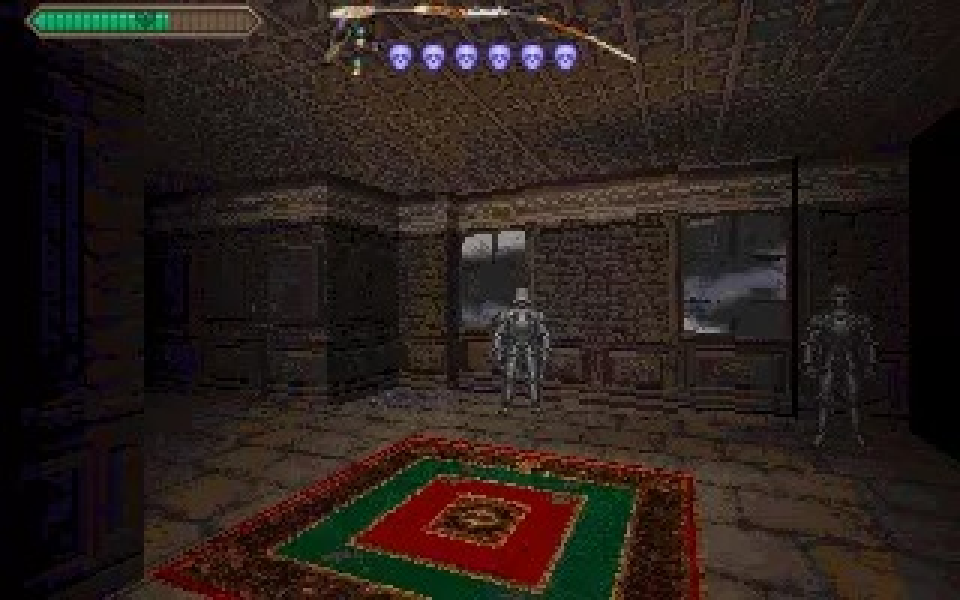
The mansion is a hub in the modern sense, its wings unlocking as the story permits, with portals in its depths leading to a Tower realm that itself bridges to the four realms of the title — garden paradises, stone hells, places stranger than either. The engine sells all of it handsomely at 640 by 480: textures stay sharp, floors stack on floors with real verticality, and the lighting is the star, a dynamic lantern glow supplemented by candles you can light and switches that work. Combat punctuates rather than drives. Creatures from elsewhere arrive in flashes, ammo is generous, later weapons refill themselves, and the fights are defensive puzzles as often as firefights — some enemies are traps waiting for the right object, some are infinite and simply to be outrun, and none of them will follow you through a doorway, which makes every threshold in the house a tiny fortress.
The FMV deserves its reputation in both directions. Sequences can run ten minutes, branch into optional questions, and rest on live actors shot against green screens with lip-sync that wanders like a drunk looking for his car. David Tuomi’s Adam and Emma Powell’s Rebecca play it straight, and the commitment carries scenes the budget couldn’t. Movement itself is a period piece worth describing: arrow keys or screen-edge hotspots to walk, the angle-bracket keys to sidestep out of a firing line, a Caps Lock toggle to run, and a genuine need to look up and down — ammunition hides in crates, answers hide on shelves. It is a control scheme from the brief window when first-person adventures were inventing their grammar in public, and Realms’ dialect is more coherent than most.
Where the game creaks is in the adventurer’s traditional dungeons: a stone maze stocked with sixteen brains to find, switch patterns solved by faith rather than logic, and first-person platforming sequences that ask precision of an engine built for wandering. And for a game with haunting in the title, it is barely frightening — the mansion is atmospheric rather than dangerous, the intruders arrive on plot cue, and the prevailing flavour is closer to an unusually solemn Indiana Jones serial than to horror.
The Long Way Round
Contemporary critics averaged out around the low eighties for this game, and posterity has been kinder still — it surfaces regularly in hidden-gem lists for the platform, which is remarkable for something this idiosyncratic. The defence rests on its completeness of vision: a single work that wanted the exploration of a point-and-click, the presence of a first-person engine, the cast of a radio play and the lore of a fantasy novel, and very nearly held all four in one pair of hands. Its multiple endings, its sheer acreage of optional reading, and a design credit shared between writer Paul Green and Crowther’s engineering give it the feel of a small team’s big swing. It is too long, too pleased with its own mythology, and too willing to strand you — and it is unlike anything else on DOS.
“Not a shooter with puzzles, but an adventure with a gun in it — a four-disc gothic novel you walk through, lantern first.”
The Verdict
Realms of the Haunting asks for patience: with its two-handed inventory, its wandering lip-sync, its twenty chapters and its brains maze. What it repays that patience with is one of the richest first-person adventures of the nineties — beautifully lit, dense with story, and confident enough to make you read, think and explore far more than you shoot. Players who bounced off its interface in 1997 will bounce again; everyone else should meet it on its own terms.
Verdict: a gothic epic hiding inside a shooter costume — demanding, daft in places, and genuinely singular — 7.5.
Keep reading: Under a Killing Moon — the other great first-person adventure of the era · the DOS system archive