
Some weeks, the past and the present arrive on the newsstand together. In the last days of August 2025, Retro Gamer put Joe Musashi on its cover, devoting a ten-page retrospective to nearly four decades of Sega’s ninja. One day after that issue reached readers, on 29 August 2025, Shinobi: Art of Vengeance went on sale — the first brand-new entry in the series in fourteen years. A magazine history and a living sequel, landing within twenty-four hours of each other, made that week the biggest moment Shinobi had enjoyed since the Mega Drive era. It is worth pausing over what each half of that double act understood about the series, because they were really making the same argument from opposite ends: this was never just another platform hero with a sword.
A Cover Star After Fourteen Quiet Years
Retro Gamer issue 276 built its cover feature around a simple, well-earned headline act: “The Evolution of Shinobi.” Across ten pages, the magazine retraced the whole arc, from the 1987 arcade original through the Mega Drive classics, and it did not treat the new game as an afterthought bolted onto a nostalgia piece. The creative team behind Art of Vengeance was interviewed as part of the story, sitting alongside the veterans of the older games, so the retrospective reads as a handover as much as a history lesson.
Ben Fiquet, chief executive of developer Lizardcube, told the magazine that the studio had studied the full back catalogue and tried to fold in whatever elements fitted best — but he was candid about where the centre of gravity lay. The main inspirations, he said, were The Revenge of Shinobi and Shinobi III. He was equally honest that the blend proved trickier than expected: a game that wants to be a platformer, an action title and something with a Metroidvania streak at the same time does not stay simple for long, and the project, in his word, snowballed. That kind of candour is exactly what a good retrospective is for. The rest of issue 276 kept Shinobi in strong company, with a history of Naughty Dog’s Jak and Daxter games, the making of Frontier: Elite II and Descent, and an Ultimate Guide to Final Fantasy VI — a reminder that, even in a packed issue, the ninja earned the cover on merit rather than courtesy.
1987: The Arcade That Taught a Generation to Duck

Iga Ueno Castle, in the Japanese city most associated with the historical ninja. Shinobi’s feudal fantasy was always a pop-culture remix of places like this. Photo: z tanuki, Wikimedia Commons (CC BY 3.0).
The original Shinobi arrived in arcades in 1987, at the height of the West’s ninja craze, and it could easily have been a disposable cash-in on a fashion. What saved it was design discipline. Joe Musashi walked — never hurried — through side-scrolling stages, rescuing kidnapped children of his clan from the terrorist organisation Zeed, armed with shuriken at range and a blade up close. One hit killed you. The game demanded patience, positioning and nerve, then broke up its own rhythm with first-person bonus rounds that sprayed stars at the screen. It was converted to practically everything, with the Master System version becoming many European players’ first encounter, but the arcade game’s core lesson survived every port: a ninja’s power is not speed. It is control.
That lesson scaled. Shadow Dancer followed in arcades in 1989, adding a loyal dog and a ticking clock of bombs to defuse. But the series’ defining move was happening at home, where Sega was about to launch a 16-bit console that needed games capable of proving what the hardware could do.
The Revenge of Shinobi Set the Mega Drive Standard
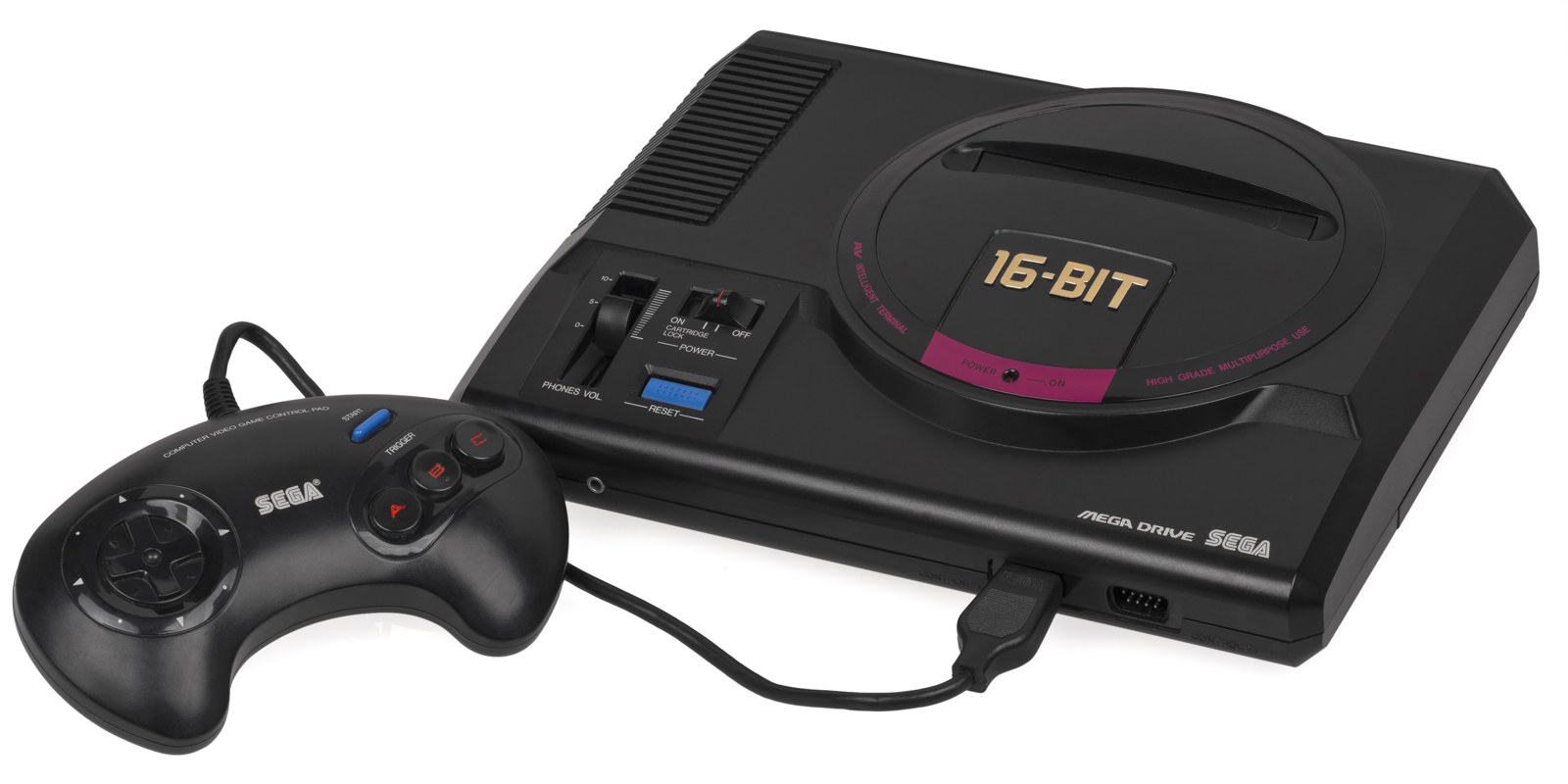
The Japanese Mega Drive. The Revenge of Shinobi, released in the console’s first year, was one of the games that told early buyers they had chosen well. Photo: Evan-Amos, Wikimedia Commons (public domain).
The Revenge of Shinobi launched in 1989, in the Mega Drive’s infancy, and it is not much of an exaggeration to call it the machine’s first essential action game. Everything about it announced a generational step up: large, expressive sprites; stages that swung from bamboo forests to military bases to a moving train; screen-filling bosses; and four ninpo magic attacks that let players clear a screen, leap higher, or walk through fire. Yuzo Koshiro’s soundtrack — propulsive, melodic, unmistakably his — became one of the most celebrated scores on the system and is still the series’ musical signature.
It also understood something subtle about its hero. Joe Musashi in Revenge is a one-man army, but the game never lets you play him as a brawler. Shuriken are finite. Enemies punish button-mashing. The famous early boss encounters — including, in early production runs, a procession of cheerfully unlicensed lookalikes that later revisions had to paint over — were puzzles of timing as much as tests of reflexes. Shinobi III: Return of the Ninja Master refined the formula further in 1993: wall jumps, a dive kick, a dash, horseback and surfboard set pieces, and a flow so smooth that many fans still name it the series’ peak. Fiquet’s team naming those two games as their twin north stars tells you they read the same history the magazine printed.
Reinvention, Then the Long Silence
The series did not stand still after the Mega Drive. Shinobi Legions took the Saturn into digitised-actor territory in 1995, to a mixed welcome. Then, in 2002, the PlayStation 2 reboot did something braver: it replaced Joe with a new lead, Hotsuma, rebuilt the action in full 3D, wrapped him in a flowing red scarf that remains a superb piece of character animation, and asked players to chain kills against a ticking clock set by a cursed, soul-drinking sword. It was difficult, stylish and divisive — a reboot that respected the name’s demand for mastery while changing almost everything else. Its follow-up, Nightshade, handed the scarf to Hibana in 2003.
After that, the trail goes cold. A side-scrolling Shinobi for the Nintendo 3DS in 2011 — starring Jiro Musashi, Joe’s father — was a respectable handheld entry, but it proved to be a full stop rather than a comma. Through the whole of the 2010s, while Sega’s other mascots were revived, remastered and reissued, Joe Musashi stayed in the shadows. Fourteen years is a long time in games. Long enough, as Retro Gamer’s cover demonstrated, for absence itself to become the story.
What Both Halves of That Week Understood About Joe
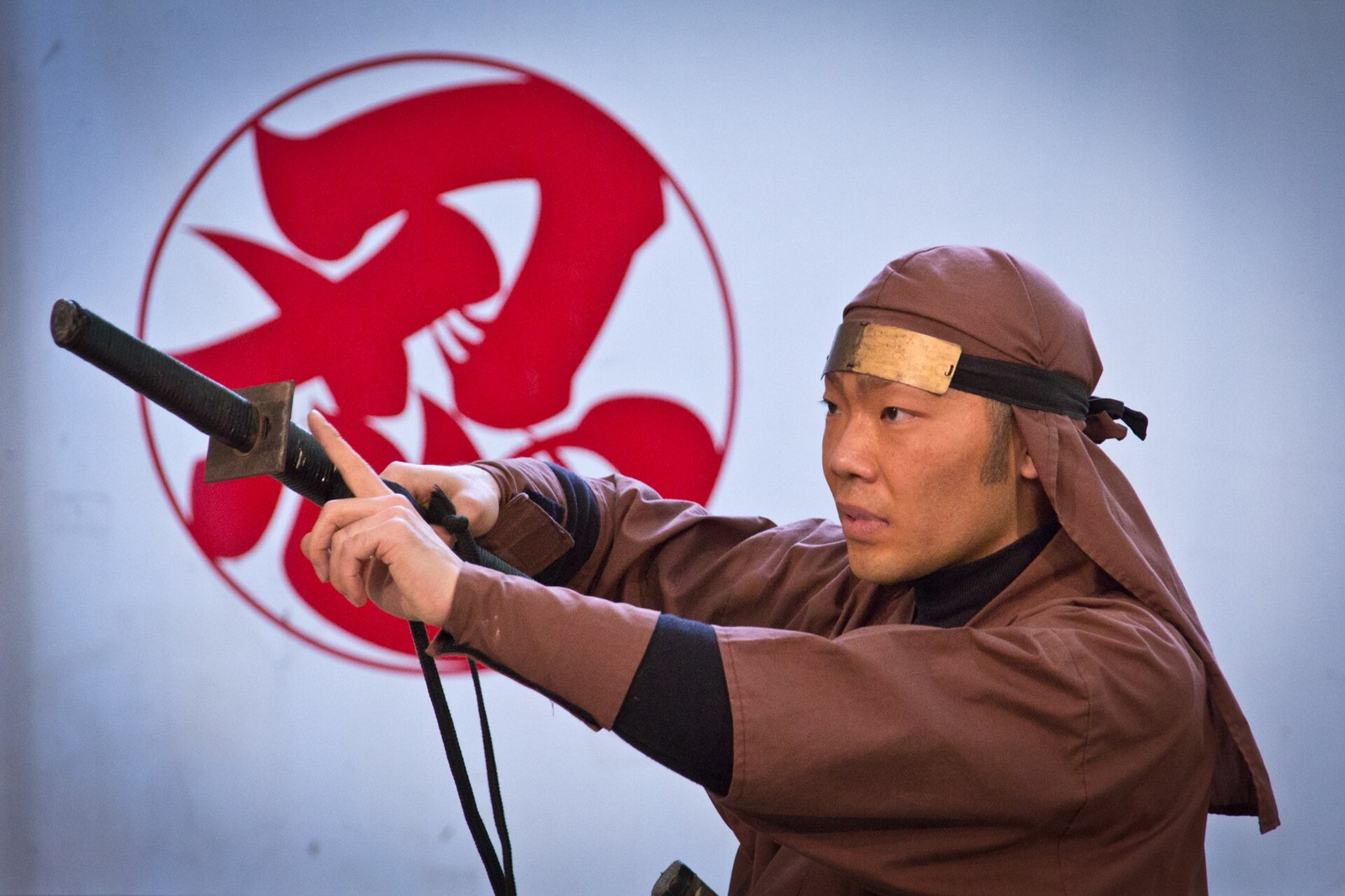
A demonstration at the Iga Ninja Museum in Ueno, Japan — the real tradition, equal parts theatre and technique, that Shinobi has been remixing since 1987. Photo: John Gillespie, Wikimedia Commons (CC BY-SA 2.0).
Read the magazine feature and play the new game back to back, and a shared thesis emerges. Shinobi was never really about a generic ninja. It is about economy of motion: a hero defined by how little he wastes. The arcade original built that into one-hit deaths. Revenge built it into finite shuriken and deliberate pacing. Even the PS2 game, for all its spectacle, built it into a kill-chain timer that punished hesitation. Art of Vengeance, developed by Lizardcube with Sega, translates the same idea into a modern dialect — long, flowing combo strings, executions that reward keeping a chain alive, hand-drawn animation in which every strike lands like a brushstroke. The tools changed; the discipline is the same discipline.
The magazine’s contribution was to make that continuity visible, lining the games up side by side and letting the people who made them explain the thread. The game’s contribution was to prove the thread still holds under modern expectations — exploration, unlockable techniques, stages built to be revisited — without sanding off the series’ identity. Neither treated Joe Musashi as a museum piece. One framed him as history; the other treated him as a going concern. August 2025 needed both.
Art of Vengeance, Judged With Hindsight
With the benefit of a full review cycle, the verdict is not in doubt. Art of Vengeance settled at Metacritic scores between 85 and 87 depending on platform — 87 on PlayStation 5 and Xbox Series X/S, 86 on PC, 85 on Switch — a “generally favourable” consensus by the aggregator’s own wording. OpenCritic put its top-critic average at 87 with 94 per cent of critics recommending the game. The individual notices matched the aggregates: GameSpot scored it 9 out of 10, Game Informer 9.25, Push Square 9, while IGN and Nintendo Life awarded 8s. GamesRadar+ was the notable dissenter at 3 out of 5. The common threads in the praise were the fluidity of the combat, the confidence of the hand-drawn art direction, and the sense that Lizardcube — the studio behind Wonder Boy: The Dragon’s Trap and co-developer of Streets of Rage 4 — had done for Shinobi what it had already done for two other treasured Sega names. The game went on to earn a Best Action Game nomination at The Game Awards 2025, which is not bad company for a series that had been silent since the 3DS era.
It also matters where the game sits in Sega’s wider plans. Art of Vengeance was the first release to emerge from the revival programme Sega teased at The Game Awards in December 2023, the one that promised new Jet Set Radio and Crazy Taxi games alongside returns for Golden Axe and Streets of Rage. Being first out of the gate carried risk: a weak Shinobi would have cast a shadow over everything behind it. Instead, the programme opened with one of the best-reviewed action games of its year.
So the history Retro Gamer printed in issue 276 turned out not to be an obituary or a nostalgia lap. It was a programme note for a comeback that, one day later, actually arrived. Joe Musashi spent fourteen years waiting in the shadows. On the evidence of that week — ten pages of history on the shelf, and a sequel worthy of them on the store — the wait made the return sharper, not smaller.