
The Sega 32X is the most mocked piece of hardware Sega ever sold – a plastic mushroom that plugged into a Genesis, promised 32-bit gaming for $159, and was commercially dead within fourteen months, cleared out at $19.99 while its maker pretended it had never happened. Around 665,000 were sold, most of them in the first hopeful months before the calendar turned. But the jokes skip the interesting part: the 32X was not a bad machine. Its best games are excellent, its engineering was clever, and its failure was a strategy failure – two Segas, on two continents, building two different 32-bit futures at once and making each destroy the other. The Saturn’s fall starts here. This is the complete story of the mushroom: how it grew, why two halves of the same company planted it, what it cost everyone who trusted it, and why the little library it left behind is better than its reputation in every particular that can be measured.
Two Segas: The Civil War in a Cartridge Slot
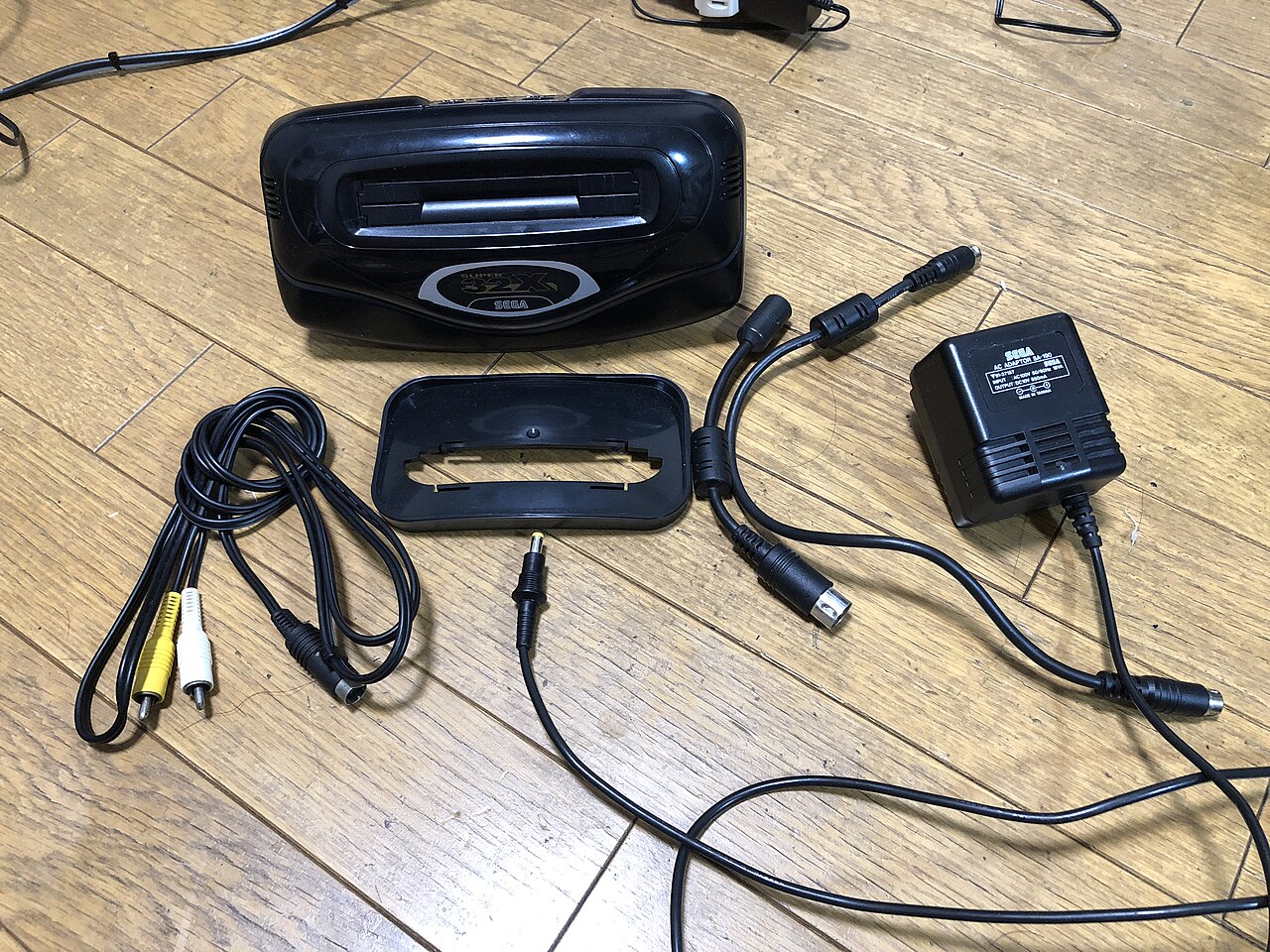
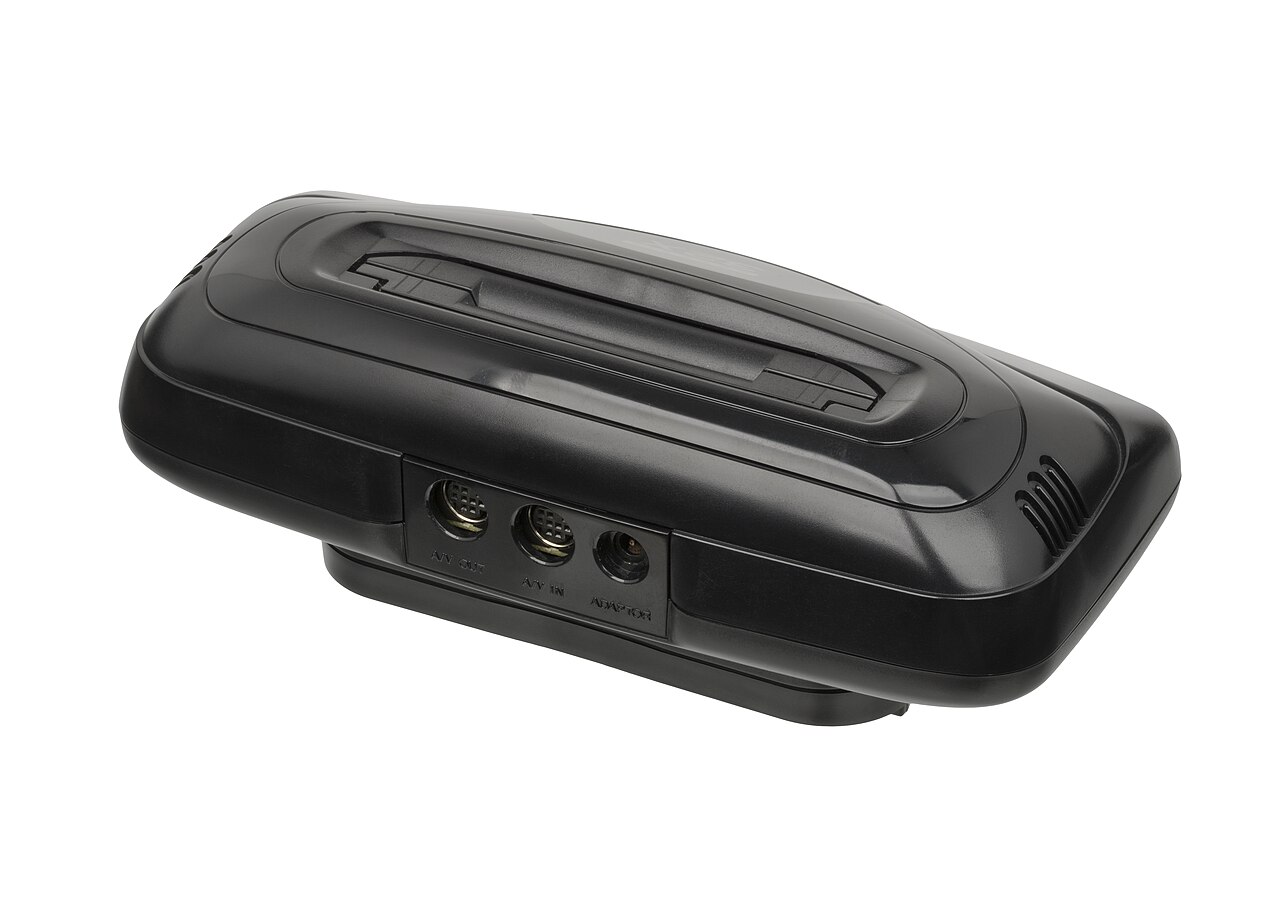
The 32X was born of a corporate disagreement that its shape made visible. By 1994 Sega’s empire had two capitals with two realities. In Japan, the Mega Drive had lost to Nintendo years before, and Sega of Japan was building the Saturn – a clean, expensive, 32-bit future. In America, the Genesis was a phenomenon still printing money, and Sega of America, Tom Kalinske’s empire, looked at the Saturn’s price and complexity and feared strangling its golden goose for a machine the American market hadn’t asked for. The 32X – Project Mars in development – was America’s answer: a Genesis add-on carrying twin Hitachi SH-2 processors (the same CPU family the Saturn used, two of them at 23MHz), a quarter-megabyte of RAM, and its own video hardware that generated a framebuffer and composited it over the Genesis’s output. For $159.99 the installed base got something with a legitimate claim on “32-bit” – polygon performance in the Virtua Racing class, colour depth the stock Genesis couldn’t dream of – and Sega of Japan, blessing the project while prioritising its own, set the two futures racing. The industrial design told on itself: the 32X sat in the cartridge slot under spring tension, steadied by little metal clips that engaged the slot doors – the most frequently lost accessory of the decade – and passed the Genesis’s video through a patch cable at the back. With a Sega CD underneath it formed the famous tower: three tiers, three power bricks, one television input, the era’s defining piece of hardware gothic. Sega even designed the apology in advance – the Neptune, an all-in-one Genesis-plus-32X console, shown to magazines and cancelled before birth. A company confident in its add-on does not design its replacement before launch.
Launch Into the Saturn’s Shadow
The 32X launched in America in November 1994, and its first weeks were the trap’s bait: demand was real, supply was short, and Sega of America could plausibly claim a hit in progress – half a million units moved by the turn of the year. But every participant in the market could read a calendar. The Saturn was coming in September 1995 (it would infamously arrive in May, sprung early at E3), the PlayStation behind it, and the games press said the quiet part in print: wait. Retailers, asked to stock Genesis, Sega CD, 32X, Game Gear, Pico and Saturn simultaneously, stocked less of each and trusted none; third-party developers, asked to bet on an add-on with an announced execution date, mostly declined. In Japan the Super 32X launched that December into a market where the Saturn was an immediate triumph, and died there on arrival – an American answer exported to a country that had never asked the question. Through 1995 the American cliff arrived on schedule: the Saturn’s launch consumed the oxygen, 32X software slowed to a trickle, and by early 1996 Sega discontinued the platform outright, the remaining stock famously flushed through clearance channels at $19.99. Fourteen months, launch to landfill pricing. The hardware had not changed in that time. The strategy had simply finished colliding with itself. Ownership, for the faithful who stayed, had its own daily comedy: the full stack – Genesis, Sega CD, 32X, and Sonic & Knuckles locked on top in the tower’s final form – drew power from three separate bricks, breathed through a thicket of patch cables, and graced a thousand magazine photographs as the visual shorthand for an industry that had forgotten how to say “enough.” Every element of that thicket was, individually, defensible engineering. Together they were a portrait of a company that could no longer subtract.
The Technology: Two SH-2s and a Compositing Trick
Technically, the 32X is the strangest architecture in this hub, because it is not one machine but a treaty between two. The Genesis underneath kept its 68000, its Z80 and its Yamaha FM sound, and went on drawing backgrounds and sprites on its own video planes exactly as before. The mushroom above contributed the twin SH-2s – typically divided master-and-slave, one running game logic while the other chewed geometry, an asymmetric multiprocessing arrangement that would not be out of place in a machine twenty years younger – plus PWM audio channels that gave 32X games their distinctive sample-rich sound, and a framebuffer of its own that was composited, by priority, over (or under) the Genesis’s picture on its way to the television. The great 32X games are the ones that exploited the treaty in full: Genesis planes for the parallax world, SH-2 polygons for the actors, three processors’ worth of sound. The failures are the ones that treated the add-on as a porting shortcut and met the framebuffer’s fill-rate ceiling in a hurry. All of it had to be learned in months, by small teams, on a platform with an announced death date – which is why the library’s variance is not a mystery but a measurement. Given three years, the 32X’s programming culture would have converged on AM2’s fluency. It was given fourteen months, and the variance is what fourteen months looks like – a library split between what the hardware could do in the hands of its inventors and what it could do in the hands of everyone else, with no time for the second group to become the first.
The Add-On Decade: The Road the Industry Didn’t Take
The 32X was the last, loudest expression of the early-nineties add-on doctrine – the belief that a platform could be extended indefinitely by stacking – and its death, alongside the Sega CD’s twilight, closed the era. The counterexample had been running in parallel the whole time: Nintendo answered the same technological pressure by putting the enhancement inside the cartridge, Super FX chips and their kin, keeping the SNES a single platform a shopper could understand in one sentence. The industry’s ledger on the two philosophies is unambiguous, and the symmetry at the decade’s end is almost literary – Nintendo, having won with the cartridge-chip doctrine, promptly built its own mushroom: the 64DD, a Japan-only add-on launched years late to a platform already being replaced, dead within two years, remembered by its maker’s fans with exactly the affectionate embarrassment the 32X earns from Sega’s. The lesson the whole sorry decade teaches is not that add-ons fail – the Sega CD and the 32X both contain excellent work – but that an add-on is a promise, and the market prices promises by the promiser’s record. Sega in 1994 had already taught its customers what its promises were worth. The mushroom simply collected on the lesson, in public, with two microprocessors and a juggling act of cables.
Forty Games: The Small, Strange Library
What the 32X left behind – about forty titles, counting the handful of Sega CD combo discs – is the most quality-variance library in this hub, masterpieces and misfires in the same small box. At the summit sits Virtua Racing Deluxe, AM2’s racer expanded beyond the Genesis SVP version with more cars and tracks, for many players the definitive home Virtua Racing of its generation and a standing rebuke to anyone who calls the hardware weak. Virtua Fighter followed it up the hill: a conversion of the Model 1 original so faithful in geometry and feel that it remains the port students of the era cite first. Star Wars Arcade brought the Model 1 shooter home as the system’s launch-window showcase. And Knuckles’ Chaotix, the Sonic-adjacent platformer built on a two-character ring-tether – a rubber-band physics gimmick that divided reviewers in 1995 – has appreciated steadily ever since into the library’s cult crown. The depths are equally famous: a Doom conversion rushed to launch with levels missing and its soundtrack argued about to this day; Cosmic Carnage, a fighter so misconceived it serves as the catalogue’s cautionary exhibit; and the five CD-32X discs (Corpse Killer, Fahrenheit, Slam City, Night Trap, Supreme Warrior) – FMV games requiring both add-ons, the tower’s most committed and least defensible products. Between the poles: Tempo’s stylish obscurity, Metal Head’s mecha ambition, Shadow Squadron’s space combat, Zaxxon’s Motherbase 2000, a tail of sports and racing conversions, and a lost library of announced-and-cancelled titles (X-Men: Mind Games the most mourned, its near-complete build recovered by the community years later) that suggests the catalogue the strategy never gave time to exist. The connoisseur’s footnote is the port quality hiding in the catalogue’s middle: the 32X’s Mortal Kombat II is routinely ranked the finest home version of its round; its Blackthorne is the definitive contemporary edition of Blizzard’s platformer; and its After Burner and Space Harrier are the first completely arcade-true home conversions of Yu Suzuki’s scaler classics, a quarter-century of compromised ports ended by a mushroom. A platform whose B-list contains the best versions of four classics is not a platform without merit. It is a platform without time – which, in the end, is the same obituary the Saturn would receive, one floor up.
The Reception: Fourteen Months in Headlines
The 32X’s press file is a time-lapse of a platform dying in public. The launch coverage, in late 1994, was genuinely receptive: Star Wars Arcade and Virtua Racing Deluxe reviewed as the real thing, the hardware assessed as a credible bridge, the $159 price praised against the Saturn’s expected cost. The turn came with the Saturn’s shadow in the spring of 1995, and it came from the same pages – buyer’s guides began carrying the asterisk (a fine machine, if its maker supports it), developers’ anonymous grumbling about mixed messages from Sega’s two headquarters became reportable fact, and by the platform’s first birthday the magazines were writing retrospectives. The principals have been candid in the decades since: Kalinske’s retrospective account, in essence, is of an American initiative proceeding in good faith while Japan’s Saturn timetable overtook it – two subsidiaries passing in the night, each with a defensible plan, summing to an indefensible one. That remains the fairest verdict available, and it is why the 32X’s story is taught. No villain was required. Structure did it: a federation of Segas, a technology transition, and a mushroom asked to hold the seam. When the seam split, the mushroom took the blame, because it was the part you could see.
The Bill: What the 32X Actually Cost Sega
The 665,000 units were the smallest part of the damage. The 32X’s true cost was trust, spent in three currencies Sega would need within the decade. Retailers learned that Sega platforms could be orphaned in a year, and stocked the Saturn – and later the Dreamcast – with a caution that became self-fulfilling. Developers learned the same lesson harder: studios that had built 32X games watched their platform discontinued mid-sentence, and the phrase “Sega abandons hardware” entered the industry’s permanent vocabulary, quoted back at the Saturn’s launch and the Dreamcast’s. And consumers learned it most durably of all: a generation that had paid $159.99 for fourteen months of support brought that memory to the Saturn’s $399 question and, in large numbers, answered it with a PlayStation. The mushroom is therefore misfiled when it is shelved as a joke peripheral. It is the first exhibit in the case of Sega’s exit from hardware – the moment the company’s two halves demonstrated, in public, that they could not agree on a future, and taught every partner in the business to price that disagreement into their support. The Saturn did not fall because the 32X existed. It fell, in part, because of what the 32X proved. The pattern repeated with an almost diagnostic fidelity: the Saturn’s own surprise early launch, sprung at E3 1995, caught the same retailers unstocked and furious a second time, and the Dreamcast’s team – to their credit, and proof the lesson was learnable – rebuilt the channel’s trust brick by brick before daring their launch. Platform transitions are now taught with the 32X as a standard case study, which is perhaps the mushroom’s strangest fate: the add-on nobody was supposed to remember became the example everybody is required to study.
Afterlife: The Collector’s Complete Set and the Tower as Folk Art
Time, which is kinder to small libraries than to large ones, has rehabilitated the 32X into one of the hobby’s friendliest collecting targets: forty games is a finishable set, the antithesis of the Neo Geo AES’s jewellery economics, and a complete 32X shelf – mushroom, clips, tower and all – is achievable for the price of one serious AES cartridge. The tower itself has become folk art, the three-tier stack reproduced in tribute builds and fan-made Neptunes assembled from the unreleased console’s documentation by enthusiasts who finish Sega’s sentences as a hobby. The market has its own sense of humour about the platform: a complete-in-box Knuckles’ Chaotix now changes hands for more than the console it plays on, while most of the library remains cheerfully affordable loose – and the decade’s most-lost accessory, those little cartridge-slot clips, is today a 3D-printed commodity, the maker scene quietly manufacturing the part Sega’s packaging department made losable. Even the mushroom’s inconveniences have been crowdsourced away. The engineering reputation has risen with the FPGA era (the 32X is reproduced core-perfectly in MiSTer, its compositing trick intact), and the history has settled where the evidence points: a capable piece of hardware, several genuinely excellent games, and a parent company that launched it as one half of an argument with itself. Sega’s mushroom was never the problem. The problem was a company growing two futures in the same pot, in the dark, and charging its most loyal customers $159.99 to watch them strangle each other. The 32X deserved a better strategy. In this hub, at last, it has the better obituary – written, as it happens, on the site of the company it tried to save.