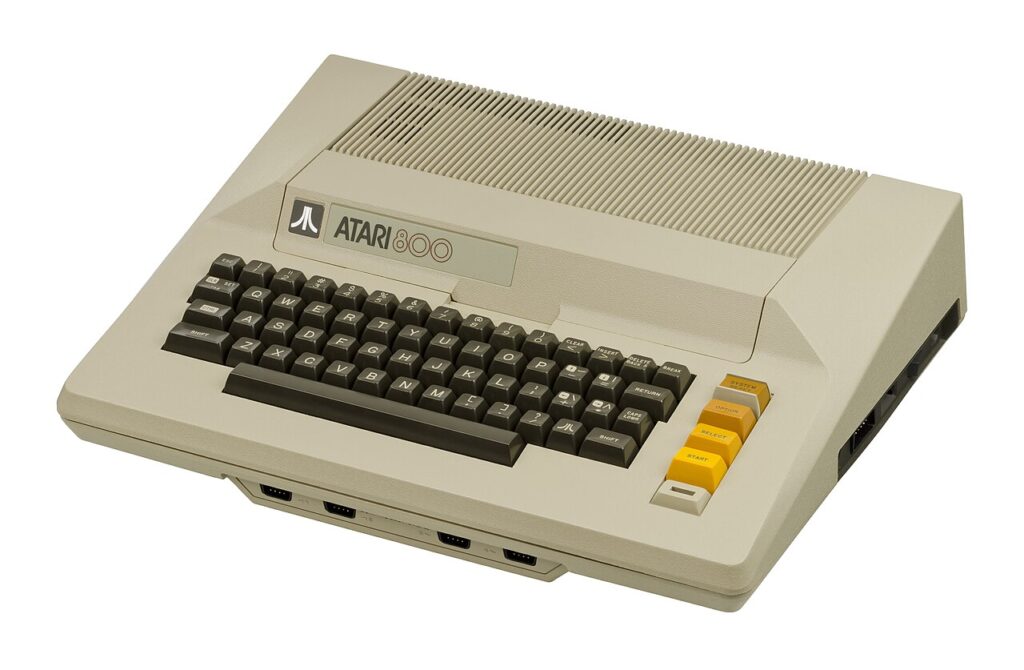
In November 1979, while the Apple II beeped and the PET blinked, Atari shipped two computers with custom graphics and sound processors, hardware sprites, four controller ports and a first-person space epic that sold the machines by itself. The Atari 400 and 800 – Candy and Colleen to their designers – were the first home computers built game-first: consoles that computed, rather than computers that apologised for playing. Their architecture ran for thirteen years through the XL and XE lines, their chief designer’s next machine was the Amiga, and their software catalogue is one of the founding documents of the medium. This is the complete story of the Atari 8-bits: the moonshot engineering, the founding games, the price war that broke their stride, and the thirteen-year family that refused, in the end, to stop.
Candy and Colleen: The 2600 Team Builds a Computer
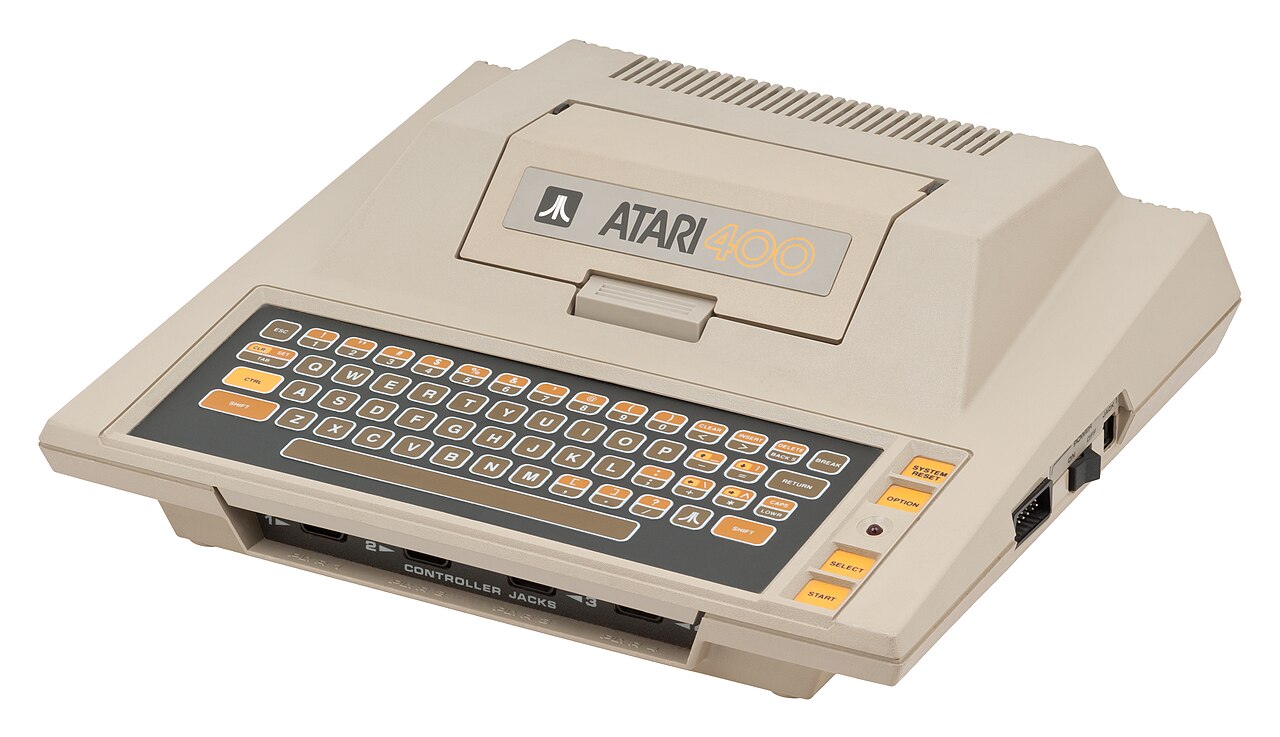
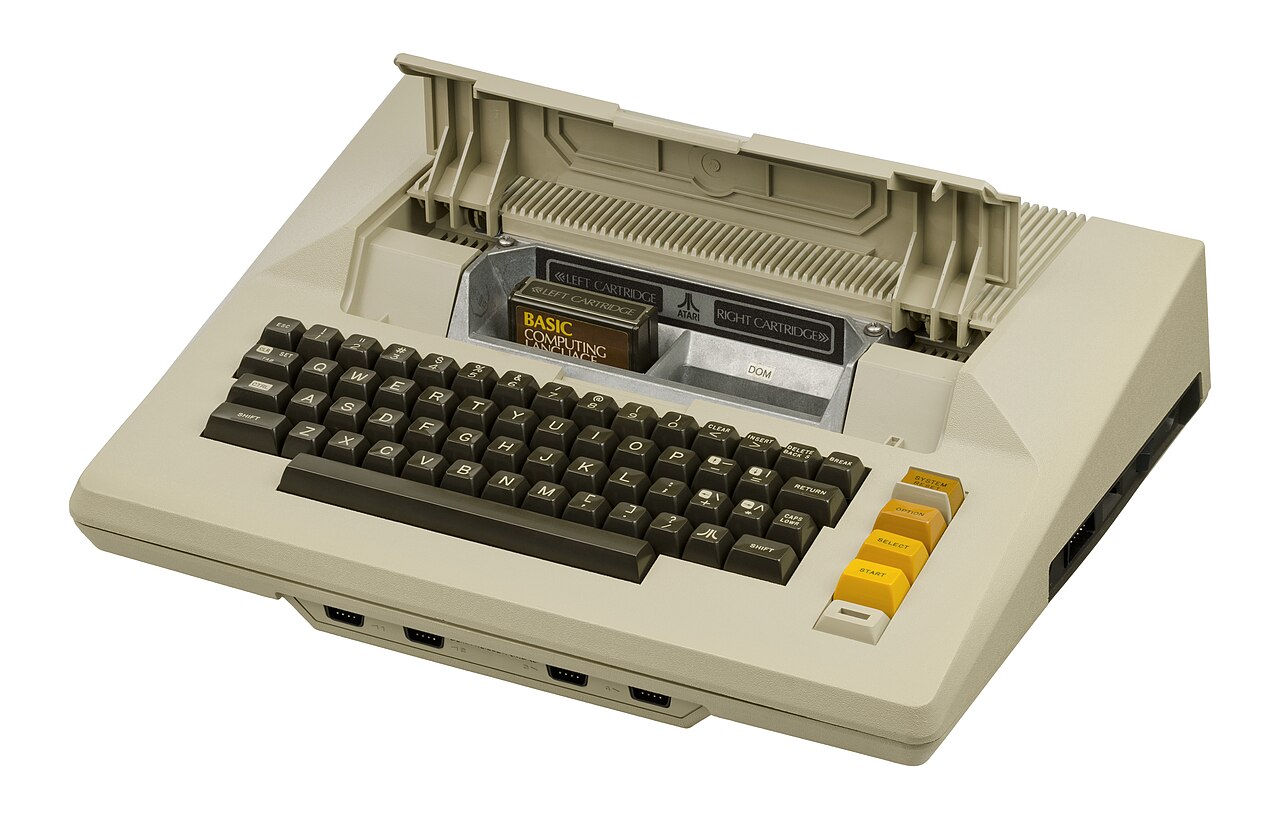
The Atari 8-bits began as the 2600 team’s second act. Once the VCS was designed, Atari’s engineers – Jay Miner prominent among them; remember the name, because his third act is the Amiga – set out to build the home machines the late seventies’ technology finally allowed, designed from a games player’s requirements outward. Two models shared one architecture: the 400 (codenamed Candy), the playful one, membrane keyboard and modest memory, aimed at games and education; and the 800 (Colleen), the serious sibling, with a proper keyboard, two cartridge slots, four controller ports, and internal expansion bays that took RAM and ROM boards up to 48K. They launched in November 1979 at $549.99 and a stiff $999.99, into a market ruled by the PET, Apple II and TRS-80 – machines that cost as much or more and could do almost nothing the Atari did on screen or through a speaker. The 800’s construction became legend in its own right: to satisfy the era’s radio-interference rules, Atari wrapped its electronics in a cast-aluminium internal chassis, so the flagship home computer of 1979 is built, quite literally, like a piece of military hardware, its module bays clicking open under the top cover. The 400 wore its intentions openly – a sealed, spill-proof membrane, a child’s first computer designed by people who understood children spill things. Between them the pair stated the thesis the whole line would argue for thirteen years: a computer should be judged, first, by how it plays.
ANTIC, GTIA and POKEY: The Silicon That Came from the Future
The machines’ advantage was a chipset no rival could answer for years. ANTIC was a dedicated display processor with an instruction set of its own – the display list, a program the programmer wrote for the screen itself, mixing graphics modes line by line, scrolling them independently, and firing interrupts mid-frame so the palette could change on a chosen scanline. The rainbow-banded, multi-mode screens that result are the Atari 8-bit look, and the concept – a coprocessor executing a display program while the CPU thinks – is the founding idea of the modern GPU’s command stream, in a 1979 home computer. GTIA (the very first units carried its predecessor, CTIA) supplied the colour and the sprites, named with an engineer’s poetry: players and missiles, four of each, whose widths, priorities and collisions the hardware adjudicated. POKEY ran the four-channel sound – the richest standard audio of the 1979 class by a distance – and read the keyboards and paddle controllers besides. Around the chips sat one more quiet marvel: the SIO serial bus, a single daisy-chained cable along which disk drives, printers, cassettes and modems hung as intelligent peripherals, addressed and arbitrated by the machine – plug-and-play peripheral architecture a decade and a half before USB made the same pitch. Set an 800 beside its 1979 contemporaries and the comparison is not close, and everyone in the industry knew it then and knows it still. The Ataris were games consoles’ silicon wearing computers’ clothes, built by the coin-op generation that had invented custom-chip arcade hardware, and they played like it from the first day.
Star Raiders and the Founding Catalogue
Every great platform has the game that explains it, and the Atari 8-bits’ is among the most important ever made. Doug Neubauer’s Star Raiders (1979-80) put the player in a first-person starfighter – a moving 3D starfield, a galactic chart to strategise across, shields, damage, hyperwarp, the Zylon war entire – and delivered, on a home computer in the year of the PET, an experience the arcades could not better. It sold hardware the way killer apps are defined to: shops demoed computers with it, customers bought the demo, and a generation of designers took notes they are, in some cases, still working from today. Around it assembled a founding catalogue of the medium itself. Atari’s own coin-op conversions came home with arcade fidelity as their selling point (an excellent Pac-Man, a Donkey Kong that famously kept all four screens when richer machines’ versions cut corners). Third parties wrote history on the platform: Bill Hogue’s Miner 2049er, the platform-game landmark; Chris Crawford’s Eastern Front (1941), the thinking wargamer’s founding text; M.U.L.E., Ozark Softscape’s masterpiece of economic strategy, designed around the machines’ four joystick ports for four human traders – a game whose definitive version exists only here, because only here could it be played as designed. Jumpman began on the Atari. Lucasfilm Games began here too: Ballblazer and Rescue on Fractalus!, the two most technically audacious home games of 1984, were developed for the Atari 8-bits (and their 5200 sibling). Add Alternate Reality’s native ambition, the Infocom and Ultima lines in strong editions, and a type-in culture of real depth, and the catalogue reads as what it is: the first software library of the home-computing age that a modern player can approach without translation. The software houses deserve their line in the record: Synapse Software, the platform’s prestige label, whose Shamus, Necromancer and The Pharaoh’s Curse set an early standard for original home-computer game design; Datasoft, whose Bruce Lee began here and remains the machine’s most fondly remembered licensed title; and the dozens of smaller houses for whom “Atari first, ports later” was simply how a game was born in the years before the C64’s gravity bent every orbit toward itself.
The Culture: Antic, De Re Atari and the Best Documented Machine of Its Age
The Atari 8-bits grew the most literate user culture of the early home era, and Atari itself set the tone: De Re Atari, the company’s own programmer’s guide, explained the custom chips in depth to anyone who bought the book – an openness no rival matched – and Ian Chadwick’s Mapping the Atari, a complete annotated memory map, became the hacker’s bible passed between user groups like scripture. The magazines named themselves from the silicon: Antic, founded in 1982 and named for the display chip, and ANALOG Computing carried type-in listings, machine-language tutorials and hardware projects of a seriousness that assumed the reader was a colleague. Atari BASIC, supplied on cartridge, had its famous idiosyncrasies (strings handled as character arrays, a generation’s habits formed accordingly), but the culture routed around them into assembly language earlier than most, because the documentation told them exactly where the metal was. Schools bought in – Atari’s education push put 400s and 800s into American classrooms beside the Apple II, courseware publishers built catalogues for them, and the touch-typing generation met computing, in a measurable number of districts, on a membrane keyboard. The founding generation of American games programmers is disproportionately Atari-8-bit alumni, and the reason is sitting in this paragraph: no machine of the age told its owners so much, so clearly, about how it worked.
The Ecosystem: 810s, SIO Chains and the BBS Years
Ownership, Atari-style, was an expanding chain – literally, since SIO peripherals daisy-chained device to device off one port, each with its own little processor and its own dialect of beeps. The anchor was the 810 disk drive, 90K of single-density storage whose loading chirps and grinds owners can still identify blindfolded; the XL era’s 1050 doubled the manners and the capacity; cassettes (the 410, then the 1010) served the rest of us at the era’s usual contemplative pace. Around the chain accreted the full eighties menagerie: printers, the 850 interface that opened the serial world, modems that put the machines onto the first online services and the BBS scene – a scene with the pleasing recursion that many boards were themselves run on Atari 8-bits, FoReM and its rivals serving callers from a floppy in someone’s spare room. The graphics peripherals (a light pen, a touch tablet with AtariArtist) pitched the machines at the creative market the Amiga would later harvest, and the arcade-grade Trak-Ball kept the games honest. It was, by the standards of 1981, an ecosystem of genuine sophistication, and it taught its owners the platform-holder’s hardest lesson in its kindest form: that a computer is not the box. It is everything that plugs into the box, and everyone who writes for it.
The Price War, from the Losing Side
The middle of the Atari 8-bit story is an economics lesson written in aluminium. At the line’s birth Atari was the largest games company on earth, and the 800’s cost-no-object construction was a statement of that confidence. Then the industry ate itself: Texas Instruments cut its 99/4A toward $99 and lost a fortune doing it, Commodore – owning its chip factories – priced the C64 as a weapon, and the premium home computer became unsellable at premium money. The 800’s virtues were precisely its costs: you cannot build a computer inside a die-cast chassis, on plug-in memory boards, and meet a plastic rival at the checkout. The XL redesign was the necessary surrender – integrated, cost-engineered, the modularity traded for manufacturability – and the 800XL that resulted was, by common consent, the right machine at the right specification, arriving as the American market’s mind was made up. The final irony is executive: in July 1984 the consumer division was bought by Jack Tramiel, weeks after his expulsion from Commodore – the price war’s winning general inheriting the losing army. To his credit, Tramiel kept the 8-bits as his budget line for the rest of the decade, which is how the architecture survived to have its European and Polish second lives at all. The Atari 8-bits did not lose because they were worse. They lost because they were better in ways that cost money, in the years when the market decided money was the only way that counted.
The Long Family: XL, XE and the Geography of Survival
The architecture’s commercial story is one of a strong start, a bruising middle, and a very long life. The 400/800’s early years made Atari the premium name in home computing, but the price war of 1983 – Commodore’s C64, sold with a chip-maker’s margins – hit the line exactly where the 800’s build quality had priced it, and Atari’s responses stumbled: the pretty 1200XL (1983) with its compatibility grumbles, then the correction, the 800XL (late 1983), the line’s best-seller and the machine most owners mean by “Atari 8-bit” – right specification, right price, too late to retake an America Commodore had flooded. Jack Tramiel’s Atari, from 1984, kept the line lean and long: the ST-styled XE refresh (65XE, 130XE), and in 1987 the family’s charming full circle – the XE Game System, the computer reborn as a console with a clip-on keyboard, the 1979 thesis (“a console that computes”) restated as a product, bundled with a light gun and the line’s whole history as its launch library. Geography redrew the map as the years passed: the line’s second homeland became Europe, and its third, most fervent one, Poland, where Atari 8-bits – cheap, capable, cassette-fed – became a generation’s machine and seeded a demoscene that runs to this day. Production of the family ended only in January 1992: thirteen years, one architecture, from the Carter administration to the 16-bit age’s maturity – among the longest runs of any home-computer design ever sold.
The Second Catalogue: Budget Labels, Poland and the Never-Ending Eighties
The Atari 8-bit’s software story has a second volume that the American narrative misses, because it was written in Europe after America moved on. In Britain the machines became budget-label territory of the richest kind – Zeppelin Games, founded in Newcastle substantially on the Atari, and its peers feeding the XL/XE installed base with cheap, inventive cassettes into the early nineties. In Poland the story went further and stranger: publishers like LK Avalon, founded in 1989 as the country opened, built a commercial Atari catalogue in Polish for Polish players, while the demoscene that formed around the machines grew into one of the strongest in Europe, its productions – demos that bully ANTIC into effects its designers never filed – still premiering at parties today. The homebrew thread never actually broke: new Atari 8-bit games are released on cartridge, commercially, in the 2020s, forty-five years after the architecture’s debut, which means the Atari 400/800 line shares with the Vectrex the rarest distinction in this hub – a software lineage with no gap in it. The 1979 machines had two afterlives, one in America as nostalgia and one in Europe as continuity. The second is the one the machines themselves would have chosen. It is certainly the one their owners chose, in numbers, for thirteen years and then some.
Afterlife: FujiNet, Minis and the Amiga’s Ancestor
The Atari 8-bit scene in 2026 is the model of what a mature retro community looks like. Its hardware renaissance is led by FujiNet, the network adapter that gives a 1979 computer Wi-Fi, virtual disks, printers and internet protocols – a device so beloved it has become the platform’s default modern accessory – alongside memory expansions (Ultimate 1MB), modern storage cartridges, and perfect-health recapping culture for machines now in their fifth decade. The mainstream afterlife arrived with Retro Games’ THE400 Mini (2024), a licensed miniature that put the line back in ordinary shops, and the 800XL remake chronicled elsewhere on this hub suggests the full-size revival era has reached the Ataris too. The historical accounting, meanwhile, keeps rising: Star Raiders sits in the medium’s influence canon where it belongs, and the architectural lineage is now stated plainly in the histories – Jay Miner took the coprocessor philosophy he proved in ANTIC’s display lists directly into the Amiga’s custom chips, which makes the Atari 400 and 800 the direct ancestors of the machine this site holds dearest. They were the first home computers designed by games people, for play first and everything else second – and when the industry’s founding generation tells its own origin stories, a striking number of them begin with a beige keyboard, a clicking cartridge door, and a starfield that moved like nothing else in the house. The industry spent the next forty years agreeing with them.