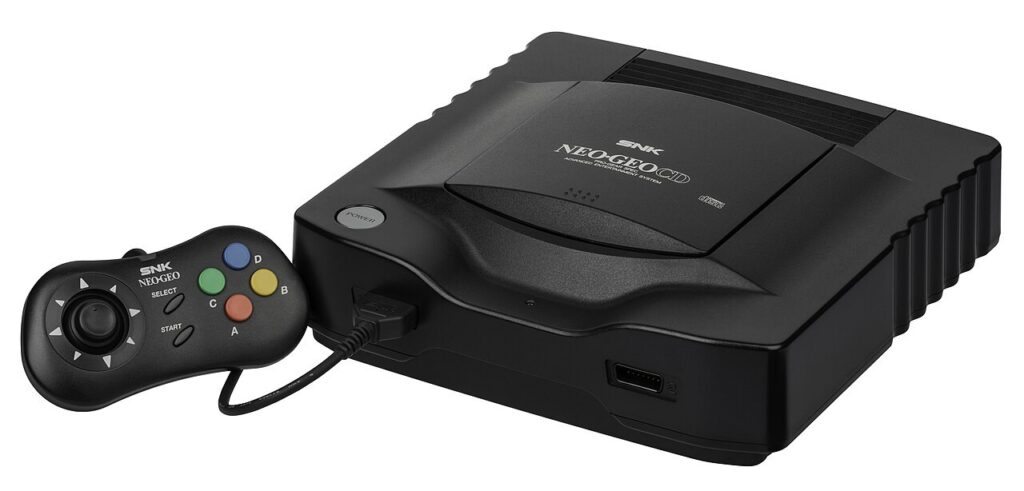
The Neo Geo CD was SNK’s grand bargain: the arcade-perfect library of the most expensive console ever sold, reissued on compact discs that cost a tenth as much to make – with the difference collected, instead, in time. A single-speed CD drive and seven megabytes of RAM stood between the player and King of Fighters, and the loading screens became so famous they acquired a mascot, a juggling monkey, who remains the platform’s patron saint. Around half a million players decided the trade was fair, and a great many of them are still happily paying it today. This is the complete story of the democratised Neo Geo, told in full, and of the monkey who made them wait.
The Problem: A Library Priced Like Jewellery
By 1994 the Neo Geo AES had a catalogue problem that was really an economics problem. SNK’s home cartridges were the arcade boards themselves, and as the games swelled – a hundred megabits, two hundred, more – the ROM chips inside each cartridge pushed retail prices toward and past $300 a game. The library was the finest in the medium (the parent hub tells that story), and its audience was capped by arithmetic: a games collection is not a home when every addition costs a week’s wages. Democratisation, it should be said, was in the platform’s blood from the start – the home Neo Geo had begun life in Japan as a rental system, hardware too expensive to sell, lent by video shops to customers who paid by the night. The AES-for-purchase had been the first attempt to widen that circle. The CD was the second, and it widened it by an order of magnitude. The compact disc offered SNK the same escape it had offered NEC and Sega: a disc costs single-digit dollars to press, so the identical game could sell for $49-79 and still out-earn the cartridge. The engineering, though, contained the whole tragedy in advance. A Neo Geo game was built to stream from instant-access ROM; a CD delivers its data through a straw. SNK’s answer was architecture as compromise: the Neo Geo CD is essentially the AES chipset fronted by 7MB of RAM – a holding tank into which the disc pours the game in slices, level by level, round by round. Everything the machine is, follows from that tank: the games are identical, the graphics untouched, the sound frequently improved beyond the cartridge’s reach – and every transition between slices costs a loading screen, delivered by a single-speed drive in a year when Sega and Sony were shipping double-speed. SNK chose the cheap drive to hold the machine’s price near $399 (the front-loading original landed in Japan in September 1994). It was the correct commercial decision and the platform’s eternal punchline, and both judgments have been true for thirty years.
Three Models and a Monkey
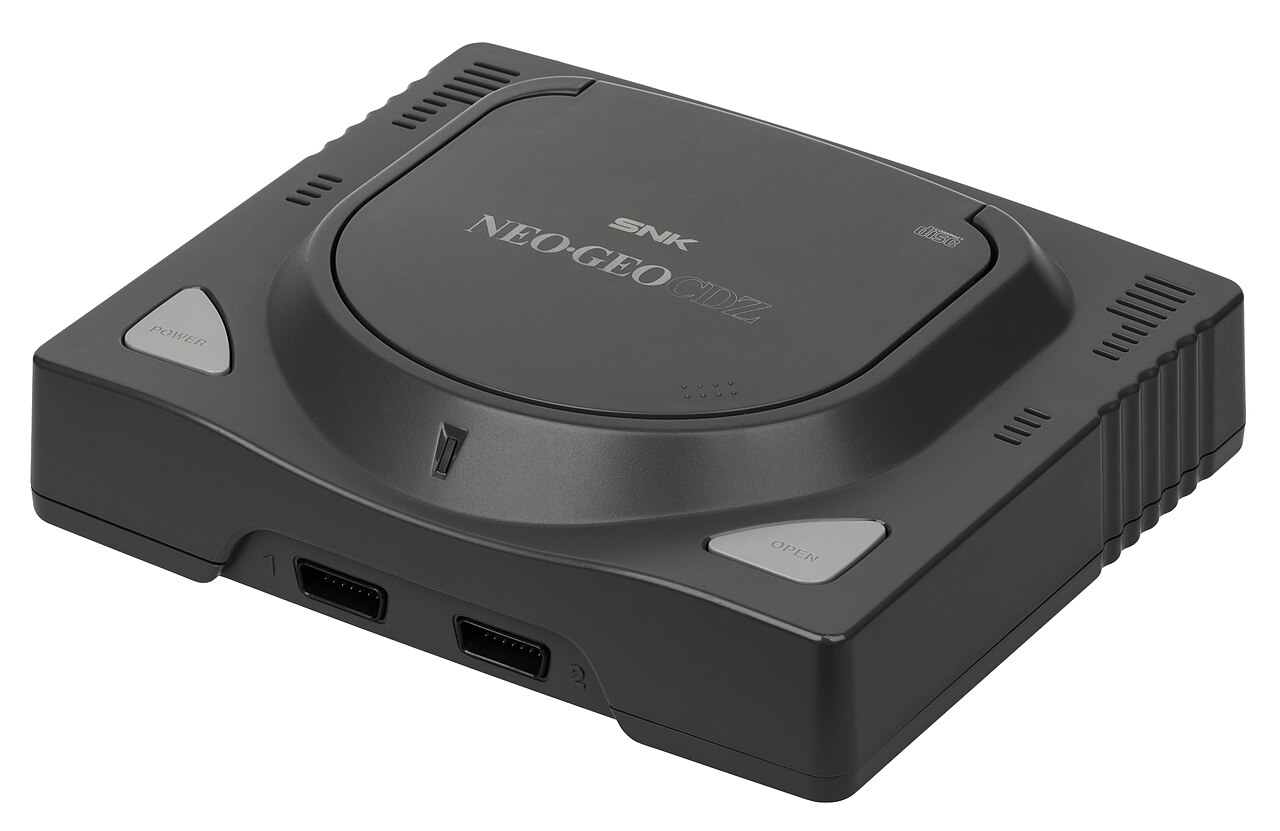
The platform came in three bodies. The original front-loader (Japan, September 1994) is a handsome, motorised-tray rarity that most Western collectors have never seen in the flesh. The top-loader that followed became the standard: cheaper, simpler, the machine that carried the system’s brief Western campaign of 1995-96 and the bulk of its roughly half-million sales. And in December 1995 Japan received the CDZ, a restyled revision whose enlarged cache and drive refinements trimmed the notorious waits by a margin owners describe as meaningful rather than miraculous – and whose reputation for running hot has made surviving CDZs the nursed aristocracy of the platform. The pack-in controller, meanwhile, was a quiet triumph: SNK’s first D-pad was no D-pad at all but a tiny, clicky, microswitched thumb-stick disc, an arcade lever miniaturised for the thumb, so precise that its design DNA flows directly into the beloved Neo Geo Pocket stick four years later. And over everything presides the monkey. SNK’s loading screen – a small monkey, juggling, while the drive ground through its slices (a King of Fighters round change could run the act for the better part of a minute, team battles demanding an encore between every fighter) – was conceived as apology and received as entertainment. Players timed him, imitated him, put him on merchandise in the decades after. The industry had never before branded its own worst flaw. The monkey is why the loading, remembered anywhere else as suffering, is remembered here as folklore – the only loading screen in the medium’s history with its own fan art, its own merchandise, and its own obituaries written in advance by players who expect, correctly, to miss him when the emulators finally make him optional everywhere.
The Hardware in the Hand: Hi-Fi Manners
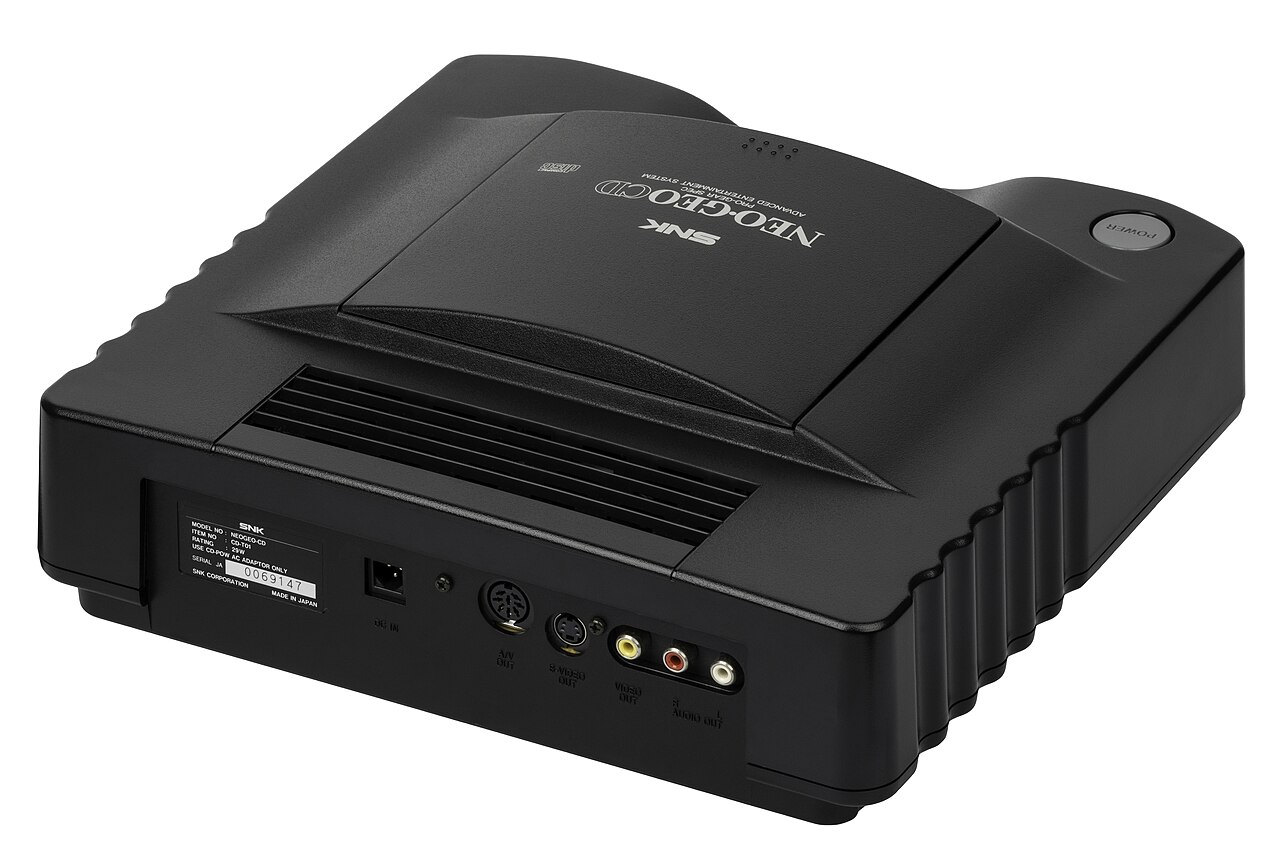
For a machine defined by a compromise, the Neo Geo CD is beautifully built, and the details explain the collector loyalty. It saves to the same memory card as the AES, so a player’s progress walked between the jewellery shop and the discount window without friction – a cross-compatibility courtesy the industry rarely manages across one product line, let alone two price tiers. The top-loader’s mechanism is Discman-simple, a spindle under a lid with almost nothing to wear out, which is why the drives survive while fancier contemporaries’ lasers retire; the front-loader adds a motorised tray and the heft of good hi-fi, because that is what SNK thought it was building. The omissions are equally instructive and equally of their moment: S-Video was the ceiling of the factory video output, and the RGB modification the machine never shipped with has become a standard rite of the modern scene, alongside drive servicing and the CDZ’s thermal courtesies. None of this is the specification of a toy. The Neo Geo CD was assembled like the component it resembled – which circles back to the arranged soundtracks and the discs on the hi-fi shelf. SNK built a stereo that played the best fighting games on earth, slowly. The slowness is the joke. The quality is the answer.
The Library: The Same Jewels, Repriced, Re-scored
Some 160 titles reached the Neo Geo CD, which is to say the AES canon of the mid-nineties at democratic prices: the King of Fighters run from ’94 toward ’99, the Samurai Shodown and Fatal Fury lines, Last Blade, the shooters (Viewpoint, Last Resort, Pulstar, the Aero Fighters games), Metal Slug and its sequel in their single-load-friendly structures, and the sports and curios that padded the AES’s eccentric shelf. Two systematic glories distinguish the CD editions. The first is audio: freed from cartridge ROM budgets, SNK’s sound team delivered arranged CD soundtracks – real-instrument re-recordings of the fighting games’ scores – that remain, for many of these titles, the definitive versions of the music, albums smuggled inside games. The second is the exclusives, the games the CD got that the jewellery store never did: Samurai Shodown RPG, a full-length role-playing epic in the Shodown universe and the platform’s crown curiosity (Japan-only for decades, its fan translation a modern labour of love); Crossed Swords II, a sequel that skipped the AES entirely; and Ironclad, a horizontal shooter that stayed CD-exclusive until a Virtual Console rescue a decade and a half later made it briefly famous as the Neo Geo game almost nobody had played. Judged as a way to own the Neo Geo canon in the nineties, there was no contest: the CD library was the AES library, at a working player’s prices, with better music – and a monkey between you and every round.
The Loads, Quantified: A Survival Guide from the Owners
Because the loading is the platform, it deserves the owner’s-eye taxonomy the jokes skip. The burden varies by architecture. Single-load designs – shooters and puzzlers that pour their whole selves into the 7MB tank at boot – are effectively cartridge games with a long handshake: Metal Slug’s structure is of this merciful kind, and much of the early catalogue loads once and plays forever. Stage-loaders (the platform games, the adventures) distribute their waits tolerably. The fighting games are the tax’s true collectors, because the genre’s unit is the round: a King of Fighters team battle could summon the monkey between every character, turning a three-on-three into a ceremony of intermissions that contemporary reviews timed with stopwatches and owners learned to schedule tea by. The extremes are folklore-grade – the biggest late fighters, their stages and casts swollen past the tank’s comfort, could hold a loading screen for the better part of a minute as a matter of routine. And the community adapted like professionals: preferring single-character modes that halved the waits, grading the CDZ’s improvements in seconds saved per hour, and developing, over thirty years, the considered defence that the loads imposed a rhythm the cartridge age never had – anticipation as a feature, the disc change on a vinyl record, the interval at the theatre. Modern optical-drive emulators delete the waits entirely, and a surprising number of owners, given the choice, set the monkey’s appearances to “authentic.” Nostalgia is usually for the games. Here it is also, demonstrably, for the gaps between them.
The Arranged Era: When the Cheap Version Sounded Best
The Neo Geo CD’s most durable cultural product may be its music. Cartridge Neo Geo sound was already elite – the Yamaha FM and sample hardware in skilled hands – but it was bounded by ROM, and the CD abolished the bound. SNK’s sound team responded like musicians handed a studio: the fighting games’ scores were re-arranged for real ensembles, funk and fusion bands with horn sections and session drummers, recorded at album quality and laid onto the discs as redbook audio. The King of Fighters arranged tracks in particular escaped the games entirely, circulating as albums, covered by fan bands, cited by collectors as the definitive editions of compositions the arcade had introduced through a smaller pipe. The phenomenon was general across the catalogue – the CD editions of the shooters and adventures carry their music at a fidelity their AES parents could not afford – and it inverted the platform’s founding bargain in the sweetest way: the version that cost a tenth as much to buy was, in the one department the disc natively ruled, the superior artefact. Owners noticed the corollary and used the machines as what they also were – handsome, remote-controlled CD players, the games’ soundtrack discs spinning in the living-room hi-fi when the fighting was done. For a certain kind of nineties household, the Neo Geo CD was the best stereo component they owned. The fighters were almost a bonus.
The Import Economy: How the West Actually Bought It
The Neo Geo CD’s Western biography was written less by SNK than by the import trade. SNK’s official push – a US launch for the top-loader in late 1995 at $399, a modest European presence – flickered briefly against the Saturn and PlayStation launches and guttered within two years as the company’s home divisions abroad contracted. But the machine had two structural advantages that kept it alive in the West regardless: its discs were effectively region-free, the only toll being that the console’s own region set the language, and the import shops of the Diehard GameFan era adored it – the “AES for humans,” in the coverage’s recurring spirit, lavishly photographed in the import catalogues while the official channel packed up. Through the late nineties a steady grey river of Japanese top-loaders and CDZs flowed to Western collectors, which is why the platform’s centre of gravity in the Anglophone world has always been connoisseurial rather than nostalgic: most Western owners chose the Neo Geo CD as adults, knowingly, monkey and all. Platforms acquired in childhood acquire devotees. Platforms acquired on purpose acquire curators – and the CD’s afterlife, all careful hardware and complete-in-box discipline, has the curator’s character throughout.
The Fade: 2D’s Luxury Tier Meets the 3D Decade
The Neo Geo CD’s timing was its second wound. It launched in Japan in September 1994, weeks before the Sega Saturn arrived to open the 32-bit age; its value proposition – yesterday’s arcade perfection, discounted – was aimed at a market about to spend five years demanding polygons instead. SNK, whose real business was the arcade MVS, treated the home CD line as a sideline and let its support thin as the company’s attention (and, soon, its finances) were consumed by the Hyper Neo Geo 64 gamble and the long slide to the 2001 bankruptcy. The machine’s Western window barely opened before it closed: SNK’s home divisions abroad were never the company’s strength, and the CD’s American and European presence is best measured in import shops and magazine small ads. Final releases trailed to about 1999 (King of Fighters ’99 among the last), closing a five-year run with sales around the half-million mark and a catalogue of roughly 160 games that had done, in fairness, exactly what the brochure promised. If the machine disappointed anyone, it was those who had expected SNK to become a home-console company. The Neo Geo CD was never that. It was a discount window cut into the wall of a jewellery shop – and on those terms, honestly advertised and honestly kept, it succeeded.
Afterlife: The Affordable Door Into the Real Thing
The Neo Geo CD’s modern position is the most comfortable of any machine in this run of the hub, because its founding bargain still clears. It remains the affordable door into genuine Neo Geo hardware: a real SNK console, the real library, games at a tenth of AES prices, on discs that have aged gracefully and a machine whose single moving part is a CD drive the modern era knows how to service. The scene has industrialised the convenience: optical-drive emulators (the SD Loader family) abolish the monkey for those who want him abolished, FPGA cores reproduce the hardware cycle-exactly, and the arranged soundtracks circulate as the listening editions of the canon. Collectors grade the three bodies like vintages – front-loader for rarity, top-loader for sense, CDZ for speed and status – and the exclusives have all been rescued into modern availability, fan translations included. What survives best, though, is the platform’s honesty. There is a preservation argument, too, and it is sharper than convenience: SNK’s modern re-release programmes are built on the arcade and AES versions, which means the CD editions’ arranged soundtracks – for many titles the definitive recordings – live officially almost nowhere except on these discs. To hear King of Fighters as its composers re-imagined it, you still, in the end, need the people’s Neo Geo and its patient monkey. The Neo Geo CD told you the price of everything: the AES charged money, the CD charged time, and the monkey on the loading screen was SNK itemising the bill with a grin. Half a million people paid it gladly, and their successors, loading a CDZ tonight, are paying it still – in smaller instalments, on faster hardware, under the eye of the same patient monkey.