
At a glance: Sid the Spellbinder! · Odyssey 2 · Magnavox, 1982 · Educational / spelling action · Score: 7.5/10
Educational games of the early eighties usually meant flashcards with a joystick attached. Sid the Spellbinder! has a better idea: make spelling the ammunition. Words are presented with letters scattered and scrambled on screen; the player shoots the letters in the correct order, dodging the hazards between them, and — with The Voice module fitted — the game speaks, encouraging, prompting, and finally saying the completed word aloud. In 1982, a console that could say the word your child had just spelled was not a gimmick. It was a glimpse of what the machine in the living room might be for.

How it plays
The shooting is simple but real: letter targets sit among obstacles, accuracy matters, and the action framework keeps the drill moving at a game’s pace rather than a workbook’s. Difficulty scales across its variations, the vocabulary is pitched at young spellers, and the structure — hear it, find it, shoot it in order, hear it again — is a genuinely sound little teaching loop, built by people who understood that repetition works when it is dressed as play.
The Voice is not garnish here; it is the curriculum. Speech turns spelling from a visual puzzle into a sound-to-letter exercise, and Sid’s spoken prompts give the game a teacher’s presence that no other Odyssey 2 educational title — not Math-A-Magic!, not I’ve Got Your Number! — could match. Without the module the cartridge still functions, but it loses its voice in every sense, and the module’s educational library was always this game’s home ground.
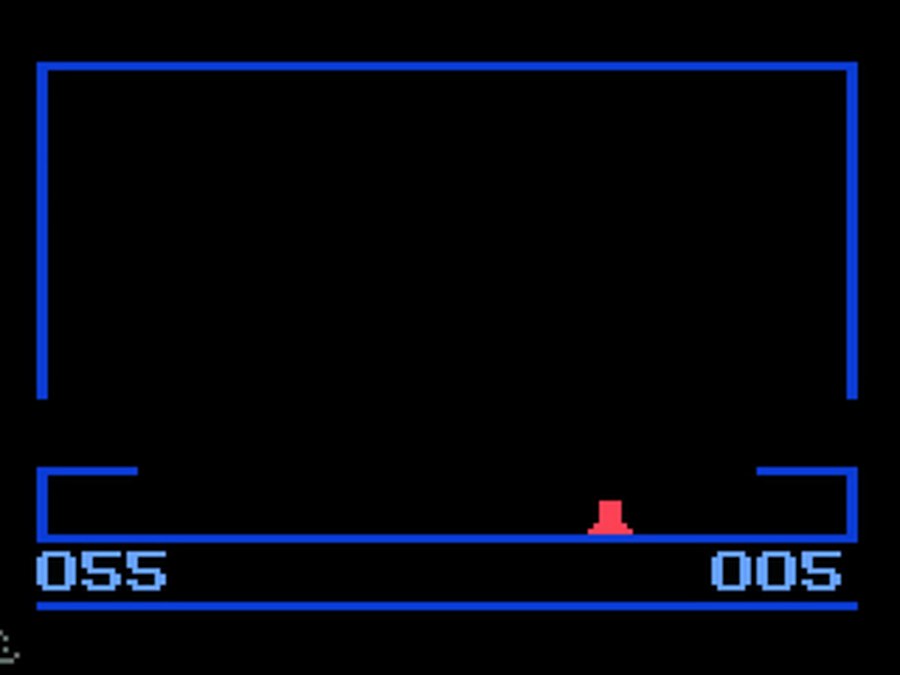
Shoot the letters in order and the machine says your word back to you — in 1982, Sid the Spellbinder! made the console sound like a teacher who liked you.
The details that decide it
As with all edutainment, the audience question decides the verdict. Adult collectors playing alone will find a charming novelty and a fine Voice demonstration. Households with young players — the audience of 1982, and the audience the secondhand market keeps supplying — will find a game that holds attention the way good teaching toys do, because it never stops being a game first.
The longer game
Sid’s design repays attention from anyone interested in how educational games grew up. The drill is never presented as a drill: the word is the level, the letters are the targets, and the hazards keep the player’s hands honest while their eyes do the schoolwork. Crucially, the game speaks the word at the moment of completion — the reward for spelling is hearing — tying the visual letters to the sound they make at the exact instant of success. That is a considered piece of instructional design, delivered through a speech toy, in an era when ‘educational software’ mostly meant a question and a text box. Magnavox’s classroom catalogue is uneven; at its best, in Sid and in Nimble Numbers Ned!, it is genuinely thoughtful.
The cartridge’s scarcity pattern follows its audience: educational titles sold to households rather than arcades, and Sid, tied to a hundred-dollar module, sold to the subset of households with The Voice — enough to be findable, few enough to carry a modest premium over the commons, especially complete. Its US-only status adds the collector wrinkle: no European release exists to soften prices.
Playing it today
The game’s longevity has a practical dimension modern parents discover quickly: spelling, unlike most 1982 subject matter, does not date. The words are words, the letters are letters, and a child with a joystick and a talking console is receiving the same lesson Sid delivered during the Reagan administration — with the Voice’s patient, robotic encouragement unchanged and unembarrassed. Retro hardware is usually a history lesson for adults; Sid is the rare cartridge that still does its original job for its original audience, which makes it one of the most satisfying secondhand purchases on the system: a teaching toy that outlived its classroom by four decades and kept teaching.
Its siblings complete the shelf. Nimble Numbers Ned! does for arithmetic what Sid does for spelling, and the pair of them, with Type & Tell! as the module’s free-play toy, form the Voice’s educational trilogy — the clearest evidence that Magnavox meant the classroom pitch on the console’s box. Collectors who dismiss the educational library as filler are discarding the part of the catalogue that justified the keyboard, and Sid is the trilogy’s best argument.
Buy it with the module, play it with a kid if one can be borrowed, and listen to a 1982 speech chip say the word correctly. Some cartridges preserve games. This one preserves a voice — several, in fact, one spelled word at a time.
Verdict
Sid also completes a story about the Odyssey 2’s identity: the console with the keyboard kept insisting it was a teacher as well as a toy, and this cartridge, speaking its lessons aloud, is that insistence at its most appealing.
For the modern Voice owner, Sid is the library’s proof of range — the same module that heckles you in Timelord teaches spelling here — and for households with young players it remains, improbably, usable: a spelling game with a voice, from 1982, that children still lean toward. Educational software is not supposed to have a forty-year shelf life. This one earned it.
Seven-and-a-half — the highest score in this series for an educational title, and it is earned the way the best teaching always earns it: by respecting the student’s attention. Sid the Spellbinder! never stops being an arcade game to become a lesson; the lesson is the arcade game’s win condition, spoken aloud at the moment of triumph by the most charming teacher 1982 could synthesise. Its constraints are its context — it needs The Voice to be itself, its vocabulary is a young child’s, and adults collecting alone will file it under demonstrations — but within its purpose it is close to flawless, and its purpose has not expired. Somewhere tonight there is a grandchild spelling a word correctly because a forty-four-year-old cartridge said it back to them. No score in this series measures anything better than that. Buy Sid with the module, keep it with the talking library, and let it teach. Class, on the Odyssey 2, is still in session.
In this series: Sid the Spellbinder! is one of eighteen Odyssey 2 cartridges reviewed in this build-up of the system’s shelf, alongside features on The Voice, the Master Strategy Series, the keyboard and the Videopac years, a hidden gems list and a full buying guide. Read it with the flagship history, Odyssey 2 Forever, for the whole story of the keyboard console — and if you are choosing a first cartridge from the set, the scores in this series are the shortlist, with the buying guide’s hedged price ranges as the shopping list.
It was never released on Videopac in Europe — speech in English was a North American proposition — making it one of three US-only Odyssey 2 titles. Our verdict: Edutainment that remembers the entertainment. A first-class Voice title and the system’s most likeable classroom.