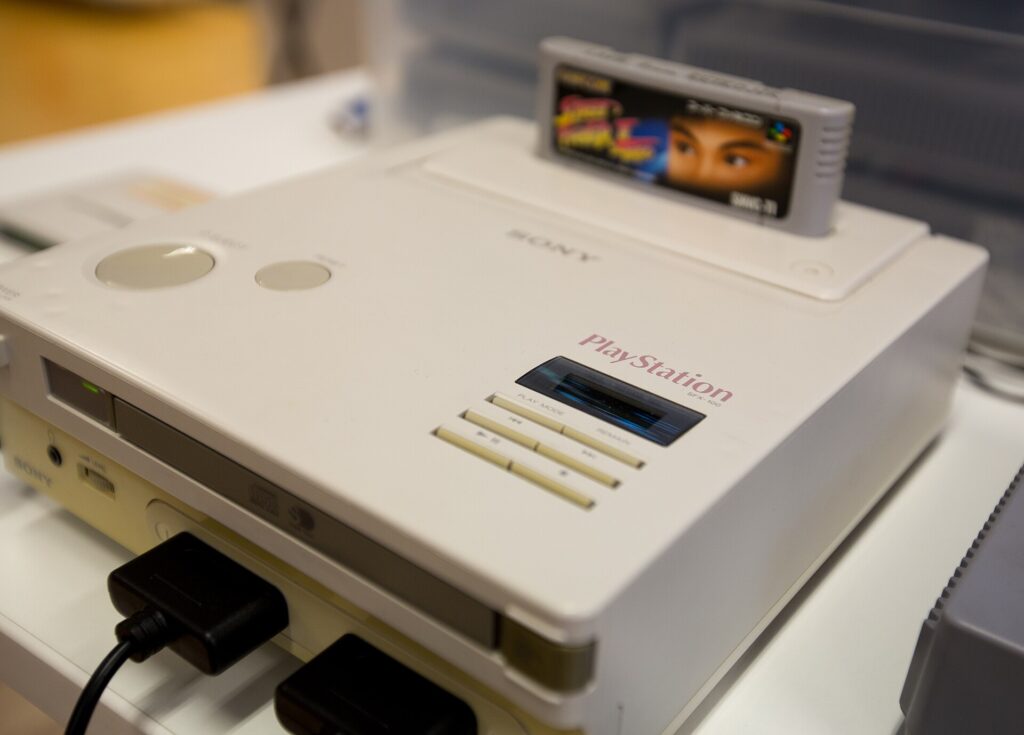
Every field has one ghost story it cannot stop retelling, and gaming’s is a grey plastic box that was never sold, from a partnership that lasted roughly a day. In the autumn of 2015 that ghost acquired a travelling schedule. The only publicly known surviving example of Sony’s Nintendo-compatible Play Station console — a machine built for a deal that collapsed in public in 1991 — was coming out of an American attic and going on show in Hong Kong, at the Retro.HK expo. Our original stub reported the promise. What follows is the whole strange tale: what the machine was, how it surfaced, what the Hong Kong appearance actually proved, and the quarter-million-dollar epilogue that nobody, in October 2015, was predicting.
What was known then: the deal that died on stage
The background was already legend by 2015. Sony engineer Ken Kutaragi, watching his daughter play a Famicom, had talked his employer into designing the Super Nintendo’s audio chip, the SPC700. Emboldened, Sony and Nintendo agreed a grander project: a CD-ROM format called Super Disc, a SNES add-on, and a Sony-branded console — the Play Station, two words — that would play both SNES cartridges and the new discs. Roughly two to three hundred prototype units were manufactured.
Then came the Consumer Electronics Show of June 1991. Sony unveiled the machine on the first day. On the second, Nintendo’s Howard Lincoln announced from the same show that Nintendo’s CD partner would be Philips, Sony’s great rival — an ambush made possible because Nintendo president Hiroshi Yamauchi had reread the contract and baulked at the control over disc software licensing it handed Sony. Negotiations limped on into 1992, but the trust was gone. Sony swallowed its humiliation, kept its engineers, and in December 1994 launched a standalone console called PlayStation in Japan. It sold over a hundred million units and rearranged the industry. The prototypes of the earlier machine were, by all accounts, ordered destroyed.
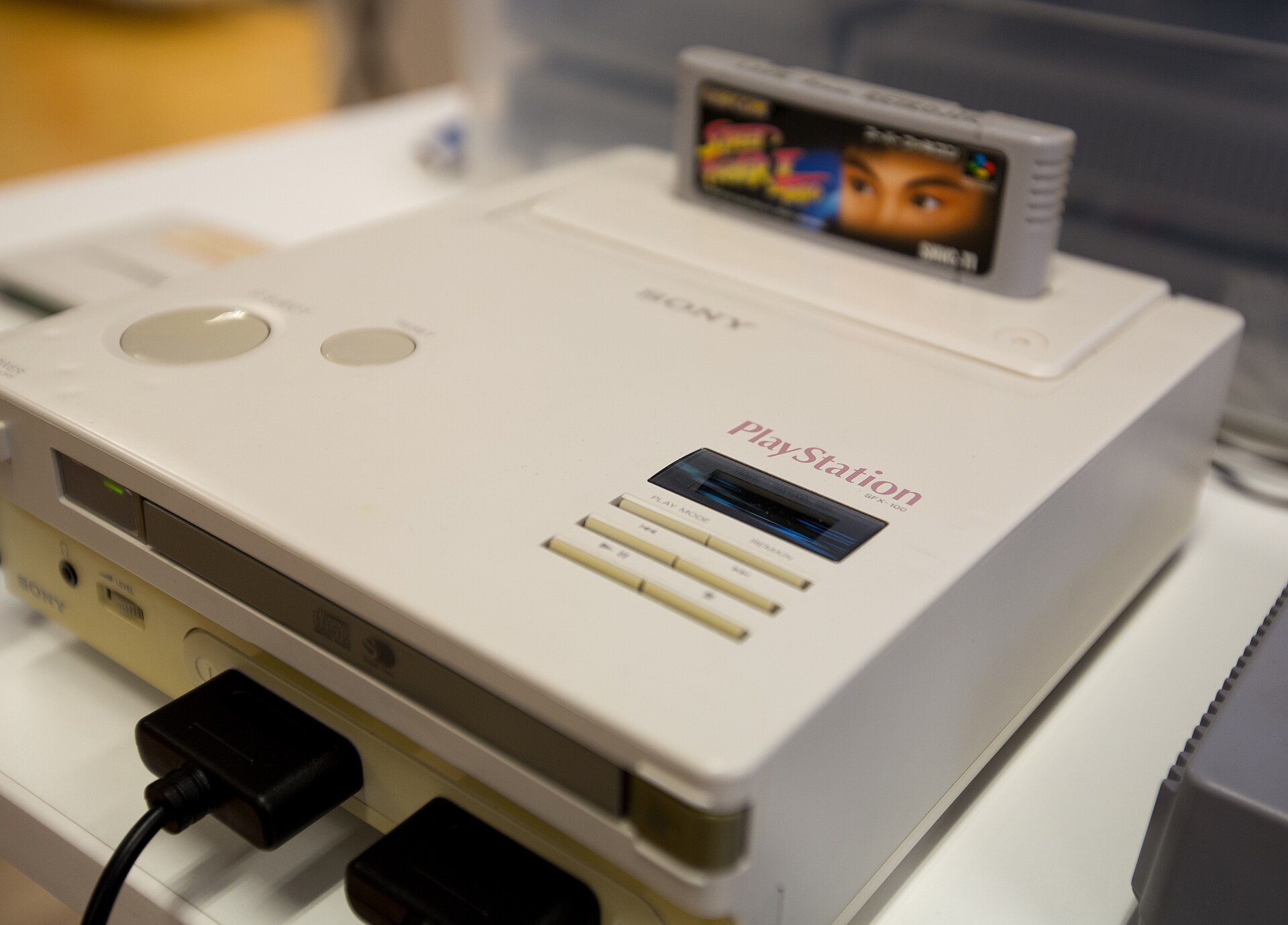
The Diebold unit: the SNES-based Sony Play Station prototype, photographed years after its rediscovery. Photo: Wikimedia Commons.
The $75 attic
Which is why July 2015 broke the retro internet. Dan Diebold posted photographs to Reddit of a Play Station — cartridge slot up top, CD tray in front, Sony branding, a Super Famicom-style controller wearing a PlayStation logo. His father Terry had acquired it in 2009 for a reported $75, as part of a lot bought at the bankruptcy auction of Advanta, a finance company where Terry had worked in facilities. Among Advanta’s former executives was Ólafur Jóhann Ólafsson, the founding president of Sony Computer Entertainment, who had apparently left the console behind in a box of effects when he departed. Terry, told to clear the offices, kept the box. Neither Diebold understood what the machine was until Dan started reading about the old Sony-Nintendo deal years later.
Scepticism was rational. The internet had been hoaxed before, the Diebolds initially declined to power the unit up for fear of damaging it, and a dormant prototype invites exactly that kind of protective vagueness. What the story needed was witnesses, X-rays and a public demonstration. That is what Hong Kong was for.
Retro.HK: the public examination
The stub you are reading a replacement for was published on 1 October 2015, trailing the Diebolds’ trip. The appearance duly happened: father and son brought the console to Hong Kong for the Retro.HK retro gaming expo, where Engadget’s team met them, documented the machine in detail and watched it run. A local workshop, Restart, X-rayed the unit first so it could be examined without blind risk — the scans even ruled out the paranoid favourite, some kind of self-destruct mechanism. Inside, the logic board, chassis and optical drive all carried labels marked “2,” suggesting this may have been the second prototype assembled.
With a borrowed power supply — the original had never reached the Diebolds — the machine powered on and played Super Famicom cartridges. The CD side, however, stayed silent: the drive received power but would not function, and the cartridge carrying the system’s CD boot software appeared damaged. So Hong Kong settled the existence question and left the capability question open. The prototype was real, it was Sony’s, it played Nintendo’s cartridges — and its disc drive, the entire point of the 1991 project, remained a mystery in a grey box. The Diebolds, meanwhile, told reporters they had already refused offers in the tens of thousands of dollars — figures around $45,000 were quoted — and spoke of wanting the machine in a museum.
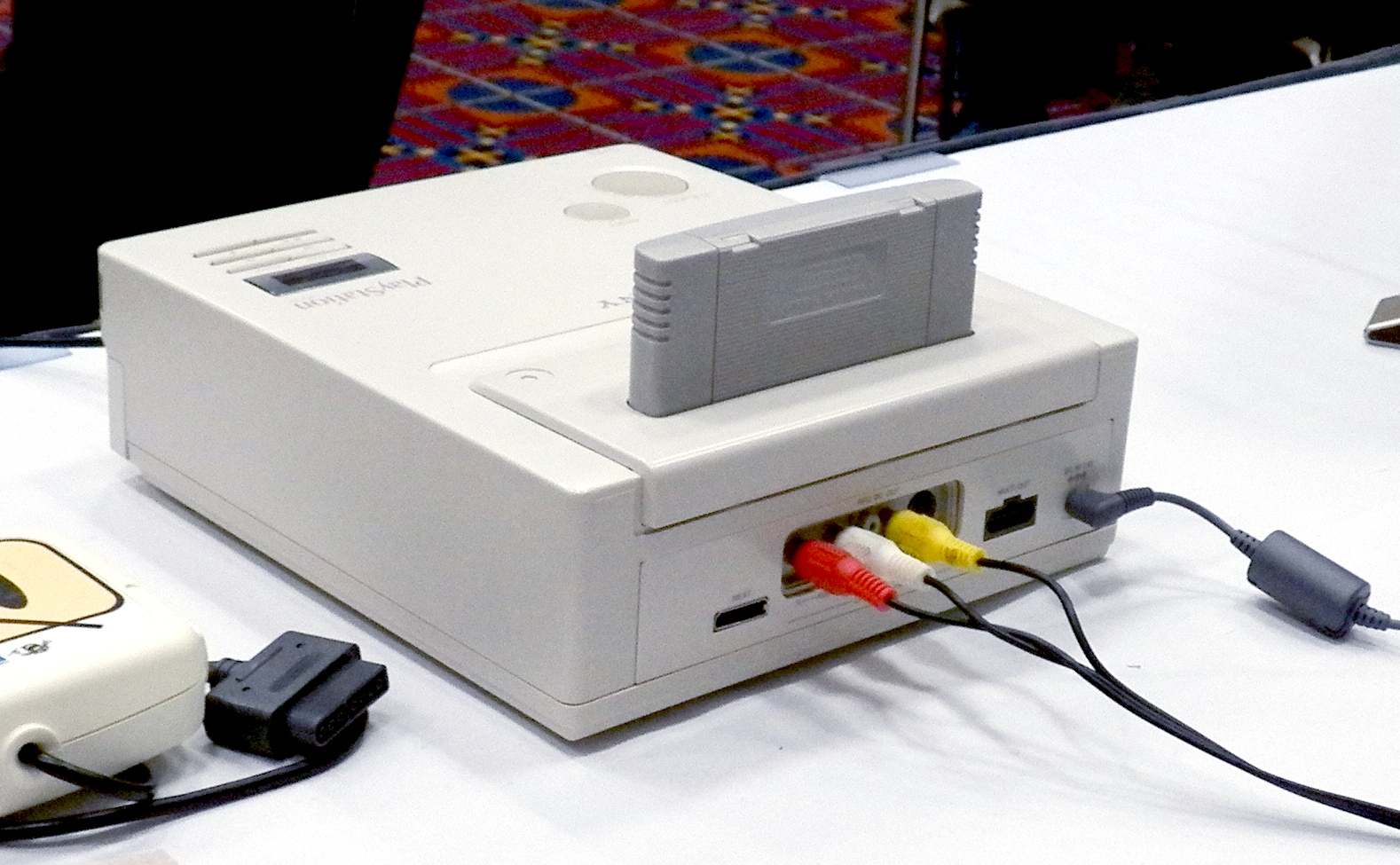
The back of the prototype, showing its period ports and a non-original power connector fitted after the original supply was lost. Photo: Wikimedia Commons.
Hindsight: the teardown, the repair, the auction
Hindsight. The story’s second act belonged to hardware hacker Benjamin Heckendorn — Ben Heck — whom the Diebolds handed the console to in 2016 for a full teardown video. One correction is worth making to how this episode is often summarised, including in early drafts of coverage like ours: the famous hands-on teardown was Heckendorn’s 2016 work, building on Engadget’s November 2015 Hong Kong power-on, not the same event. In 2017 Heckendorn went further, replacing failed components and indirectly curing the dead audio and the CD drive; with a custom power supply built for the unit, it played audio CDs and homebrew written for the platform — there being, of course, no commercial Super Disc games in existence to test.
Hindsight. Then came the sale the Diebolds had spent years declining. After touring the machine to expos and reportedly turning down a private offer of $1.2 million, Terry Diebold consigned it to Heritage Auctions. On 6 March 2020 the prototype sold for $360,000 including buyer’s premium — a $300,000 hammer price after 57 bids — to Greg McLemore, founder of Pets.com and Toys.com, who outbid, among others, Oculus co-founder Palmer Luckey and said he intended the machine as the centrepiece of a permanent museum of gaming history. The lot set a Guinness World Record as the most expensive video game console sold online. From $75 bankruptcy lot to $360,000 record in eleven years is, even by the standards of retro collecting, a remarkable exchange rate on an attic.
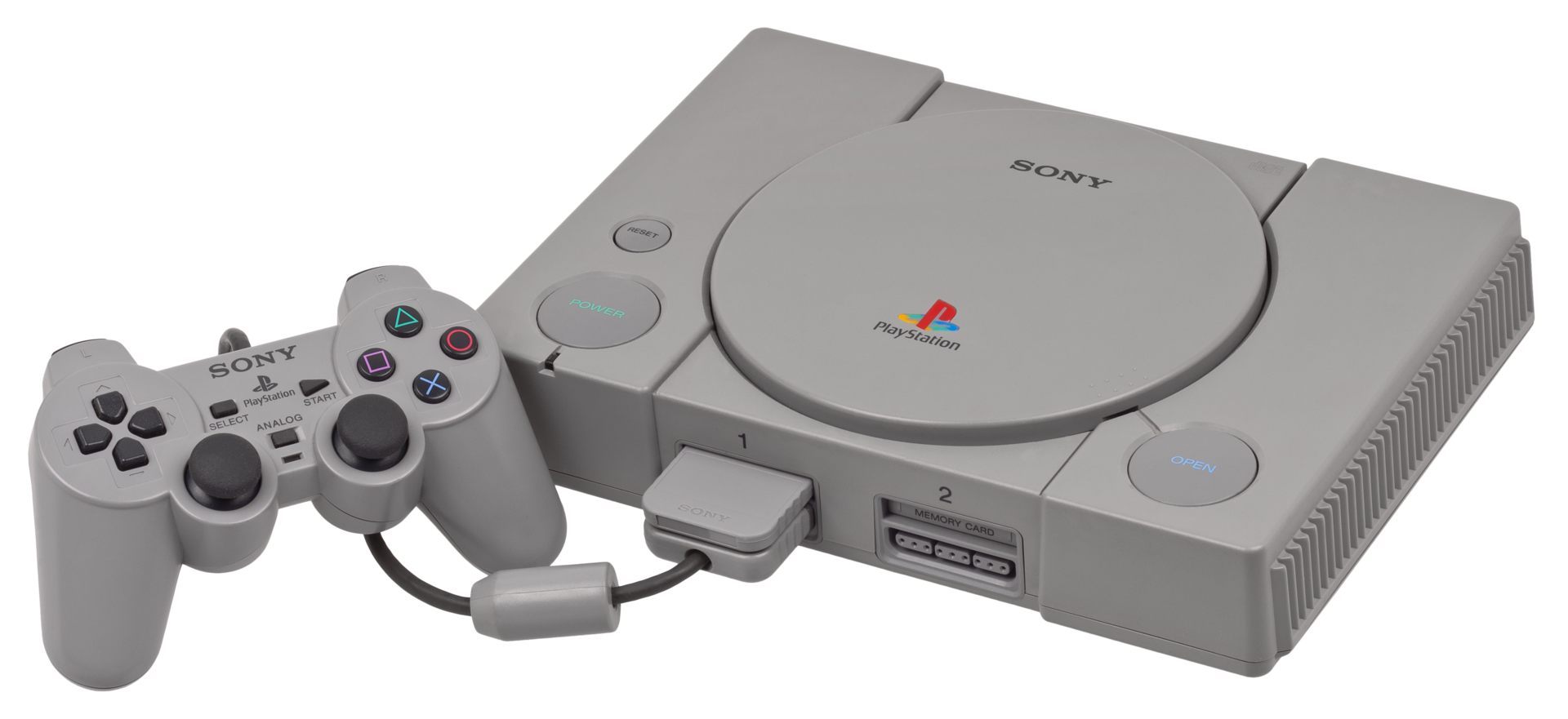
What the grudge built instead: Sony’s standalone PlayStation, the console that emerged after the Nintendo partnership collapsed. Photo: Evan-Amos / Wikimedia Commons.
Hindsight: not quite the only one
Hindsight, and a second correction. Throughout the auction coverage the Diebold unit was described as the sole surviving prototype. That was the honest state of public knowledge at the time — but it is no longer the whole truth. In March 2025, Ken Kutaragi himself showed a reporter a Play Station prototype he had kept in a closet at home, in markedly better cosmetic condition than the Diebold machine. At least two examples are now known to exist. The Hong Kong star remains the first found, the best documented and the only one to pass through public auction — but “the only one” is a claim its legend can no longer make, and any retelling, ours included, should stop making it.
Why Hong Kong mattered
It is tempting to remember the Retro.HK trip as a publicity stop. It was closer to a verification ceremony. Before Hong Kong, the Play Station was a Reddit thread and an argument. After it, the machine had been X-rayed, opened, powered and played in front of journalists and technicians with no stake in the tale — the moment a rumour became an artefact. Everything since, from Heckendorn’s soldering iron to Heritage’s gavel, rests on the credibility established in that expo hall.
The console itself remains the most eloquent object in gaming history: a Nintendo machine with Sony’s name on it, built for a future that lasted one day at a trade show. In October 2015 it flew to Hong Kong in a family’s luggage so strangers could confirm it existed. Five years later it was worth more than the house it had been stored in. Both facts, somehow, are true.