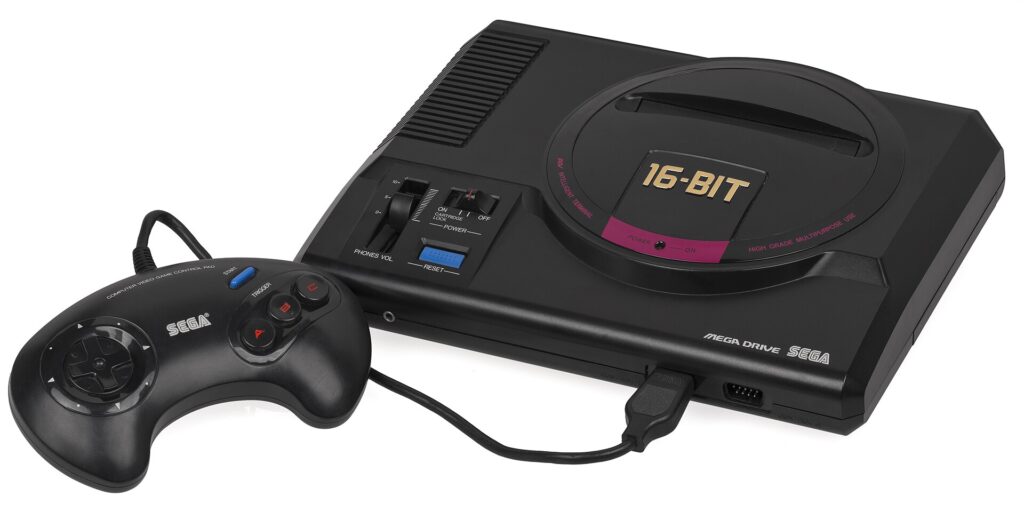
Thirty-eight years ago today — Saturday, October 29, 1988 — a new shape appeared in Japan’s electronics shops: matte black, low and wedge-like, with “16-BIT” written across its shell like a declaration of war. The Sega Mega Drive cost ¥21,000, came with no game in the box, and had exactly two cartridges to its name on its first morning. Six days earlier, Nintendo had released Super Mario Bros. 3.
That quiet Saturday looks, from here, like one of the great hinge points in video game history — not because of what happened in Japan, where the Mega Drive never climbed above third place, but because of what the machine did next. It crossed the Pacific, changed its name to Genesis, and started the most famous street fight the industry has ever had.
At a glance: Launched in Japan on October 29, 1988 · ¥21,000 · Motorola 68000 processor at 7.6 MHz · Launch games: Space Harrier II and Super Thunder Blade · Known in North America as the Sega Genesis · 30.75 million sold by Sega worldwide, with millions more built under license.
Beaten Twice Before It Started
Sega had been here before — twice, against the same opponent, and both times it had lost. Its first console, the SG-1000, went on sale in Japan on July 15, 1983: the very same day Nintendo launched the Famicom. The Famicom became a phenomenon. The SG-1000 sold respectably and was forgotten. Sega answered in October 1985 with the Mark III, a machine technically superior to the Famicom in almost every measurable way, and ran headlong into the wall that would define its decade: Nintendo’s licensing contracts bound Japan’s great third-party developers to the Famicom, so the stronger machine simply had less to play.

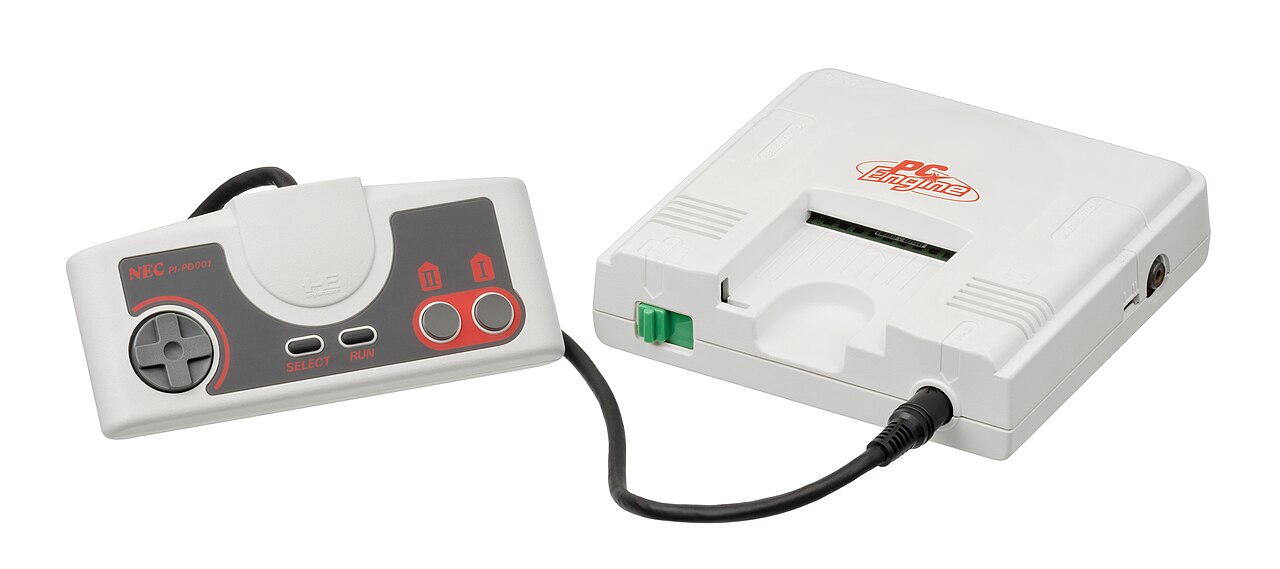
Then the ground moved again. On October 30, 1987 — a full year before the Mega Drive was ready — NEC and Hudson Soft launched the PC Engine: compact, capable, and marketed hard on its 16-bit graphics. Under the hood its processor was still an 8-bit design, but shoppers don’t buy under hoods. By launch day, the PC Engine had a year’s worth of games and momentum in Japanese homes. Sega’s new console was arriving late to a two-front war: an entrenched champion on one side, a younger upstart on the other.
A Motorola Heart
The Mega Drive’s answer was to stop chasing home consoles and start importing the arcade. At its center sat a Motorola 68000 running at about 7.6 megahertz — the same processor family that powered Sega’s System 16 arcade boards, the hardware behind Shinobi and Altered Beast. Nothing in a Japanese living room had a CPU like it. The Famicom and the PC Engine both ran on descendants of the venerable 6502, the chip architecture of the previous decade; the 68000 was a true 16-bit processor, and it is why Sega’s “16-bit” claim had substance while the PC Engine’s was mostly paint.
The supporting cast told the same story of a company learning from its own history. A Zilog Z80 — the chip that had been the Mark III’s main processor outright — was retained to run the sound hardware, and its presence is part of why an adapter could let the new machine play the old machine’s cartridges. Yamaha’s YM2612 FM synthesis chip gave the Mega Drive its unmistakable metallic snarl, a voice as different from the Famicom’s beeps as the machine itself. Dozens of colors at once from a palette of 512, big sprites, fast scrolling in every direction: on paper, and usually on screen, this was the arcade’s younger sibling, not the Famicom’s rival. The question was never the hardware. It was whether anybody would make games for it.
Launch Day: Two Games Against an Empire
For ¥21,000, the box contained the console, one control pad, and no game at all. What you could buy on October 29 was Space Harrier II — not a conversion but a brand-new sequel to Yu Suzuki’s beloved arcade flyer, built from scratch for the Mega Drive — and Super Thunder Blade, a home version of Sega’s helicopter coin-op. Both were statements of intent: huge sprites, scenery rushing at the screen, the arcade experience transplanted to the television. As a demonstration of what the 68000 could do, the pair worked beautifully. As a software library, on day one, it was two games deep.
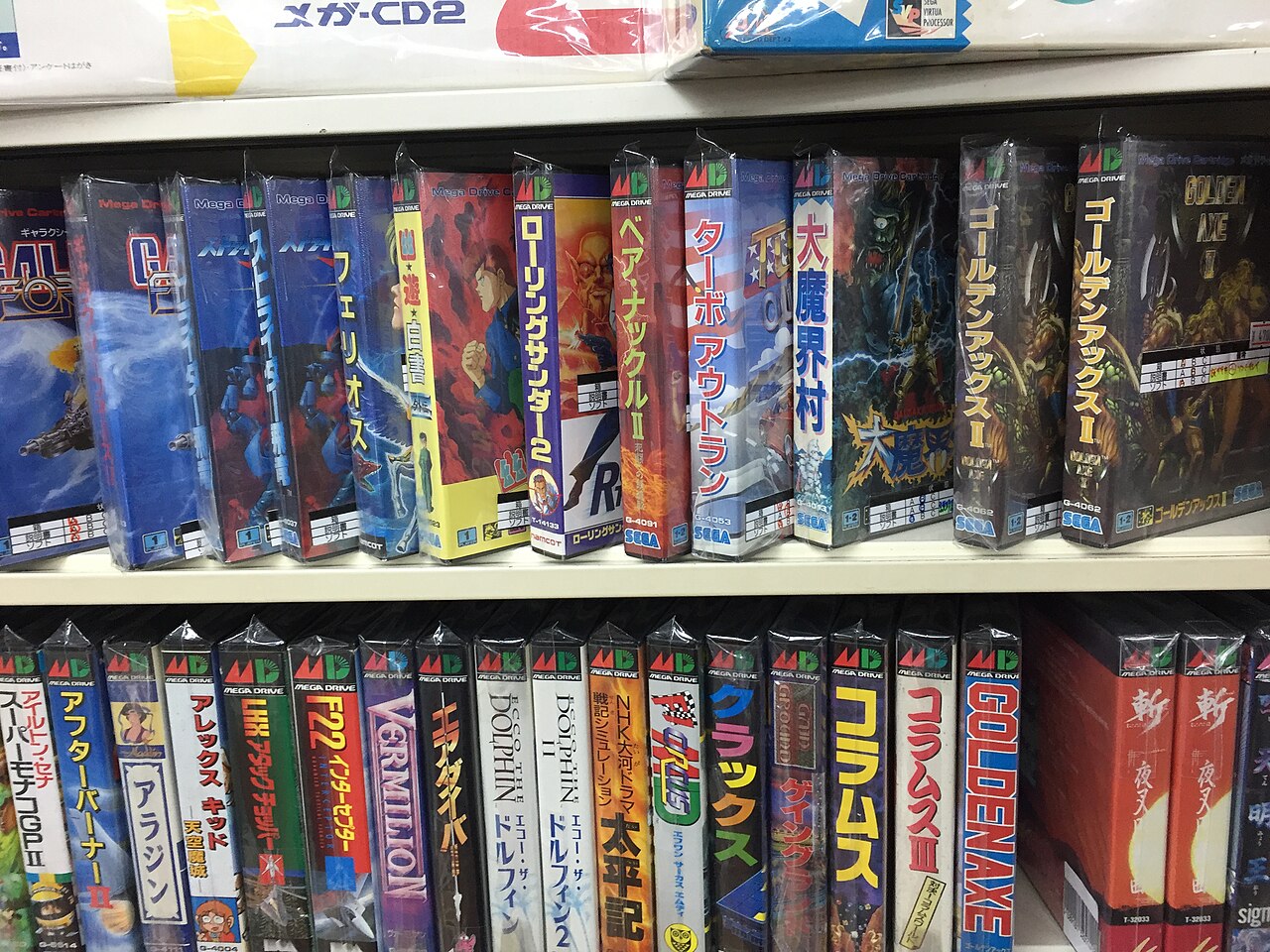
And the timing could hardly have been crueler. Super Mario Bros. 3 had arrived on October 23, and it was not merely a hit; it was the Famicom generation’s defining game, the cartridge every household in Japan seemed to be buying that autumn. The Mega Drive spent its first Christmas in the blast radius. A month after launch, on November 27, Altered Beast made the jump from the System 16 arcades — a third strong title, and still not nearly enough. Japan’s major publishers remained signed with Nintendo or were courting the PC Engine, and Sega’s own studios, however talented, could only produce so many games a year.
The home-market result was respectable and never more than that: third place in its own generation, behind Nintendo and NEC, with lifetime Japanese sales commonly estimated at around three and a half million machines. Judged on Japan alone, the Mega Drive was a well-engineered disappointment. But its story was never going to be written in Japan.
In Japan, the Mega Drive finished third. Everywhere else, it became the machine that taught a generation to argue about games.
Reborn as the Genesis
When Sega took the console west in 1989, it first had to change the name: in North America, “Mega Drive” was already the trademark of a company that made computer storage devices. So the machine was reborn as the Genesis — and Sega of America treated the rename as a mission statement. The test launch came on August 14, 1989, in New York and Los Angeles, priced at $189 with Altered Beast in the box. Europe and most of the rest of the world kept the Mega Drive name when their turn came in late 1990.

In America, everything Japan had withheld arrived at once: retail shelf space, third-party publishers hungry for an alternative to Nintendo’s terms, and a marketing department willing to say the quiet part out loud — Genesis Does What Nintendon’t. Then, on June 23, 1991, Sega swapped the pack-in game for one that showed off the 68000 better than any slogan: Sonic the Hedgehog, built by programmer Yuji Naka, designer Naoto Ohshima and their small team into a demonstration of pure speed that the competition’s hardware visibly could not match. The console war that followed, against the Super Nintendo, made Sega — for several years — the center of the entire industry. By the end of the run, Sega had sold 30.75 million Mega Drives and Genesises of its own manufacture, with millions more built under license around the world, including some three million in Brazil, where TecToy still sells the machine’s descendants today.
The Machine It Became
The Mega Drive’s legacy starts with a simple first: it was the first home console built around a genuine 16-bit processor, and it moved the whole industry’s expectations up a class. Around the core machine grew the most ambitious — and eventually the most tangled — ecosystem of the era: the Mega-CD brought optical discs and full-motion video years before they were standard, the 32X tried to stretch the hardware into a new generation, and the library deepened into one of the strongest of its time, from Streets of Rage to Gunstar Heroes. Not all of it worked. All of it was interesting.

What no one in Akihabara on that October Saturday could have predicted is the longevity. The official Mega Drive Mini put the little black wedge back on shop shelves in miniature form a generation later. Collectors still trade the original cartridges; independent developers still release new games for the hardware; and in Brazil, uniquely, the machine never really left. Thirty-eight years after two launch games and a third-place finish, the Mega Drive endures as the console that proved Sega could fight — and very nearly win.
The Mega Drive Community Today
Documentation: Sega Retro maintains the deepest public archive of Mega Drive hardware, software and history anywhere. Discussion and development: the long-running Sega-16 community keeps the Genesis side of the story argued over daily, and the homebrew scene still ships new cartridges. Playing today: original hardware and cartridges remain plentiful and affordable next to most of its rivals, the Mini covers the curious, and FPGA setups cover the purists.
Keep reading: browse the full Genesis hub; revisit our review of Sonic the Hedgehog and the original Streets of Rage; see where the ecosystem led in Sega CD: The Add-On That Saw the Future; and meet the machine this one replaced in Master System Forever.