
Nobody throws a birthday party for a game they hate. Yet in September 2016, one of the most criticised titles in the entire Nintendo Entertainment System library turned thirty — and instead of being politely forgotten, it received the most lavish gift a bad game can get: somebody who believed in it enough to rebuild it. The game was Super Pitfall. The somebody was Brazilian artist and developer Mário Azevedo, known online as Nesrocks. And the result, the Super Pitfall 30th Anniversary Edition, remains one of the finest demonstrations ever made of the difference between a bad game and a good game buried under bad decisions.
One clarification before we descend, because anniversaries invite confusion: the thirty years being celebrated in 2016 belonged to the game’s original Japanese release. Super Pitfall first appeared for the Famicom on 5 September 1986; the NES version followed in North America in 1987. The hack arrived on the Famicom version’s thirtieth birthday, to the day.
From Masterpiece to Punchline
To feel the full weight of Super Pitfall‘s reputation, start with what it was following. David Crane’s original Pitfall!, released for the Atari 2600 in 1982, was one of the defining games of its era — a jungle treasure hunt of swinging vines, rolling logs and alligator-infested ponds that sold millions of copies and effectively invented the platform adventure. Its 1984 sequel, Pitfall II: Lost Caverns, went further still, unfolding into a vast underground labyrinth with warp zones, checkpoints and a continuous musical score, and is still routinely named among the greatest Atari 2600 games ever made.
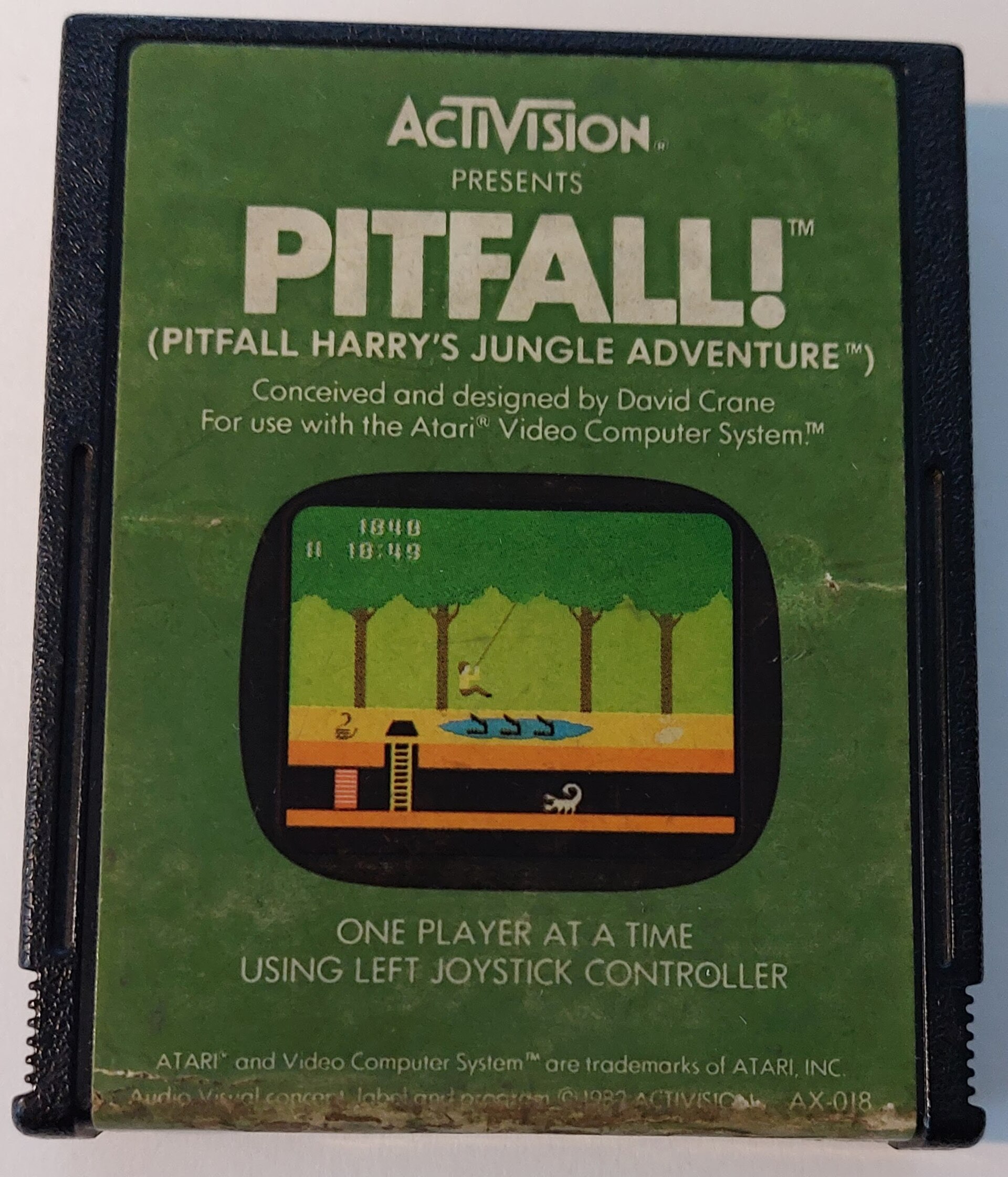
An original Atari 2600 Pitfall! cartridge — the 1982 classic whose name Super Pitfall had to live up to. Photo: Wikimedia Commons.

Pitfall II: Lost Caverns for the Atari 2600, the sprawling underground adventure that Super Pitfall loosely remade. Photo: Wikimedia Commons.
Super Pitfall was conceived as a loose remake of Pitfall II for far more powerful hardware. Development was handled by Micronics, a studio whose name became a byword among NES fans for rough conversions, and the game was published by Pony Canyon in Japan, with Activision bringing it west. The raw ingredients were promising — a huge multi-area underground world, hidden treasures, hostages to rescue — but the execution betrayed them at almost every step. The catalogue of grievances is long and specific. Essential items and warps were completely invisible, discoverable only by jumping in apparently random spots. Dropping off certain ladders meant falling blindly into instant-death pits you could not have known existed. Your pistol felt useless against the enemies swarming you. Progress depended on secrets the game never hinted at, wrapped in flickery, sluggish presentation. Reviewers at the time were unkind; history was unkinder, with the game settling into “worst on the NES” conversations and eventually receiving the full Angry Video Game Nerd treatment, which cemented its punchline status for a generation who had never even played it.
The Fan Who Saw a Good Game Underneath
Nesrocks looked at the same game and saw something else. In his own summary of the project, he described Super Pitfall as one of those odd games that are broken beyond belief yet still talked about — with some players even holding genuinely fond memories of it — and argued that a good game existed underneath all of its problems. It was, he noted, the ugly duckling of the series and the only Pitfall the NES ever got. Something had to be done, and the anniversary made the moment feel right.
What followed was not a weekend touch-up. Azevedo is a professional game artist by trade, and he taught himself the assembly-level skills the project demanded, with ROM hacking guidance from veteran hacker Macbee. The goal he set was surgical rather than revolutionary: keep the original game’s concept, its feeling of exploration and, wherever possible, its actual level design — because change the map wholesale and it stops being Super Pitfall at all — while rebuilding everything around that skeleton that had made the original so hostile.

The Nintendo Entertainment System, home to exactly one Pitfall game — and, thanks to this hack, finally a good one. Photo: Evan-Amos, Wikimedia Commons.
What the Anniversary Edition Actually Changes
The list reads like a point-by-point answer to thirty years of complaints. The graphics were redrawn from scratch, giving Pitfall Harry and his world a cleaner, more expressive look. The soundtrack is entirely new music, with the main area’s theme deliberately drawing on the melodies of Pitfall II in homage. Items are no longer invisible — what you need is on screen, where a fair game would put it. Warps are no longer secret triggers but doors you can see and choose to enter. The heads-up display now tracks your progress on the important collectibles, so the sprawling map becomes a plan instead of a riddle. Progress saves automatically to battery-backed memory — the original offered neither saves nor passwords — and a round of bug fixes and performance work smooths out the original’s technical stumbles. Even the infamous opening ladder trap, the blind drop that taught a generation of children to distrust this game within its first minute, is gone.
The redesign goes further in places. Your gun now has unlimited ammunition, turning a token weapon into a tool you can actually rely on. The original’s second quest was removed, on the reasonable grounds that with every collectible visible it had lost its purpose, and in its place sits a fairer completion challenge: one hundred optional treasures to find for players who want to master the map — ten rings in the underworld and ninety chests elsewhere. Small map adjustments reduce pointless backtracking and quietly hint at solutions the original expected you to divine. Beta testers, by the author’s account, responded with a disbelief that has become the project’s signature review: they had never seen a hack like this before.
An Email from the Man Who Started It All
The project’s most touching footnote concerns David Crane. Because the Pitfall name is so completely his, many players assumed down the years that Crane had something to do with Super Pitfall. He did not — the game was made without him — but when the Anniversary Edition appeared, Crane himself reached out to Azevedo with an email of praise for the work. The creator of the 1982 original, complimenting a fan for rescuing a sequel he never touched, in a series he had left behind decades earlier: it is hard to think of a neater verdict on what the hack achieved.
Hindsight: The Fix-Hack Gold Standard
With a decade of hindsight, the Anniversary Edition’s reputation has only hardened. It is routinely held up as the benchmark for an entire philosophy of ROM hacking — not the hack that turns a game into a joke or a kaizo ordeal, but the hack as restoration: identify the design intent, remove everything that obstructs it, and leave the soul of the game standing. Countless frustrating classics have received gentler fixes since, but few have been rebuilt with this completeness or this affection, and fewer still can point to a blessing from their series’ creator.
Super Pitfall waited thirty years for somebody to take it seriously. The joke of 2016 was that the worst Pitfall game received the best birthday present in the series’ history. The punchline, ten years on, is that it is not really a joke any more — play the Anniversary Edition and you are simply playing a good game that happened to spend three decades disguised as a bad one.
Editorial note: the 30th Anniversary Edition is a fan work and is covered here for its historical and critical interest only. In line with our policy on ROM hacks, we publish no download or patch links.