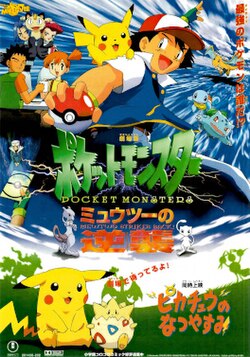
There are twenty-three animated Pokémon films, one live-action outlier, and roughly twenty-five years of arguments about which ones actually hold up once the nostalgia goggles come off. Some were cinema events with trading cards in the lobby. Some went straight to DVD, television or Netflix and quietly turned out to be the better films. This ranking judges the ten best on story, heart, animation and rewatch value — not box office, and not childhood loyalty alone. Expect the founding film to be respected, but not handed the crown for free. Well. Mostly.
10. Pokémon Heroes: Latios and Latias (2002)

Alto Mare, a canal city modelled on Venice, is the most beautiful setting any Pokémon film has given us, and for long stretches Heroes is content simply to drift through it: a water race at dawn, a secret garden, a Latias disguised as a girl who cannot speak and communicates entirely in gestures and playfulness. Directed by Kunihiko Yuyama, the fifth film is the series at its most gentle — which is exactly why its ending lands so hard. Latios sacrifices himself to stop a tidal wave and becomes the new Soul Dew protecting the city, giving the franchise its first real on-screen death of a major Pokémon. The villains, Annie and Oakley, are thin, the plot involving a defence mechanism is muddled, and its tiny North American theatrical run made it the lowest-grossing film in the series there. None of that has stopped its reputation growing: in a 2017 official fan poll it was voted the favourite Pokémon film outright. Flawed, serene and quietly devastating, it earns the last place on this list on atmosphere alone.
9. Pokémon the Movie 2000: The Power of One (1999)

The second film had an impossible job — follow a phenomenon — and it solved it by going bigger: three legendary birds, Articuno, Zapdos and Moltres, a collector in a flying fortress trying to provoke the sea guardian Lugia, and a prophecy that lands on the least prepared chosen one imaginable. Ash being told, in so many words, that the world will turn to ash is the kind of pun only this series would dare, and the film plays it completely straight. Lugia’s arrival, rising from the sea to a genuinely lovely score, remains one of the great entrances in any Pokémon movie, and Melody — the festival maiden who starts the film bored by tradition and ends it playing the song that saves the world — is one of the better one-off human characters. It earned about $133.9 million worldwide, less than its predecessor, and the middle sags under its own prophecy machinery. But its scale, its music and a talking Slowking with impeccable comic timing keep it comfortably in the top ten.
8. Pokémon: The Rise of Darkrai (2007)
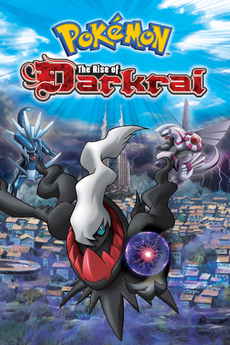
Alamos Town, modelled on Barcelona — its Space-Time Towers are a loving nod to Gaudí’s Sagrada Família — is being blamed on the wrong Pokémon. Darkrai, a creature that gives people nightmares, is cast as the villain by a town that does not understand it, while the real catastrophe unfolds overhead: Dialga and Palkia, deities of time and space who were never meant to meet, tearing reality apart in a brawl nobody on the ground can stop. The misunderstood-monster story is an old one, but Darkrai tells it well, anchoring it in a small human kindness generations earlier — a girl named Alicia once welcomed Darkrai into a garden — and in the song “Oración,” written to calm exactly this disaster. It was the highest-grossing anime film in Japan in 2007, earning around ¥5.02 billion, and it opened a loosely connected trilogy. The human cast is forgettable and the climax leans on tower-powered plot machinery, but Darkrai’s apparent disintegration, defending a town that hated it, is one of the series’ most affecting fake-outs.
7. Pokémon the Movie: I Choose You! (2017)

Made for the anime’s twentieth anniversary, I Choose You! restarts Ash’s story in an alternate continuity: the rainy first meeting with Pikachu, the Spearow attack, the glimpse of Ho-Oh — but remixed, with new companions Sorrel and Verity, a rival named Cross who abandoned his Charmander, and Marshadow lurking in Ash’s shadow. Purists grumbled, with some justice, about Misty and Brock being written out of their own origin story, and about a brief, notorious moment in which Pikachu appears to speak human words. Seen on its own terms, though, this is a warm, handsome retelling with a real interest in what kind of trainer Ash wants to become — his mid-film slump, dreaming of an ordinary life with no Pokémon at all, is surprisingly honest writing for this series. It grossed about $37.6 million worldwide and launched the alternate-timeline trilogy that produced two of the films ranked above it. A reboot that mostly justifies itself.
6. Pokémon 3: The Movie — Spell of the Unown (2000)

The strangest and most intimate of the early films. Molly Hale is a small, lonely child whose father has vanished while studying the dimension-hopping Unown — so the Unown grant her wishes, crystallising her mansion and conjuring an Entei who believes, completely, that he is her father. There is no world-ending prophecy here, just a grieving kid building a family out of illusions, and an Entei whose devotion is both touching and faintly frightening. Ash’s mother, Delia, is kidnapped to complete the picture, which gives Ash a personal stake the series rarely allowed him, and Charizard’s return — swooping in from the Charicific Valley because he saw his trainer in danger on television — is still a top-tier crowd-pleaser. At only 74 minutes it never outstays its welcome, the crystal visuals were a step up for the series, and critics at the time agreed it had the strongest plot of the first three films, even while shrugging at the franchise as a whole. Small scale, big feelings.
5. Pokémon the Movie: Secrets of the Jungle (2020)
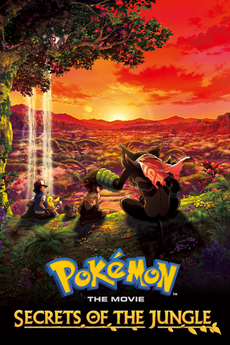
A Zarude breaks his troop’s strictest law, leaves the tribe, and raises a human baby he finds in a cradle on a riverbank. Ten years later Koko believes he is a Zarude — until Ash arrives, and a photograph, a pendant and the Biotope Company’s Dr. Zed start unravelling who Koko really is. Yes, the bones are familiar from other jungle-raised-child stories, and the film knows it; what matters is how sincerely it plays the father-son relationship at its centre, and how genuinely nasty its villain becomes once his history with Koko’s parents is revealed. Delayed by the pandemic from July to December 25, 2020 in Japan and released internationally on Netflix in October 2021, it returned the series to traditional 2D animation after the CGI remake experiment, and it looks lush for it. It is the most emotionally complete of the alternate-timeline films, and its ending — a child choosing to be a bridge between two worlds — earns every tear it asks for.
4. Pokémon Detective Pikachu (2019)

The live-action gamble that should not have worked: a noir mystery, loosely adapted from a niche 3DS spin-off, in a city where Pokémon live alongside humans as partners rather than battlers. It works because Ryme City is a joy to look at — a Psyduck with anxiety issues, a Mr. Mime interrogation played as pure silent comedy, a Snorlax asleep in traffic — and because Ryan Reynolds’ wisecracking Pikachu and Justice Smith’s grieving, Pokémon-averse Tim Goodman give the spectacle an actual relationship to hang on. The plot, involving Tim’s missing father, a purple gas called “R” and a Mewtwo borrowed heavily from the first animated film, gets gloopy in the final act, as these films tend to. But directed by Rob Letterman, it grossed about $433 million worldwide on a $150 million budget, became one of the best-reviewed video game films of its era, and proved Pokémon could live outside anime entirely. The highest-placed oddity on this list, and proud of it.
3. Pokémon: Lucario and the Mystery of Mew (2005)

A medieval festival, a staff that has held a prisoner for a thousand years, and a Pokémon who wakes up believing his master betrayed him. Lucario — introduced here before its generation of games even launched — carries this film: proud, bitter, telepathic, slowly learning from Ash, whose aura matches that of the hero Sir Aaron, that the story he has told himself for centuries is wrong. The truth, when a time flower finally shows it, reframes sacrifice rather than betrayal, and Lucario’s ending mirrors Aaron’s in a way that still catches viewers off guard. At 101 minutes it is one of the longest of these films and uses the time on world-building — the Tree of Beginning, a living ecosystem with its own defences — instead of padding. It was Japan’s second-highest-grossing domestic film of 2005, behind only Howl’s Moving Castle, was nominated for Best Anime Feature at the American Anime Awards, and was the last Pokémon film dubbed by 4Kids Entertainment. The fan consensus that this is top-three material is, for once, simply correct.
2. Pokémon the Movie: The Power of Us (2018)

The best Pokémon film about people. In Fula City, built on wind granted by Lugia, Ash is only one thread among many: Risa, a former runner coaxed back towards life by an Eevee errand; Callahan, a fabulist lying to impress his immunocompromised niece; Toren, a researcher who cannot present his own work; Harriet, an elderly woman who has shut Pokémon out since a fire fifty years ago; and Margo, hiding an injured Zeraora and a civic lie. Co-produced with Wit Studio and directed by Tetsuo Yajima — the first film in the series not directed by Yuyama — it weaves those small stories into a climax where a forest fire and a spore cloud are beaten by neighbours, not prophecies. Its Japanese title, Everyone’s Story, is the honest one. It became the first Pokémon film to earn a “fresh” critics’ score on Rotten Tomatoes, and it grossed a modest $23.7 million only because its release was limited. If you show one Pokémon film to an adult who thinks they have outgrown Pokémon, show them this one.
1. Pokémon: The First Movie — Mewtwo Strikes Back (1998)
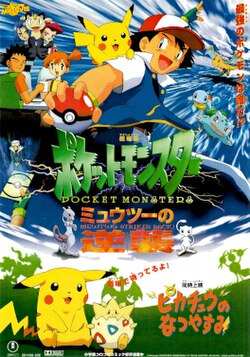
It had to be, and not just for nostalgia. Mewtwo — a clone who wakes up in a laboratory, is told he exists to serve, and decides to hold the species that made him to account — is a villain written by Takeshi Shudo with a genuine philosophical grievance, and the film builds to originals and clones beating each other senseless while Mewtwo’s question hangs over all of it: are we only what we were made to be? Ash’s answer, stepping between two armies and being turned to stone for it, and Pikachu’s tears over him, seared themselves into a generation — the film grossed about $172.7 million worldwide from a modest budget, played in cinemas with exclusive trading cards, and set the template every sequel since has followed: a legendary power, a moral problem, and empathy as the resolution. The English dub softened some edges, and the CGI remake in 2019 proved the story survives any technology. Twenty-three films later, nothing has displaced it. The very best, like no other.
Honourable mentions: Pokémon 4Ever for its time-travel twist and a young Professor Oak hiding in plain sight; Arceus and the Jewel of Life for completing the Darkrai trilogy with real ambition; and Pokémon Ranger and the Temple of the Sea for giving May the spotlight and the sea the rest. Disagree with the order? Of course you do. That is half the fun of a list like this — the other half is the rewatch it sends you on.