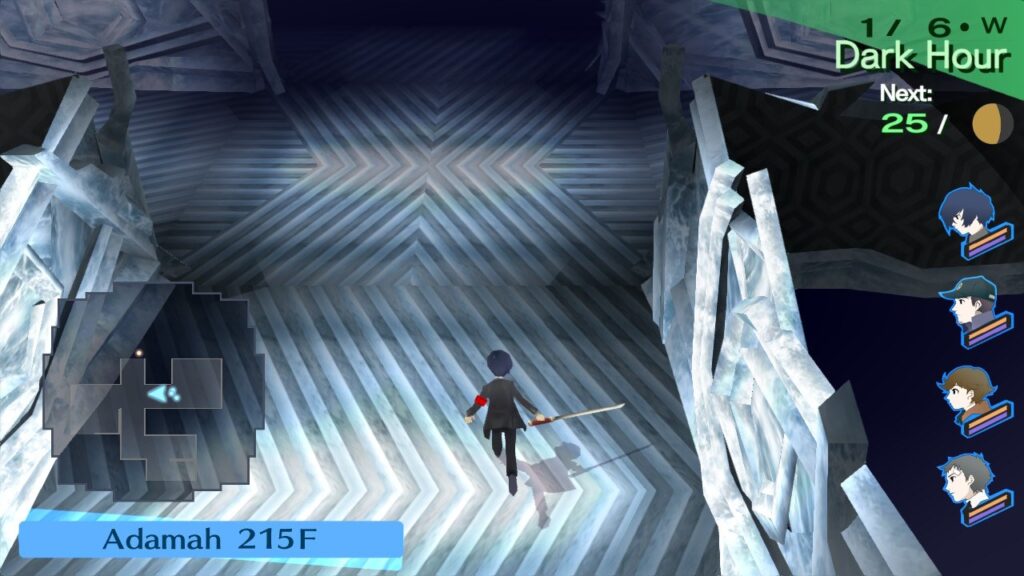
At a glance: Persona 3 Portable · PSP · Atlus, 2009 (JP) / 2010 (West) · RPG · Score: 9.5/10
Persona 3 was always secretly a handheld game wearing a console’s clothes. Its structure — a school calendar, a year of days, each split between classes, friendships and one midnight hour of dungeon — breaks naturally into sessions of twenty minutes. Persona 3 Portable, Atlus’s reworking of the PS2 original and its FES expansion, understood this completely. It rebuilt the game around the PSP’s rhythms, trimmed what portability could not carry, added what the original never had, and produced the definitive way to live through the Dark Hour — arguably twice.
The story is unchanged in outline and unmatched in tone. By day you are a transfer student at Gekkoukan High in the port city of Iwatodachi; by night, during the hidden twenty-fifth hour, your school becomes Tartarus, a tower of shadows, and you fight through it with SEES, a club of teenagers who summon their Personas by pointing Evokers — gun-shaped catalysts — at their own heads. Persona 3 is a game about death: how a cast of orphans, invalids and runaways learn to spend a finite year. No JRPG of its era is braver, and none wears melancholy so lightly between jokes.
The route that changes everything
P3P’s headline addition is a second protagonist. Choosing the female route — the character fans call Kotone — is not a palette swap: it rewires the game’s Social Links, adds new friendships with the male party members the male route kept at arm’s length, re-records dialogue, re-composes parts of the soundtrack around a new vocal identity, and changes scenes’ meaning across the whole calendar. For returning players it is a second, full-price-worthy campaign. For newcomers it is a genuine choice between two tellings of the same tragedy, both excellent.
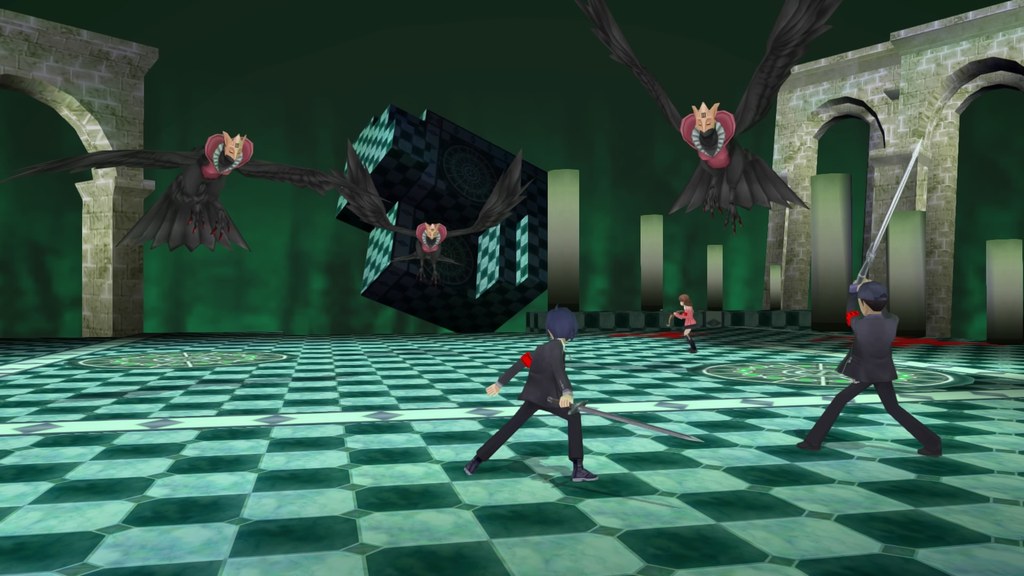
To fit the PSP, exploration outside Tartarus becomes point-and-click: static scenes, a cursor, quick travel between the dorm, school and the island’s shops and shrine. Fans mourned the lost 3D wandering, and the mourning is understandable — but the trade bought speed. Menus snap, days flow, fast travel respects your evening, and the game’s visual-novel heart, always its true engine, beats unobstructed. Inside Tartarus the full 3D dungeon remains, now with FES’s improvements, direct party control borrowed from Persona 4, and a fatigue and skill-card system tuned for shorter sessions.
Combat, cards and the calendar
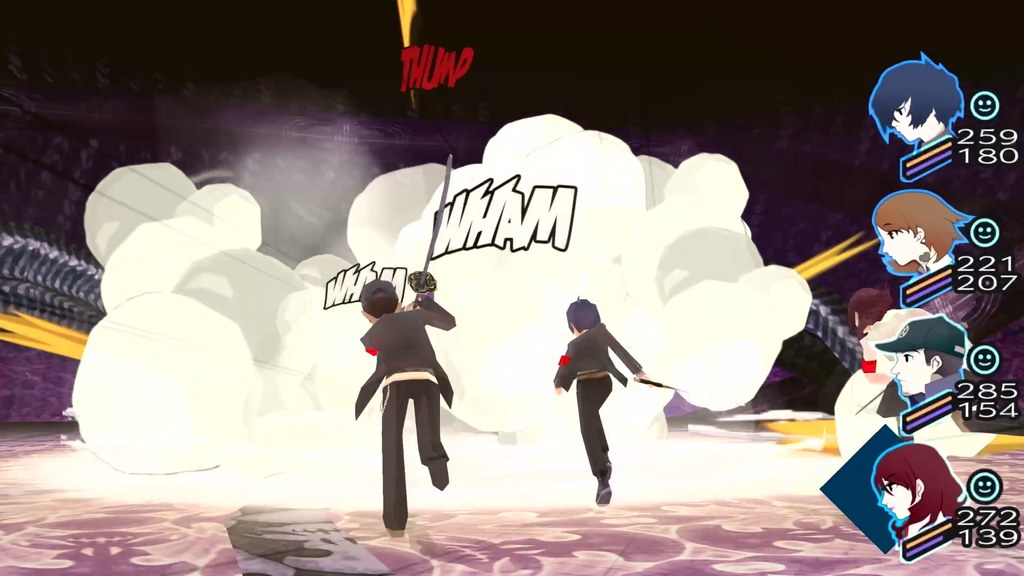
The One More battle system — hit a weakness, gain a turn, chain into an all-out attack — remains the most moreish turn-based engine of its generation, and P3P’s quality-of-life stack makes it sing on a handheld: part-time jobs fund your evenings, the arcade and karaoke shape your social stats, and every activity is a decision weighed against a ticking exam timetable. Persona fusion, with its inheritance puzzles and compendium bookkeeping, gains a job system at the Velvet Room’s margins that ties the whole loop together. It is a game of a hundred interlocking clocks, all of them yours to misspend.
What is missing must be said plainly: The Answer, FES’s thirty-hour epilogue, did not make the trip, and the anime cutscenes are replaced by in-engine stills. Presentation takes a step back from the PS2’s lavishness, and Tartarus itself — procedurally shuffled floors of corridors — was repetitive in 2006 and remains so. These are real costs. They are also, weighed against two complete campaigns, direct control and a structure perfectly re-fitted to portable play, costs most players will pay gladly.
A year you will remember
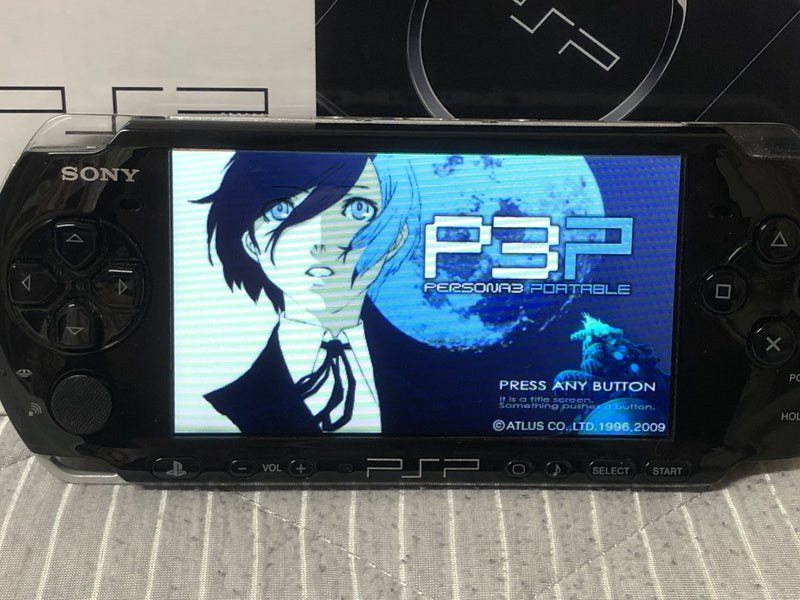
Technically the port is immaculate: load times are brief, the interface is the cleanest the series had managed, and Shoji Meguro’s soundtrack — Mass Destruction’s baby-baby-baby battle cry and all — survives compression with its swagger intact. P3P was for years trapped on the PSP, and its 2023 modern re-release confirmed what PSP owners always said: this is not the compromised version. In several ways that matter daily, it is the best one.
Social Links: the other dungeon
Half of Persona 3 is a game about showing up. The Social Link system binds your battle strength to your friendships: forge a bond with the student council treasurer, the dying young man at the shrine, the online friend who is not who she claims, and the Personas you can fuse of their arcana grow stronger. P3P rewrites several links for the female route and, crucially, lets you befriend your own party — which transforms the late game, because the people whose deaths the plot threatens are no longer colleagues you watched in cutscenes but friends you chose, repeatedly, over levelling. It is the game’s cruellest and best design decision.
Tartarus, floor by floor
The tower itself is the game’s most debated inheritance: over two hundred and fifty floors of procedurally arranged corridors, blocked into themed sections, climbed in nightly expeditions rationed by your party’s stamina. As a dungeon it is plain; as a structure it is perfect for a handheld — every expedition is a wager of time against progress, with full-moon boss deadlines giving the calendar its heartbeat. P3P’s additions, including rescue missions for townsfolk lost inside and a door of optional super-boss trials, give the climb the side-quests it always needed.
Difficulty and the second calendar
P3P is generous with difficulty options, from a Beginner mode that resurrects you mid-battle to a Maniac setting for the series’ masochists, and its New Game Plus carries levels, equipment and compendium into a fresh calendar — the intended route to the second protagonist. Completionists face the series’ traditional exam: maxing every Social Link in one year requires a schedule planned like a military operation, and the game knows it, dangling a final fusion as the prize. Nobody should attempt it first time. Everybody attempts it second time. That is the Persona effect, and P3P delivers it undiluted.
The version question, answered
New players in 2026 can choose the 2023 re-release of P3P or the 2024 remake of the PS2 game, and both are fine doors into Iwatodachi. The PSP original keeps one crown neither successor can take: it is the only version with the female route and the only one designed to be lived with in fragments — a school day on the bus, a Tartarus run before sleep. Persona 3 is a game about how you spend limited days. Playing it on a machine that itself lives in the margins of your day is not a compromise. It is the theme, embodied.
The soundtrack’s second voice
The female route’s musical identity is more than a footnote: new battle and exploration themes, built around a different vocalist and a brighter, poppier register, change the emotional temperature of identical events. A Tartarus run that felt like dread on the male route can feel like defiance on the female one, purely because of what is playing. Atlus understood that in a game about a year of days, music is memory — and gave returning players a second set of memories, encoded in melody, for the same year.
If you play one version, a word of preparation: Persona 3 Portable asks for your evenings the way its calendar asks for the protagonist’s — in small, daily, cumulative surrenders. Let it. Few games justify a year of anyone’s attention; this one is about a year, and it earns the symmetry. When the final day arrives and the soundtrack does what it does, you will understand why PSP owners spoke of this port not as a conversion but as a homecoming. The Dark Hour strikes at midnight. Make sure you are holding the machine when it does.
Verdict
The PSP’s essential JRPG: a year-long story about mortality that fits in a coat pocket and improves on a classic while shrinking it. Play one route. Then, inevitably, play the other.