
At a glance: Paper Mario: The Thousand-Year Door · GameCube · Intelligent Systems, 2004 · Turn-based RPG · Score: 9.5/10
Every beloved RPG has a chapter its fans describe first, and The Thousand-Year Door has about six of them. Intelligent Systems’ 2004 sequel to Paper Mario took the N64 game’s paper-craft charm and wrote, inside it, the funniest, warmest and most confidently paced role-playing game Nintendo has ever published: a quest for seven Crystal Stars behind an ancient door beneath the port town of Rogueport, pursued by the X-Nauts, shadowed by a second playable story starring Peach and a lovesick computer, and interrupted — gloriously — by a wrestling federation, a murder mystery on a luxury train, and a pirate’s cursed treasure. The Switch remake introduced it to a new generation; this review covers the 2004 GameCube original, which remains a complete masterpiece in its own right and the version collectors rightly hunt.
Rogueport and the art of the chapter
The structure is a storybook in eight chapters, and the variety is the point. One chapter is a pastel forest where Mario shrinks among Punies; the next puts him in the Glitz Pit, rising through the ranks of a rigged wrestling promotion under the name “The Great Gonzales,” solving the corruption behind the spectacle between bouts. The Twilight Town chapter plays with body-swapping and a villain who steals Mario’s very name; the Excess Express chapter is a three-day whodunit in a rolling snow-globe of suspects. Between chapters, Peach’s interludes with the AI TEC-XX — a computer learning what love is, one awkward, genuinely moving conversation at a time — and Bowser’s comic rampages, including playable parodies of Super Mario Bros. itself, give the game a rhythm no RPG since has quite matched. It never stays anywhere long enough to get tired of it.
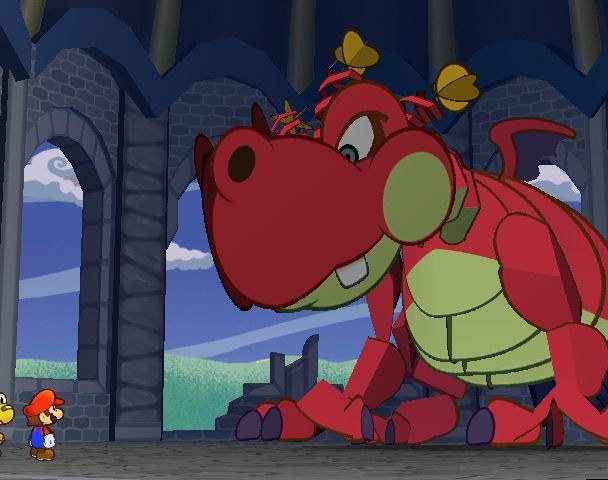
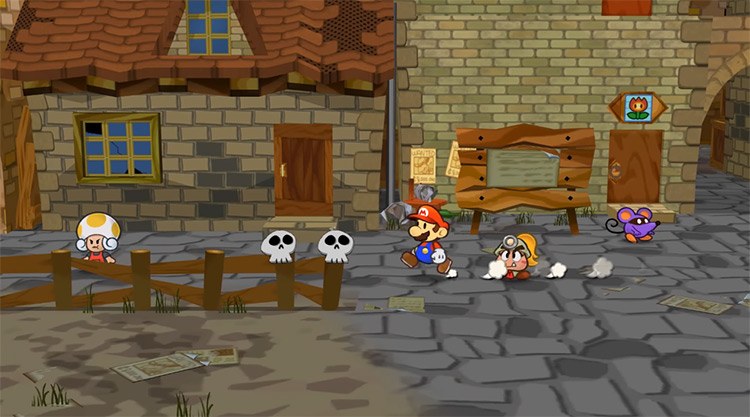
The writing carries all of it. The localisation is sharp, dry and humane: Rogueport is a genuinely seedy town of gallows humour and hanging nooses softened by paper charm, partners like Goombella, Koops, the fabulous Madame Flurrie, a baby Yoshi you name yourself, and the scene-stealing Admiral Bobbery — whose late-game storyline lands an emotional punch that family games are not supposed to attempt — all get arcs, jokes and reasons to be in the party. The villain bench is deep: Lord Crump’s bluster, the Shadow Sirens’ bickering, Grodus’s cold scheming, and a final act that raises the stakes from treasure hunt to the end of the world without losing the game’s voice.
Combat with a live audience
Turn-based battles are staged as theatre — literally. Fights play out on a stage before an audience of Toads, Koopas and Goombas who applaud good play, throw helpful items or harmful rubbish, and grow with Mario’s star power. Action commands turn every attack and block into a timed skill: press with the hammer’s wind-up, hold and release the jump, mash for the Power Shell. Superguarding, a frame-tight counter, rewards the truly devoted. Layered on top are badges — the series’ build system, letting you re-spec Mario from glass cannon to tank to danger-state gambler — Star Powers earned from the Crystal Stars, partner abilities that double as world-traversal tools, and an audience-and-stage system where fog, falling lights and set malfunctions can change a fight. It is accessible enough for a first RPG and deep enough to sustain the challenge runs and danger-Mario builds the community still performs.

Paper Mario’s papercraft is also a mechanic, not just a skin. Mario folds into a plane, rolls into a tube, turns side-on to slip through bars, and peels scenery like stickers to reveal what the world is hiding. Rogueport’s sewers hide the thousand-year door itself, fast-travel pipes, the Pit of 100 Trials for players who want the combat system examined to destruction, a trouble centre of side quests, recipes, and more optional depth than any reasonable player will finish. This is a forty-hour game if you wander, and the wandering is the good part.
Original versus remake, honestly
Two honest notes for buyers. The GameCube original runs at sixty frames per second, where the Switch remake targets thirty — in a game built on frame-tight action commands, some players genuinely prefer the original’s feel. The remake adds quality-of-life touches, new music arrangements and a fresh translation, and removes nothing important; the original counters with its period script (a few lines were softened in later editions), its partner ring’s absence notwithstanding — swapping partners in the 2004 version means opening the menu, the game’s most-cited friction, and the Trouble Centre’s backtracking can pad the mid-game. None of it dents the whole; it merely marks the difference between a 10 and a 9.5.
The little systems that add up
What separates The Thousand-Year Door from its imitators is accumulation. The audience does not just watch your battles — it can be put to sleep by a boring fight, grow when you land stylish moves, and occasionally be infiltrated by an enemy in disguise. Bingo bonuses spin out of perfect guards. Partners have their own badges, their own field abilities, their own little arcs in the interludes. The Pianta Parlor trades tokens for prizes through genuinely fun minigames. Luigi wanders the world on a parallel quest and recounts it, at length, in paperback instalments you can buy and read — a running gag that is also a small novel of unreliable narration. Even the emails Mario receives on his Mailbox SP, a period-perfect gadget, build Rogueport’s world between chapters. No single system is revolutionary; the density of care is. This is a game made by a team visibly enjoying itself, and the enjoyment is contagious across forty hours.
Performance on the original hardware is part of that polish: the GameCube version holds its sixty frames through busy battles and crowded Rogueport squares, its load times are brief, and its paper effects — pages turning between areas, scenery peeling, Mario folding himself through the world — are rendered with a crispness that CRT and modern displays both flatter. It has never needed rescuing, only revisiting.
The verdict
The Thousand-Year Door is the GameCube’s great RPG and one of the finest games Nintendo has ever released: funny in every scene, moving in the ones that count, mechanically generous and visually timeless — its paper world cannot age, because it never pretended to be anything else. Whether you come via the remake’s applause or the original disc’s, come. And if you can play the 2004 original on the hardware it was made for, with its sixty-frame timing and its unedited script, you are playing the definitive article.
And a word for the collectors reading the remake-versus-original debate from the sidelines: the GameCube disc has become one of the system’s signature treasures precisely because word of mouth never stopped. It was not the console’s biggest seller on release; it became its most beloved RPG by the slow route, copy by passed-along copy. Owning the 2004 original is owning the version that built that reputation, in the format its timing was tuned for — and playing it today feels less like archaeology than like opening a book that never went out of print in your head.
Score: 9.5/10 — A storybook RPG of wit, warmth and theatrical combat that has never been bettered in its own series.