The strangest thing about the Doom Arena Board Game is not that Doom has become a board game. Doom has been a board game before. The strange part is the direction of travel: a first-person shooter built on speed, reflexes and running straight at the problem has been rebuilt as a head-to-head arena duel that its own designer cheerfully describes as chess with a soundtrack problem. This preview is a reported one. The prototype impressions quoted and paraphrased below belong to the outlets that actually sat down with early copies — principally GamesRadar+, whose January 28, 2026 preview of a prototype is the peg for this piece, alongside Wargamer, Punchboard and GamingRespawn. No hands-on claim is made here; what follows is what the publisher announced, what those previewers reported, and what the checkable record shows about where the game stands as of October 2026.
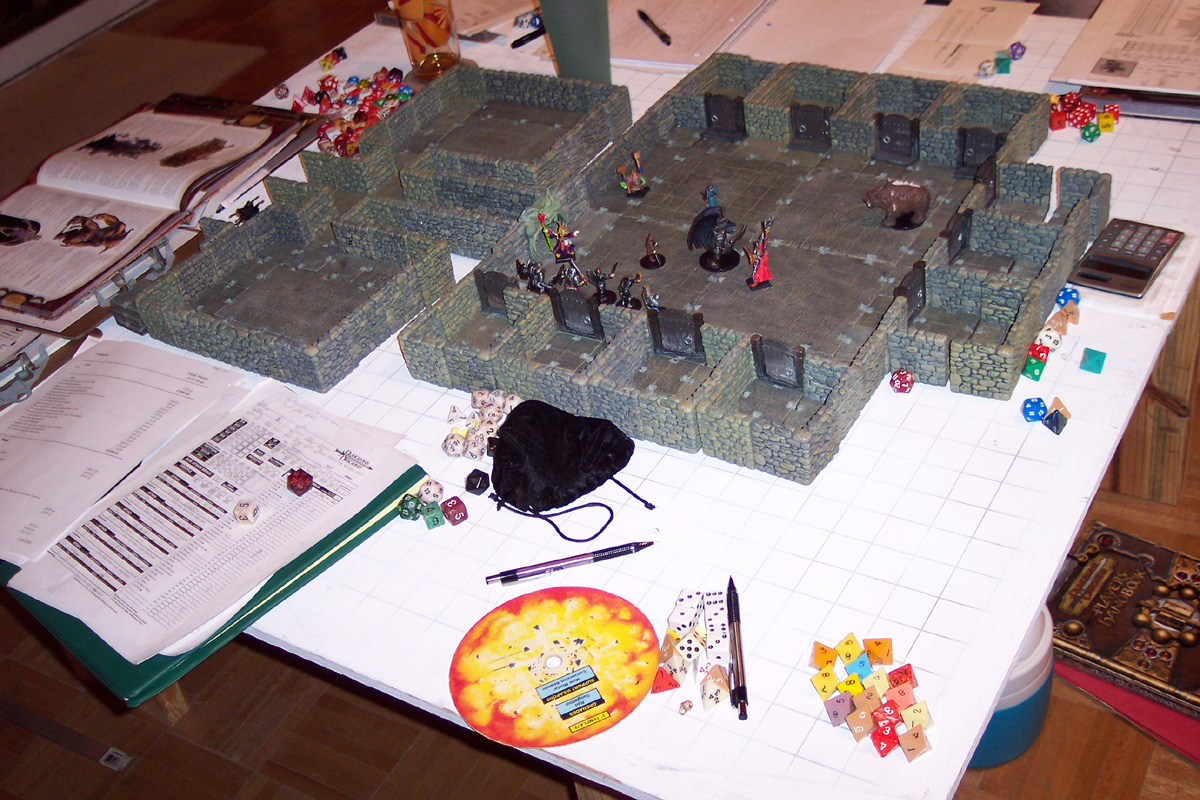
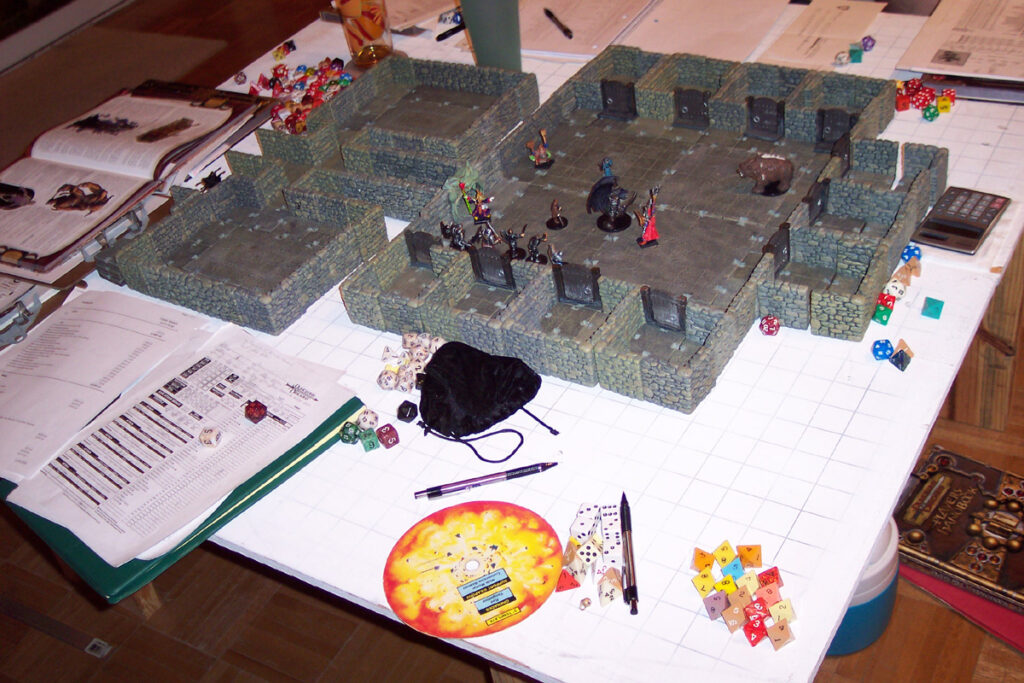
A tabletop miniatures game in progress — dungeon terrain, painted figures and piles of many-sided dice. The photograph shows a different game entirely, not Doom Arena; it is included because Arena preview coverage describes the same basic furniture of play: a gridded arena, miniatures and damage dice. Photo: Wikimedia Commons.
Who is making it — the Modiphius report checks out
The publisher identification in early coverage is correct. Doom Arena is developed and published by Modiphius Entertainment, the London tabletop publisher behind licensed games and miniatures lines for Fallout, Star Trek and Mass Effect, and it is officially licensed by id Software and Bethesda. GamesRadar+ and Punchboard both list the designer as Ben Maunder, while the Doom Wiki and GameSpot describe the design as a partnership with Resurrectionist Games, the studio working with Modiphius on the project. The Kickstarter campaign itself was fronted by Modiphius founder Chris Birch, whose name appears as the campaign creator. That is a settled, multi-source identification — publisher, designer and licensors all agree across Modiphius’s own press releases, the campaign page and independent coverage.
Modiphius announced the project in July 2025, ahead of that summer’s convention season. The announcement promised demos of early versions at Gen Con and QuakeCon, and Wargamer’s Gen Con 2025 report confirms the game was playable on the show floor, prototype miniatures and all. A further Modiphius press release on October 7, 2025 set the crowdfunding date, and the campaign launched on Kickstarter on October 28, 2025, running through November 21, 2025. GameSpot’s launch coverage put the funding goal at roughly $133,000, with a production timeline that ran through design work into March 2026, manufacturing from June 2026 and physical fulfilment in October 2026. The campaign page records the outcome: 1,785 backers pledged £295,657 — comfortably more than double the reported goal.
Two editions, one skeleton
Arena is not one box but two, sold as parallel editions sharing a core ruleset. One edition is flavoured after the original Doom of 1993 — pixel-era demons, the classic green-armoured Doom Guy, and arenas styled on the shareware generation. The other is built around Doom: The Dark Ages, the medieval-flavoured 2025 entry, with its own Slayer, its own bestiary and the Shield Saw among its signature mechanics. Maunder explained the relationship between the editions to TheGamer in terms of a shared skeleton wearing different muscle and skin: an Imp exists in both games, but its attacks and abilities differ between them, and the Dark Ages edition leans harder into close combat while the 1993 edition plays a cleaner game of range and positioning.
Modiphius’s announcement also trailed expansions drawn from both eras, including an Atlan mech and the Mecha Dragon Serrat from The Dark Ages. The Doom Wiki’s contents listings fill out the expansion shelf considerably: for the 1993 edition, Demonic Reinforcements adding Revenants and an Arch-vile, a Spider Mastermind expansion, a Barons of Hell expansion and alternative Doom Guy sculpts; for The Dark Ages, an Atlan expansion, a Serrat expansion, a Komodo expansion, a Prince Ahzrak boss expansion and further reinforcements. Backers tempted by everything faced a familiar crowdfunding ladder, detailed in the price section below.
How a match plays, according to the publisher and the previews
Strip away the branding and Arena is an asymmetric two-player skirmish. One player fields a single Doom Guy — or, in the other edition, the Slayer — and the other commands the assembled hordes of Hell. Matches are fought as a best of three rounds, with each round lasting six turns, and the winner of a round is not necessarily the side still standing. Damage is the score. Every point of damage inflicted earns Blood, the player who spills the most Blood in a round takes a keycard token, and the first side to hold the majority of keycards wins the match. GamesRadar+, Wargamer and GamingRespawn all describe that same loop, which suggests the Blood-and-keycards structure was fixed well before the prototype tour began.
The moment-to-moment rules are deliberately thin. Attacks, in Wargamer’s Gen Con account, always hit; what varies is the damage roll, made with colour-coded dice matched to the weapon, and the shape of the attack — a pistol firing in a long straight line, a shotgun covering a shorter, broader cone. Positioning therefore does the work that dice luck does in other skirmish games: sight lines, choke points and terrain decide whether a good roll is even possible. The hex arena adds its own hazards. GamesRadar+ reported yellow hexes that cost extra movement to cross, red hexes that damage anything standing on them and black pitfall hexes that eliminate a model outright, while Wargamer described impassable obstacles and acid channels on the roughly two-by-three-foot prototype board.
Escalation is where the shooter DNA shows. Between rounds, both sides spend Arsenal resources earned in play. The Doom Guy buys heavier weapons and upgrades — GamesRadar+ names the Plasma Rifle and the ever-present Chainsaw among the options — while the demon player recruits: either quantity, in swarms of Imps and Zombiemen, or quality, in the form of Cacodemons and the Cyberdemon. A Tempo system rewards the first damage dealt, granting tokens that unlock special abilities; for the Doom Guy, preview coverage lists effects such as adding stun to an attack, dealing retaliation damage, or spending heavily on a one-shot BFG attack. The demon side activates through a small pool of activation tokens — GamingRespawn puts the number at three — forcing the Hell player to choose which monsters move and fight each turn rather than advancing the whole horde at once.
Black polyhedral dice of the sort found in most gaming collections. Arena itself, according to Wargamer and GamingRespawn, rolls colour-coded damage dice matched to each weapon — attacks always hit, and the dice decide how much Blood a hit is worth. Photo: Wikimedia Commons.
The 1993 box: demons, loadouts and contents
For DOS-era players, the 1993 edition is the emotional centre of the project, and the tag attached to this post reflects that. The Doom Wiki’s contents summary for the classic core box lists 13 figures — Doom Guy models and 11 demons — alongside 20 combat dice, four arena maps, two Blood trackers, three keycards, 82 tokens, arsenal cards for the Doom Guy and the demons, weapon and upgrade cards, and a rulebook. GamesRadar+ counted the prototype’s demon cast as four fodder demons, two heavies and the Cyberdemon as the big boss, and named the core roster across the coverage: Imp, Lost Soul, Zombieman, the Shotgun Dude, Pinky and Cacodemon. Each demon, the previews agree, behaves the way long memory says it should. GamesRadar+ singled out the Lost Soul, which simply charges in a straight line, and the Cacodemon, which floats over hazardous terrain and fires its lightning ball along an unbroken straight line. Punchboard made the same point from the other side of the board, noting that Imps must loose their fireball before moving, exactly as the original game’s monsters commit the moment the player is spotted.
The alternative-sculpt expansions underline how deep the nostalgia well runs: separate Doom Guy figures armed with the BFG, the Chaingun, the Chainsaw, the Plasma Rifle and the Rocket Launcher were offered for the 1993 edition, with the Dark Ages Slayer receiving equivalent variants built around that game’s Accelerator, Grenade Launcher, Shredder, Pulveriser and Chainshot. The prototype boxes shown to previewers contained a single large map; GamesRadar+ and Punchboard both report that the finished game was set to include two double-sided large maps and one double-sided small map, a discrepancy against the Doom Wiki’s four-map contents list that likely reflects how the double-sided boards are counted.
What the previewers actually made of it
The consensus across the named outlets is unusually consistent, in both praise and reservation. GamesRadar+ gave the prototype an early verdict calling it a fantastic port that keeps the tone and charm of the source material, praising the way theme and core mechanics tie together, the range of miniatures, the quick setup and the pace of the rounds. The same review carried the preview’s clearest criticism: that the strategy can feel flat, with the writer wishing for extra layers — Doom’s secrets, hidden areas and vertical terrain were named as absences — beneath the arena fighting. Wargamer’s Gen Con preview reached a neighbouring conclusion from the opposite direction, arguing that the simplicity is the point. Its writer described a blunt, uncomplicated game whose carefully limited action economy turns positioning into the real contest, endorsed the designer’s own summary of the concept as heavy metal chess, and noted the perfect information on the board: nothing is hidden, so defeats are earned rather than dealt.
Punchboard, writing as a self-confessed sceptic about skirmish games, reported enjoying the prototype considerably, crediting the miniatures, artwork and the behavioural fidelity of the demons, and judging the asymmetric duel the right structural call. Its cautions were practical ones: the copy was an early prototype with components subject to change, and a strictly two-player box is a poor fit for bigger groups or solo players. GamingRespawn, which played the DOS-flavoured prototype, offered the warmest summary of the four, calling the game an easy recommendation on the strength of its action, its simple-to-learn and hard-to-master shape and a visual style that digitises photographs of the miniatures much as the 1993 original digitised sculptures into sprites. Read together, the four previews agree on the fundamentals — faithful, fast, accessible, tactically thinner than some players will want — and disagree mainly on whether that thinness is a flaw or the entire design working as intended.

A hobbyist painting a tabletop miniature — a different publisher’s figure, photographed for Wikimedia Commons, and not an Arena model. The Premium Edition of Arena was sold on the full set of plastic miniatures, while the cheaper Standard Edition swapped most figures for acrylic standees. Photo: Wikimedia Commons.
Prices, pledges and the two-tier box
Reported pledge prices vary slightly between outlets and territories, so the honest summary is a range with its sources attached. Wargamer’s launch coverage put the cheapest pledge containing a full game at $60 (£45) for the Standard Edition of either flavour, rising to $80 (£60) for the Premium Edition; GamesRadar+ listed pledges from £55 in its preview specifications. TechRaptor’s tier breakdown, in dollars, ran from $61 for Standard and $81 for Premium up through $254 for both Premium editions with their reinforcements and $441 for an all-in tier with every expansion and two themed dice trays. The distinction between the two main tiers is components, not rules: the Standard Edition represents the fighters with acrylic standees and includes a single plastic Doom Guy miniature, while the Premium Edition replaces the standees with the full plastic miniature set. Birch told Wargamer at Gen Con that the core boxes were designed for eventual retail rather than as a giant two-hundred-dollar crowdfunding monument, a positioning the eventual pledge prices broadly bore out. GamesRadar+ lists the game for ages 14 and up, at a moderate complexity, with playing time put at 30 to 45 minutes by both GamesRadar+ and Punchboard.
One player-count wrinkle deserves flagging rather than smoothing over. GamesRadar+ listed the game as two players at preview and two to four at launch, while Punchboard treated the finished design as two-player only and the Doom Wiki describes three- and four-player modes as future additions planned beyond the two-player core. The safe reading is that Arena was designed, previewed and primarily sold as a duel, with any larger-player modes belonging to the game’s announced future rather than to the box previewers played.
Status as of October 2026: the window, not yet the receipt
The campaign’s own schedule, as summarised by GameSpot at launch, pointed to October 2026 for physical fulfilment, and the Doom Wiki still describes the game as upcoming with an expected release in that month. As of late October 2026, the checkable public record stops short of confirming delivery. The Kickstarter page, last updated on October 21, 2026, still advertises a late-pledge route through the pledge manager alongside its final total of £295,657 from 1,785 backers, which places the project in its late-pledge and production phase rather than in post-fulfilment aftercare. BoardGameGeek’s listing for the Dark Ages edition likewise records its release status as unreleased. No source checked for this preview — Modiphius’s press pages, the campaign page, the Doom Wiki or BoardGameGeek — reports backer copies shipped, a retail street date reached or a finished-copy review published. The accurate status, then, is neither shipped nor formally announced as delayed: October 2026 was the announced target, the month has effectively arrived, and confirmation of fulfilment had not appeared in the public record when this was checked. Readers weighing a late pledge should treat that as an open production timeline, not a game already sitting in warehouses.
What can be said without qualification is narrower and, for a preview, enough. A respected licensed-tabletop publisher took the most influential shooter ever made, handed it to a designer who reduced it to speed, violence and escalation, and produced a prototype that four separate outlets found faithful and fun while questioning its depth. Whether the finished boxes answer that question is a judgement that has to wait for finished boxes — which, on the evidence available in October 2026, is precisely where Doom Arena still stands.