
If you want a single snapshot of what mainstream American gaming looked like in 2025, do not start with awards lists or social-media arguments. Start with the till receipts. When Circana — the market-research firm formerly known as NPD — published its year-end United States charts in January 2026, through senior director Mat Piscatella, the pattern was stark enough to summarise in one sentence: on PlayStation and on Xbox, the ten biggest premium games of the year were, with exactly one exception, built to be played with, against, or alongside other people. Shooters, annual sports sims, co-operative hunts and online racers took nineteen of the twenty combined places. One solitary, offline, story-driven samurai epic took the other.
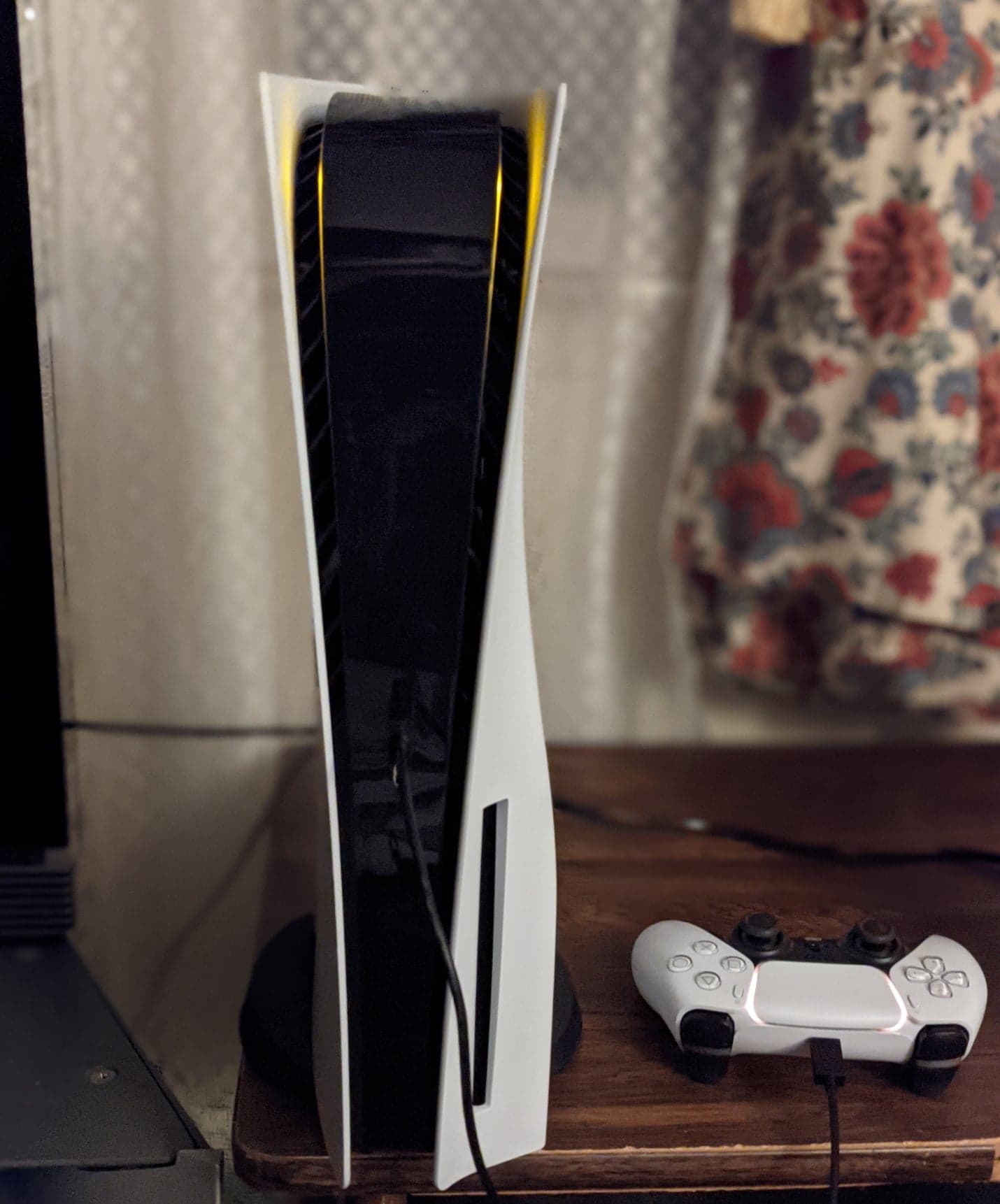
A PlayStation 5 with its DualSense controller. On PlayStation platforms in the US, nine of the ten best-selling premium games of 2025 were multiplayer titles. Photo: Wikimedia Commons.
First, read the chart correctly: this is a dollar-sales ranking
Precision matters here, because Circana publishes several different rankings and they answer different questions. The year-end best-sellers lists discussed in this feature are ranked on dollar sales of full games — physical copies sold at US retail plus tracked digital full-game sales from the publishers that share data through Circana’s Digital Leader Panel, covering the PlayStation, Xbox, Nintendo eShop, and PC storefronts named in the panel. They are not unit charts: a game sold at a premium price can outrank a cheaper game that shifted more copies. They exclude add-on spending entirely, so downloadable content, microtransactions, battle passes and in-game currency do not count towards a title’s position. And they measure purchases, not play — a copy downloaded through a subscription library is not a sale, however many hours its player logs.
Two footnotes travel with the data wherever it goes. Nintendo does not share digital sales for its own platforms, so every Nintendo-published entry in these charts is marked with an asterisk and ranked on physical sales alone; its true dollar figure would be higher. Sony’s baseball series carries a similar caveat the other way round: digital sales of MLB The Show 25 on Nintendo and Xbox platforms are not included in its all-formats total. Circana also publishes rankings without releasing the underlying per-game dollar amounts, so what is public — and all this feature relies on — is the order of the lists, the publishers, and the headline market totals Piscatella shared alongside them. Those totals put some scale behind the story: US spending across games, hardware and accessories reached about $60.7 billion in 2025, up roughly 1% on 2024, with content spending of $52.3 billion and subscription spending up 20% for the year.
PlayStation’s top ten: nine multiplayer games and a lone samurai
Here is the full PlayStation platforms chart for 2025, ranked on full-game dollar sales, exactly as Circana published it:
- NBA 2K26 (Take-Two Interactive)
- Battlefield 6 (Electronic Arts)
- Ghost of Yotei (Sony)
- Call of Duty: Black Ops 7 (Microsoft)
- Madden NFL 26 (Electronic Arts)
- EA Sports College Football 26 (Electronic Arts)
- MLB The Show 25 (Sony)
- Call of Duty: Black Ops 6 (Microsoft)
- EA Sports FC 26 (Electronic Arts)
- Forza Horizon 5 (Microsoft)
Work down that list and sort it by type. Five places belong to annual sports simulations: basketball, two flavours of American football, baseball and world football. Three belong to military shooters — one Battlefield and two different Call of Duty releases, with 2024’s Black Ops 6 still generating enough premium sales in its second calendar year to hold eighth place. The tenth spot belongs to Forza Horizon 5, an online racing game that spent years as an Xbox and PC title before arriving on PlayStation in 2025 and promptly outselling almost everything else on the platform. That leaves precisely one game with no multiplayer component at all: Sucker Punch’s Ghost of Yotei, Sony’s open-world tale of a lone ronin hunting the men who destroyed her family, sitting in third place overall.
Yotei’s position deserves underlining rather than a passing mention. It launched in October, giving it roughly a quarter of the selling year that most rivals enjoyed, and it still finished ahead of both Call of Duty entries, both EA football games and every other sports title except NBA 2K26. Only Battlefield 6 — the year’s biggest game across all formats combined — and the basketball sim finished above it. As several outlets noted when the chart appeared, it was the only purely single-player release inside the PlayStation ten. There is a second quiet story buried in the publisher column, too: three of the ten are Microsoft-published games, more than the two published by Sony itself on its own platform. The old platform walls are not just cracking; on this evidence, they are already load-bearing doorways, and traffic flows through them in both directions — as the Xbox chart is about to show.
Xbox’s top ten: the same story, with no exception at all
The Xbox platforms chart for 2025, again ranked on full-game dollar sales, reads as follows:
- Battlefield 6 (Electronic Arts)
- NBA 2K26 (Take-Two Interactive)
- EA Sports College Football 26 (Electronic Arts)
- Madden NFL 26 (Electronic Arts)
- Borderlands 4 (Take-Two Interactive)
- Helldivers II (Sony)
- Monster Hunter Wilds (Capcom)
- EA Sports FC 26 (Electronic Arts)
- WWE 2K25 (Take-Two Interactive)
- Call of Duty: Black Ops 7 (Microsoft)
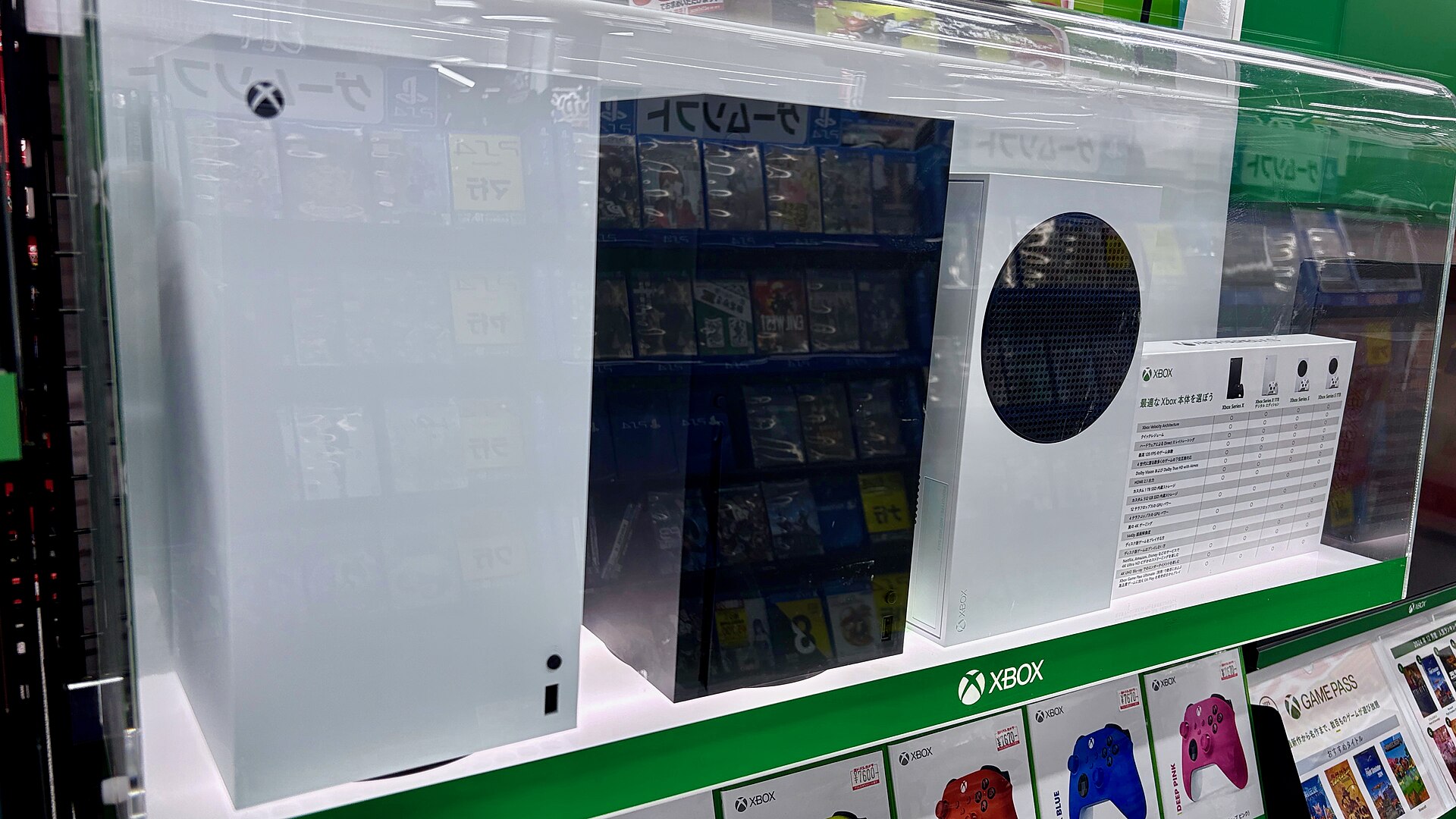
Xbox Series X and Series S consoles in a retail display case. Every one of the ten best-selling premium games on Xbox platforms in the US in 2025 featured multiplayer play. Photo: Wikimedia Commons.
On Xbox there is not even a Yotei-shaped exception. All ten entries can be played with other people, and most are unthinkable without them: Battlefield’s large-scale online warfare, Helldivers II’s four-player co-operative live service — published, remarkably, by Sony on its rival’s hardware — Monster Hunter Wilds’ co-operative hunts, Borderlands 4’s co-op campaign, five annual sports or sports-entertainment titles, and Call of Duty. The differences from the PlayStation list are as instructive as the similarities. College football outranks professional football on Xbox, the reverse of their PlayStation order. Borderlands 4 and Monster Hunter Wilds, both top-four games in the all-formats chart, appear here but not in PlayStation’s ten. And Black Ops 7, the newest Call of Duty, sits down in tenth on its publisher’s own platform while placing fourth on PlayStation and fifth across all formats.
Circana’s own commentary supplies the obvious explanation for that last oddity, and it loops back to the methodology warning at the top of this feature. Black Ops 7 was available through Game Pass, and a player who accesses a game through a subscription generates no full-game dollar sale for these charts to record. Piscatella’s year-end notes flagged its softer Xbox sales in exactly those terms. The chart is not saying Xbox players ignored Call of Duty in 2025; the engagement data below says the opposite. It is saying that on Xbox, a large share of that play was rented through a subscription rather than bought outright — and a dollar-sales ranking is blind to every hour of it.
Multiplayer is not a synonym for live service — and the distinction matters
Coverage of these charts, including the headline this feature replaces, tended to compress the finding into two words: live service. That shorthand captures something real, but it blurs at least three different business models into one. Battlefield 6 and Helldivers II genuinely are live services, designed around seasons, updates and a player base that is expected to stay for years. The annual sports titles are a hybrid: premium, full-price releases rebuilt every year, wrapped around live-service modes and year-round content drops. Borderlands 4, Monster Hunter Wilds and Forza Horizon 5 are something else again — premium games with strong co-operative or online components and post-launch support, but built first as products you buy rather than platforms you inhabit.
What unites the nineteen, across all three models, is not a monetisation label but a design centre of gravity: other players. Every one of them assumes an internet connection, a friends list, a squad, a league or a lobby. The one game in either list that assumes none of those things — a solitary, authored, finishable story — is also the one that had to be a major first-party exclusive, from a celebrated studio, sequel to a beloved hit, to break through at all. That is the accurate version of the headline finding, and in its own way it is more striking than the shorthand: in the US premium market in 2025, designing a big game primarily for one person had become the exception that needed exceptional circumstances.
Even Nintendo had a ton of multiplayer hits — but on its own terms
The scrap of the original report that survives in this post’s notes — the observation that even Nintendo had a stack of multiplayer hits — checks out against Circana’s Nintendo platforms chart for 2025, with the standing caveat that Nintendo’s entries are ranked on physical sales only, because the company does not share its digital figures:
- Pokemon Legends: Z-A (Nintendo)
- Donkey Kong Bananza (Nintendo)
- Super Mario Party Jamboree (Nintendo)
- Mario Kart 8 (Nintendo)
- Mario Kart World (Nintendo)
- Super Mario Galaxy + Super Mario Galaxy 2 (Nintendo)
- Metroid Prime 4: Beyond (Nintendo)
- Minecraft (published for Nintendo platforms by Nintendo)
- Hogwarts Legacy (Warner Bros. Games)
- Kirby Air Riders (Nintendo)
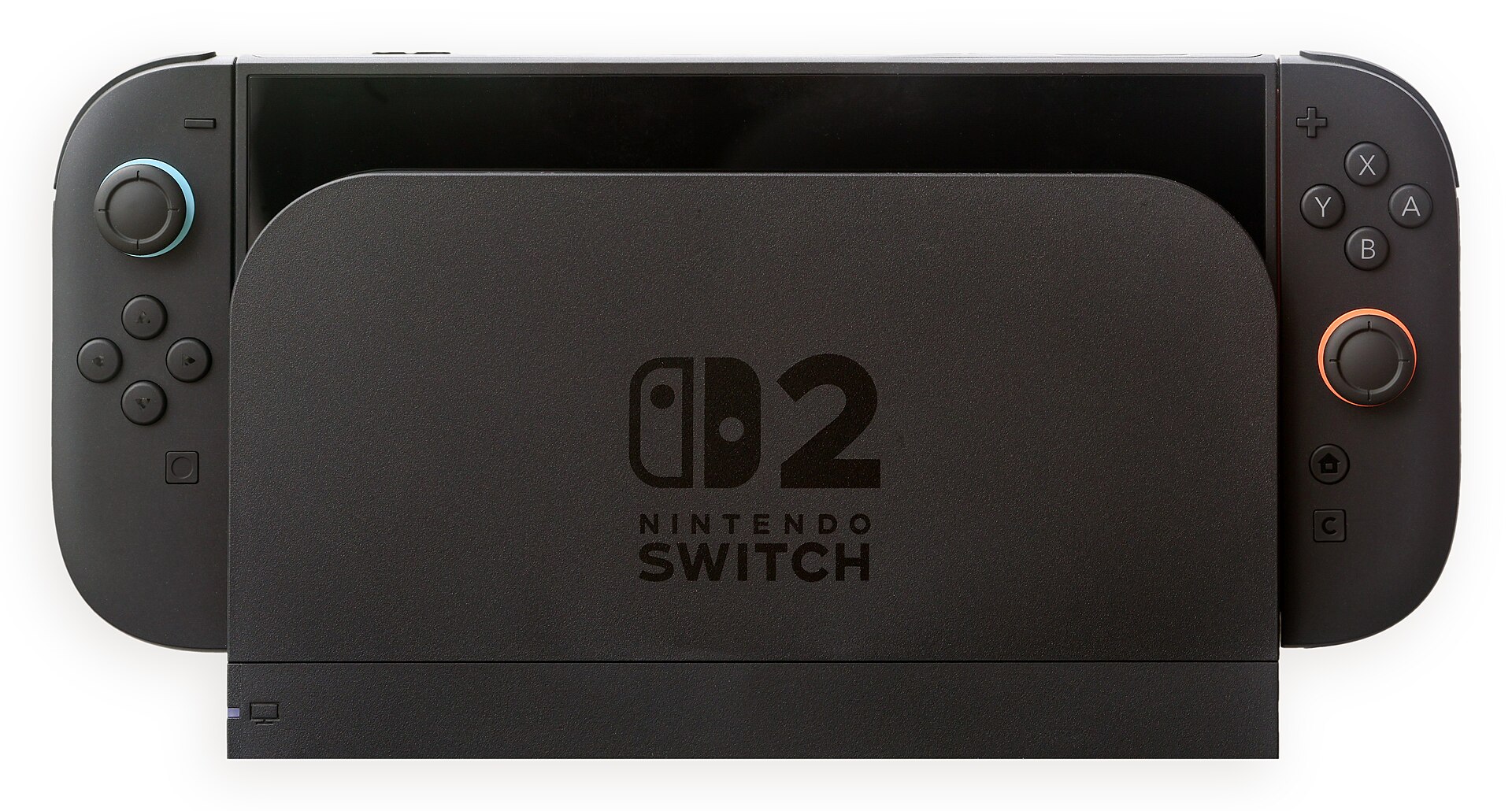
A Nintendo Switch 2 in its dock. Nintendo’s own US chart for 2025 mixed multiplayer staples such as Mario Kart and Mario Party with major single-player releases. Photo: Wikimedia Commons.
Count the multiplayer presence and the stub’s claim holds: Mario Party in third, two separate Mario Kart games in fourth and fifth — the evergreen Mario Kart 8 still selling at full speed alongside its Switch 2 successor, Mario Kart World — the multiplayer racer Kirby Air Riders in tenth, Minecraft in eighth, and a Pokemon adventure with trading and battling baked into its identity at number one. Yet the shape of Nintendo’s chart is fundamentally different from its rivals’. There are no annual sports sims, no military shooters and nothing that would normally be described as a live service. And single-player games are not squeezed into a single heroic exception here: Donkey Kong Bananza, the Galaxy collection and Metroid Prime 4: Beyond give authored, primarily solo adventures three of the top seven places, with Hogwarts Legacy — the only entry in the ten not published by Nintendo — adding a fourth in ninth. Nintendo’s audience, at least at physical retail, still buys story games in chart-topping quantities; it simply buys an unusual amount of local and online multiplayer alongside them. The hardware context reinforces the point: the Switch 2 was the best-selling console in the US in 2025 in both units and dollars, reaching 4.4 million US sales in its first seven months — the fastest-selling hardware platform Circana has tracked.
The other chart: what America actually played most
Set the sales rankings beside Circana’s separate Player Engagement Tracker and the picture sharpens — and complicates. In early January 2026, Piscatella published the five most played games of 2025 for each console ecosystem, ranked by the share of Circana’s active player panel that played them. On PlayStation the five were Fortnite, Call of Duty, Grand Theft Auto V, Roblox and Minecraft. On Xbox they were Fortnite, Call of Duty, Grand Theft Auto V, Minecraft and Roblox. The PlayStation order was identical to 2024’s; the Xbox five contained exactly the same games, merely shuffled. Piscatella also noted that Fortnite reached more than half of all active PlayStation and Xbox users at least once during the year.
Notice who is missing from the best-sellers lists: Fortnite and Roblox, the two biggest engagement phenomena in the business, do not appear in the premium top tens at all, because they are free to download and this ranking counts full-game purchases while excluding the add-on spending where those games make their money. Conversely, notice who dominates the sales lists but barely registers as a new engagement story: this year’s sports sims and shooters, bought in enormous dollar volume by players whose total hours are still heavily mortgaged to older, free or already-owned giants. Sales and engagement are not two views of the same mountain. They are two different mountains, and 2025’s data shows the industry increasingly living on both at once — selling premium multiplayer games into an attention economy that free live services already own.
So did any story games actually sell? Yes — just not quite high enough
It would be wrong to leave the all-formats chart unread, because it softens the bleakest version of the story. Across every platform combined, Circana’s full-game dollar ranking for 2025 was led by Battlefield 6, NBA 2K26, Borderlands 4, Monster Hunter Wilds and Black Ops 7, followed by the three big EA sports titles. But ninth place went to The Elder Scrolls IV: Oblivion Remastered, a primarily single-player role-playing game — albeit one carried by a famous name, a surprise release and two decades of accumulated affection. Ghost of Yotei placed eleventh overall, and Kingdom Come: Deliverance II, a demanding, defiantly single-player medieval RPG with no multiplayer at all, held fifteenth. The co-operative narrative adventure Split Fiction reached nineteenth. Premium single-player games, in other words, did not vanish from the American market in 2025. Three of them made the combined top twenty. What they did not do, on PlayStation or Xbox individually, is crack the platform top tens — Yotei’s third place on PlayStation standing as the single, conspicuous breach.
What is not public is worth stating plainly, too. Circana’s published year-end material gives ranks, publishers and market-level totals, not per-game dollar or unit figures, and the full platform charts beyond the top tens were not published in the material Piscatella shared. So no honest version of this story can tell you how many copies Yotei sold in the US, how close Oblivion Remastered came to the PlayStation ten, or exactly how large the Game Pass effect on Black Ops 7’s Xbox ranking was. Anyone quoting precise US unit numbers for these games is working from estimates, leaks or other territories’ data, not from Circana’s public release.
What it means
Read carefully, the 2025 charts describe a premium market that has sorted itself into a stable hierarchy. At the top sit recurring multiplayer ecosystems — sports leagues that renew every autumn, shooters that function as social hubs, co-operative games built to be replayed with the same friends for months. They dominate dollar sales because they are bought at full price, early, by large and loyal audiences, and they dominate engagement because they never really end. One rung down, event single-player games can still break through — but the 2025 evidence suggests the toll for entry is high: a first-party exclusive with a famous predecessor, a beloved remaster, or a word-of-mouth RPG hit, each arriving with the force of an occasion. Nintendo’s ecosystem remains the partial exception, where first-party single-player adventures still top charts as a matter of routine, cushioned by the strongest local-multiplayer catalogue in the business.
None of that makes the single-player game an endangered species; Yotei outsold two Call of Duty games on PlayStation, after all. But it does explain the strategic weather every publisher now works in. A chart in which nineteen of twenty platform places belong to games played with other people is not an accident of one odd year — the engagement top fives were unchanged from 2024, remember — it is the structure of the market declaring itself. The story games that thrive in it will be the ones treated, by their makers and their players alike, as events. In 2025, exactly one of them gatecrashed the PlayStation and Xbox top tens. That she did it alone, on horseback, with a sword, feels about right.
Sources: Circana US video game sales reporting for December and full-year 2025, published January 2026 via Mat Piscatella (platform top tens, all-formats top 20, market totals and Player Engagement Tracker top fives, all ranked as described in the text). Additional publication of the same Circana tables by GamesBeat and Install Base; PlayStation chart coverage by Push Square and TheGamer.