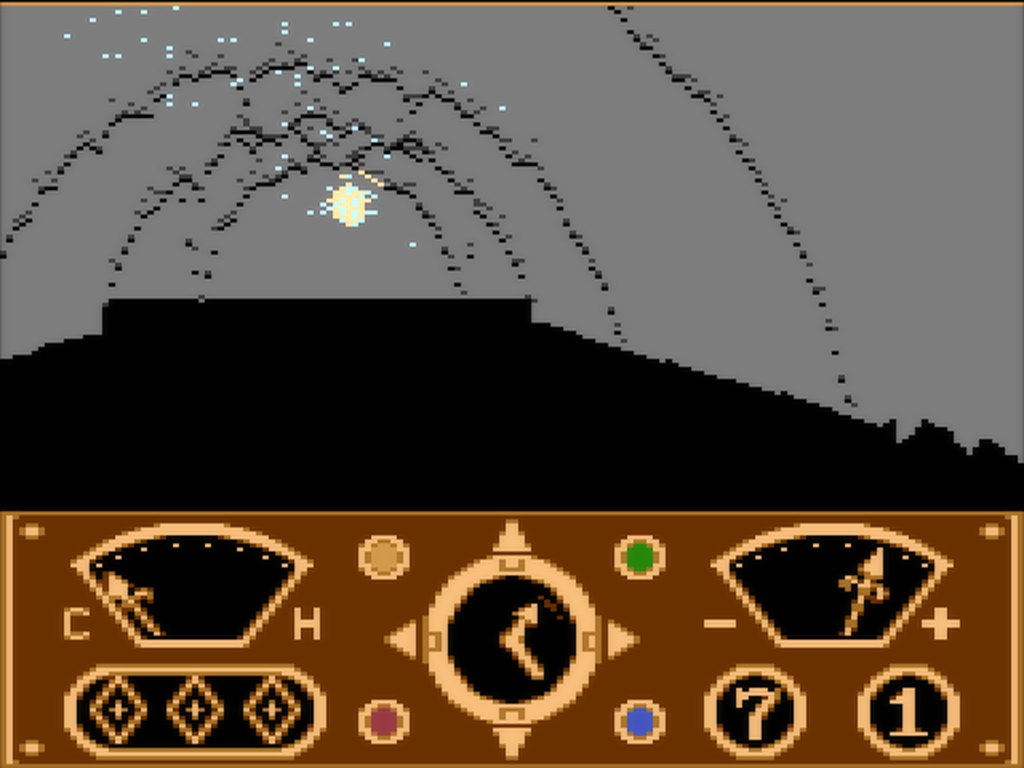
At a glance: The Eidolon · Atari 400/800 · Lucasfilm Games / Epyx, 1985 · First-person exploration / shooter · Score: 8.0/10
Of all the strange, ambitious games Lucasfilm’s infant games division shipped in 1985, The Eidolon is the strangest. Charlie Kellner’s design sends you into a fractal cave system inside a Victorian inventor’s dream-machine, armed with coloured fireballs and a century of accumulated weirdness, to wake seven dragons and finally face the Eidolon itself. It is a first-person shooter, an adventure game and a fever dream at once — on an 8-bit computer, in 1985, before ‘first-person shooter’ was even a phrase.
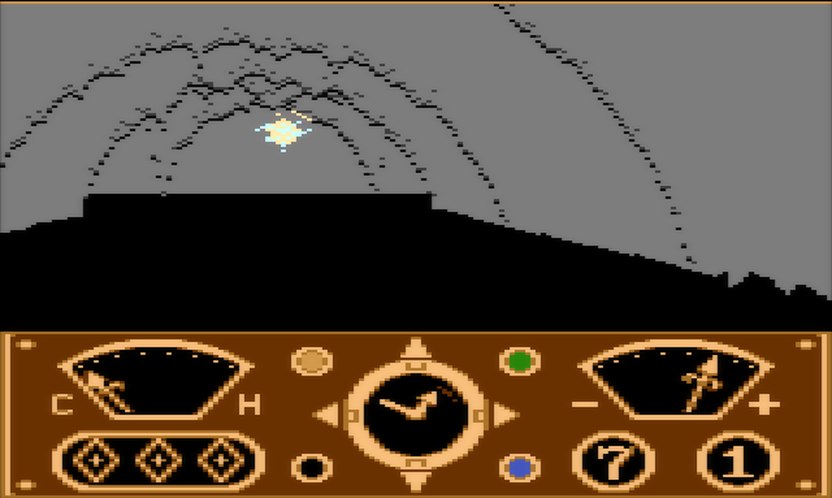
The framing is pure pulp: in a dusty basement you find Dr Josef Agon’s Eidolon, a machine that runs on the energy of your own mind, and mounting its seat transports you into a cavern network that is different every time you descend. A little brass-and-glass dashboard of dials and gauges — the Eidolon’s own instrument panel — frames the cave view, and the fiction never lets go: you are not a marine, you are a gentleman scientist’s alter ego exploring the inside of an idea.
Caves drawn by mathematics
The caves use the same fractal lineage as Rescue on Fractalus!, turned inward. Instead of mountains under a sky you get branching tunnels that undulate and fork, rendered in shaded bands of colour that slide past with a dreamlike smoothness. Enemies — gremlins, puffs, bottlenecks and other escaped thoughts from the game’s bestiary — bob towards you down the tunnels. It is slower and more deliberate than its stablemate: The Eidolon is a game of corridors, choices and resource dread.

Your weapons are fireballs in four colours, collected as you explore, and colour is the game’s language. Each creature is vulnerable to a particular hue; each dragon, when you find its chamber, demands the right sequence of colours poured into it while it breathes down the tunnel at you. Fire the wrong colour and you merely feed the problem. Energy is everything: moving drains it, firing drains it, and the caves’ scattered fireflies and gems must be hoovered up to keep the machine — and you — alive. The result is a constant low-level calculation that modern survival games would recognise: push deeper on a falling gauge, or turn back along tunnels you have already mapped in your head.
Dragons as examinations
The seven levels are guarded by dragons of increasing temperament, and waking one is the game’s set-piece: a vast head filling the tunnel, demanding the correct coloured tribute at speed while your energy counter spins down. Beat it and you may pass deeper; fail, and the cave keeps you. Between dragons the game is oddly meditative — part maze navigation, part colour-matching under pressure — and the map screen, a glowing chart of explored tunnel, becomes a prized possession on the long levels.

The Eidolon is what happened when a film studio’s skunkworks was told to make games nobody had made before — and took the instruction literally.
Honesty demands the caveats. The pace is glacial next to Fractalus; the colour-matching combat can feel like sitting an exam while the invigilator breathes on you; and the fractal tunnels, for all their novelty, repeat their tricks across seven levels that differ more in palette and temper than in structure. Frame rates dip hard when dragons and fireballs share the screen. This was the least commercial of Lucasfilm’s first wave, and you can feel why — it asks a lot of a player in exchange for its wonders.
An argument for slow games
The Eidolon’s pace, so easy to list as a fault, deserves a defence. Kellner and the Lucasfilm team were not failing to make an arcade game; they were declining to. The caves are built for a different verb set — explore, conserve, deduce, dread — and the game’s systems conspire to slow you down and make slowness interesting. Your energy gauge is a clock you can hear. The map fills in like a diary of your own courage: here is as far as I dared, here is where the dragon lives, here is the junction I never explored. When a modern designer talks about ‘walking simulators’ or the deliberate pacing of a Soulslike’s worst corridor, they are describing pleasures The Eidolon was already bottling in 1985, in tunnels drawn from equations, behind a dashboard of brass dials.
Its commercial fate tells the era’s story in miniature: the third Lucasfilm title in a year, on a platform whose owner had just been sold, asking players to read a fat manual and think in colours — The Eidolon sold to the faithful and puzzled everyone else, then spent forty years being rediscovered by exactly the players it was made for. Time has been kind to it in the way time is kind to the genuinely original. The dragons are still down there, breathing in the dark, waiting for someone patient enough to learn their colours. Be patient. Bring fireballs. Mind the gauge.
The diary in the machine
The Eidolon’s strangest inheritance is its fiction carrier: the game shipped with the diary of a vanished Victorian inventor, recovered (the manual insists) with the machine itself, and the tale it tells — of explorations that went somewhere worse than caves — is the game’s only map of its own meaning. Lucasfilm would return to this device, most famously with the Grail Diary, but here in 1985 it is already fully formed: documentation as storytelling, the manual as prop. Read the diary before your first descent and the caves change character — the guardians become specimens, the gems become evidence, the levels become strata in an argument between science and whatever lives at the bottom. Few games of the decade trusted print this much, and fewer still reward the reading so completely. The dragon at the eighth level is a fine spectacle without the diary. With it, the dragon is a conclusion.
The machine itself
A moment for the vehicle, because the Eidolon — the machine you ride — is one of the great game artefacts: a brass-and-crystal Victorian prototype that runs on the energy it steals from its enemies, an anachronism with a dashboard. Its gauges are diegetic before the word existed; its weapons are the coloured fires it harvests; its very existence in the caves is the diary’s central mystery. Lucasfilm’s artists understood that a first-person game is a portrait of the player’s tool, and they built a tool worth framing. When modern games hide the gun and show the hands, when dashboards bloom with brass and glass, they are quoting a machine that was old-fashioned on purpose, in 1985, on a computer pretending to be a time machine. It still looks like the future the Victorians promised themselves.
A note on pace
Modern players should set expectations honestly: The Eidolon walks where its siblings flew. The machine’s advance is stately, the caves reward deliberation, and the game’s scares are of the slow-reveal school — a shape resolving out of blackness at the edge of the lamp’s light. Players raised on Fractalus’s speed sometimes bounce off the first cave. Give it the second. The pace is the meaning: you are not raiding these depths, you are surveying them, in a machine built by a man who vanished into them, and the game will not hurry its argument. Few titles of any era have the confidence to be this quiet. Descend at its speed and it will show you things the fast games cannot.
Verdict
Yet the wonders are real. The Eidolon is one of the most original games of the 8-bit era — a first-person, procedurally tunnelled, colour-coded dragon hunt wrapped in a story about exploring the inside of your own mind, from a studio six months old. As a game it is an 8; as an experience, and a piece of history you can still play, it earns every point of it. Descend at least once. The machine is waiting in the basement.