At a glance: The Horde · 3DO · Toys for Bob / Crystal Dynamics, 1994 · Strategy action · Score: 8.0/10
Before tower defence was a genre with a name, The Horde was doing it with a sword, a bag of gold and Kirk Cameron. Toys for Bob’s 1994 strategy-action hybrid casts you as Chauncey, a serving boy elevated to knight and granted land by the King — land that happens to sit in the path of the Horde, a ravening mob of red gremlin-like Hordlings who stream out of the wilderness each season to eat your village, your crops and eventually you. Your job splits in two: spend the calm months building and defending, then draw your sword and hold the line yourself when the horde arrives. It is inventive, funny and surprisingly tense — one of the 3DO’s most original games.
The structure is a full feudal career. You serve through a series of fiefs, each a few years long, moving from the gentle Shimto Plains to frozen wastes and swamps, growing a village from two huts and a cow into a walled town with shops, while the taxman — in the person of the Chancellor, played in glorious FMV by Michael McCafferty — skims your treasury for the Crown. Fail to make the village pay and the King takes the land back. Let the Hordlings eat it and there is nothing left to tax. Between the two pressures, a complete little economic strategy sim runs under the action.
Dig, build, panic
The building phase is played from a raised isometric view with the seasons as your clock. You dig pits and moats, plant spike traps and decoy cows, raise fences and walls, hire archers, and lay out crops and houses so the village earns while it defends. Every choice is a wager: a new cow is income the Hordlings will cross the map to eat; a wall segment is money that grows nothing. The interface is pure 1994 — cursor, menus, a certain amount of fighting the controller — but the design underneath is sharp, legible and decades ahead of its time.

Then the season turns, the horn sounds, and the game becomes an action title. Hordlings pour in from the map edges in classes — runners, brutes, shamans who raise the dead, diggers who tunnel under walls — and you become the mobile reserve, sprinting between breaches with your sword, rescuing villagers, and making the horrible arithmetic of defence: save the cows or save the houses, hold the gate or chase the shaman. The isometric melee is simple — swing, dodge, repeat — but the pressure it operates under makes it sing. A defence that looked elegant on paper becomes a screaming improvisation, and winning by one surviving villager feels like a triumph.
A storybook with teeth
Presentation carries the concept a long way. The whole game is framed as a storybook narrated in full-motion video, with live actors in costume delivering the royal court’s scenes with pantomime gusto — including a young Kirk Cameron as Chauncey himself, earnest and bewildered, and a Chancellor oozing villainy in every frame. It should be embarrassing. Instead it is charming, because the game commits completely: the art direction, Paul Reiche III’s team’s writing and the performances all pull in the same direction, toward a fairy tale that knows it is funny.
The Horde’s genius is the seam between its two halves: the planner builds the battlefield, then the soldier has to live in it.
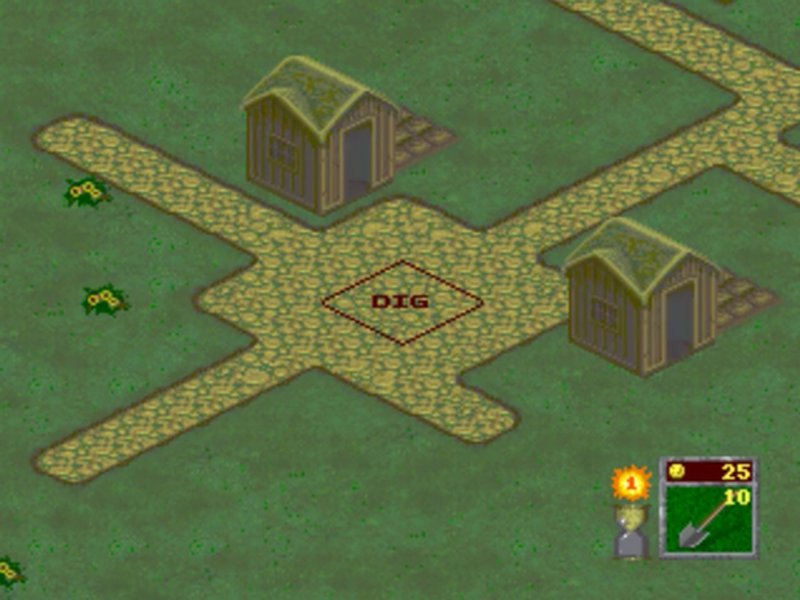
The sound design plays its part — pastoral calm in the building months, drums and shrieks when the season turns — and the Hordlings themselves are little masterpieces of spiteful animation, cackling as they gnaw through your granary. Technically the 3DO version, the original and best-presented edition, keeps the action readable even as the sprite count climbs in the late-game sieges.
The cracks in the wall
Honesty requires listing the faults. The action half never quite matches the strategy half’s depth: Chauncey’s swordplay is functional rather than expressive, and late sieges can become wars of attrition decided by preparation hours earlier. The controls, particularly cursor work at speed, belong to their era. Save space and password-era friction apply. And the difficulty spikes — the swamp fiefs punish a village built for plains — will test the patience of players raised on gentler onboarding.
None of which overturns the verdict forming since 1994: this is one of the most forward-looking designs of its generation. Base-building, wave defence, hero units, economic pressure — the ingredients of a dozen later genres, assembled with humour and a storybook’s heart, on a console that supposedly only did racing games and FMV.

The economy of fear
The game’s deepest system is its money, and it deserves an autopsy. A village in The Horde is a little engine: crops planted in the calm appreciate into gold, cows multiply value and vulnerability in equal measure, and every defensive crown spent is a crown not compounding. The Chancellor’s taxes arrive like weather — indifferent, escalating, and fatal if ignored — so the player is always solving two sieges at once, the Hordlings at the fence and the Crown at the ledger. This is why the building phase has its peculiar tension: you are not decorating, you are allocating, against two clocks, with incomplete information about which threat arrives bigger. Later strategy games would build entire genres on that allocation anxiety. The Horde serves it with a sword in your hand and a cow in peril.
The later fiefs show the design’s range. Snowfields slow the horde and starve the crops; swamps breed specialised horrors; the desert turns water and shade into strategy. Each new land re-prices every building you trusted, and the campaign’s length — a full feudal career across five holdings — is justified by how thoroughly each biome re-teaches the game. By the final fief your village is a fortified economy with a flag, your sword arm is a genuine military asset, and the season’s turn still makes your stomach drop. Games that manufacture that feeling on schedule, for hours, are not accidents.
Toys for Bob would go on to Star Control’s fame before it and Skylanders’ empire after, but The Horde is the studio’s design signature in its purest form: systems with jokes in them, jokes with systems under them. The 3DO original remains its best edition — the platform it was built for, with its video storybook and its colour intact.
New players, start here
For the tower-defence generation arriving fresh: the Shimto Plains’ first year is the tutorial the genre would later formalise — build less than you want to, keep a reserve for the Chancellor, and put your first fences where the Hordlings actually walk rather than where the village looks prettiest. The game teaches by eating your mistakes, gently at first. Stick with it past the second fief, where the systems interlock, and The Horde stops feeling like a novelty and starts feeling like what it is: the ancestor in the room, still holding court.
Availability
The Horde later travelled to the Saturn, the PlayStation and the PC, and those ports are respectable — but the 3DO original remains the edition with the full storybook presentation and the design’s home-turf polish, and it is common enough on the collector market to be an easy recommendation rather than a trophy hunt.
Verdict
The Horde is the 3DO library in miniature: a Toys for Bob invention too original for its own commercial good, presented with money and wit, and playable today with almost nothing lost. Tower defence fans owe it a pilgrimage; everyone else will find a strategy game with a sword in its hand and a grin on its face. Score: 8.0/10