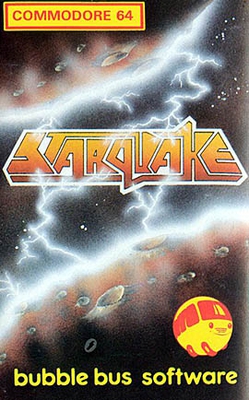
Starquake began with a screenshot its creator never followed up. Stephen Crow saw a single magazine picture of Ultimate Play The Game’s Underwurlde, decided he wanted to build a vast side-on world of his own, set it in space — and then never played Underwurlde at all. He didn’t own it. He barely knew what it was about. Everything else about his 1985 Spectrum classic, from its little round hero to its five hundred and twelve screens, was worked out from that one image and a stubborn belief that a home computer game should move at fifty frames per second, no excuses.
Learning From the Masters
Crow was a classic bedroom coder, and like many of his generation he had taught himself by studying the games he admired. Ultimate, the Leicestershire studio behind Atic Atac and Sabre Wulf, were his benchmark — the pinnacle of what the Spectrum could do. His earlier game Wizard’s Lair had been built quite openly from Ultimate DNA, a top-down maze adventure mixing ideas from Atic Atac and Sabre Wulf, even though, almost unbelievably, he had never owned Atic Atac. He was learning by reverse-engineering screenshots and reputation as much as code.
After Wizard’s Lair he turned down an approach from Thorn EMI and signed instead with Bubble Bus Software, a small publisher that had just set up in his own hometown of Tonbridge. It gave him a local, personal home for the most ambitious thing he had attempted: a huge explorable planet, built around a hero he had already designed in his head. Bubble Bus was the right size of publisher for it, too — close enough to trust its coder completely, small enough to let him spend half a year building a construction set before the game itself properly existed.

A Hero Borrowed From a Comic Strip
The hero came first, before the planet, before the plot. BLOB — short for Bio-Logical Operated Being — was inspired by a minor character in the Lunar Jetman comic strip that ran in Crash magazine, a bug-eyed little robot who appeared in the background of John Richardson’s panels without ever doing very much. Crow loved Crash, loved the strip, and liked the look of the robot. A sphere-ish body had a practical virtue too: it made rotation easy to read as the character turned, and it suited the goofy, humorous personality he wanted. BLOB’s mission, once the world was built around him, was to recover the scattered pieces of an unstable planet’s core before the whole world tore itself apart.
That order of work — character first, everything else after — shaped the entire game. Crow spent months with BLOB on a test screen with a single platform, animating the walk, the turn, the way he popped in and out of the game’s elevators, tuning the gravity and the fall speed in tiny increments until movement felt exactly right. Only then did the abilities accumulate: BLOB’s laser, the teleports, the rocket pads that let him fly, and his neatest trick, the ability to conjure temporary platforms beneath himself, a few at a time, to reach places the map had deliberately left out of jumping range.
Build the Toybox First
By the time the construction set satisfied him — roughly six months of tinkering, with the test area grown to about sixteen screens — every mechanic in Starquake already worked. Expanding that toybox into a full planet was, by comparison, the quick part. Crow set himself a quota of twenty screens a day and simply ground through it, finishing the world in four to six weeks: 512 screens of caves and machinery, their layouts recombining mechanics he had already proven, their look drawn from chemistry diagrams so the planet’s structures resembled molecules, mixed with rocks and strange plants. Because it was an alien world, he could draw whatever he liked — and the map’s sheer size, in an era of games you could finish in an afternoon, was the selling point.
Fifty Frames or Nothing
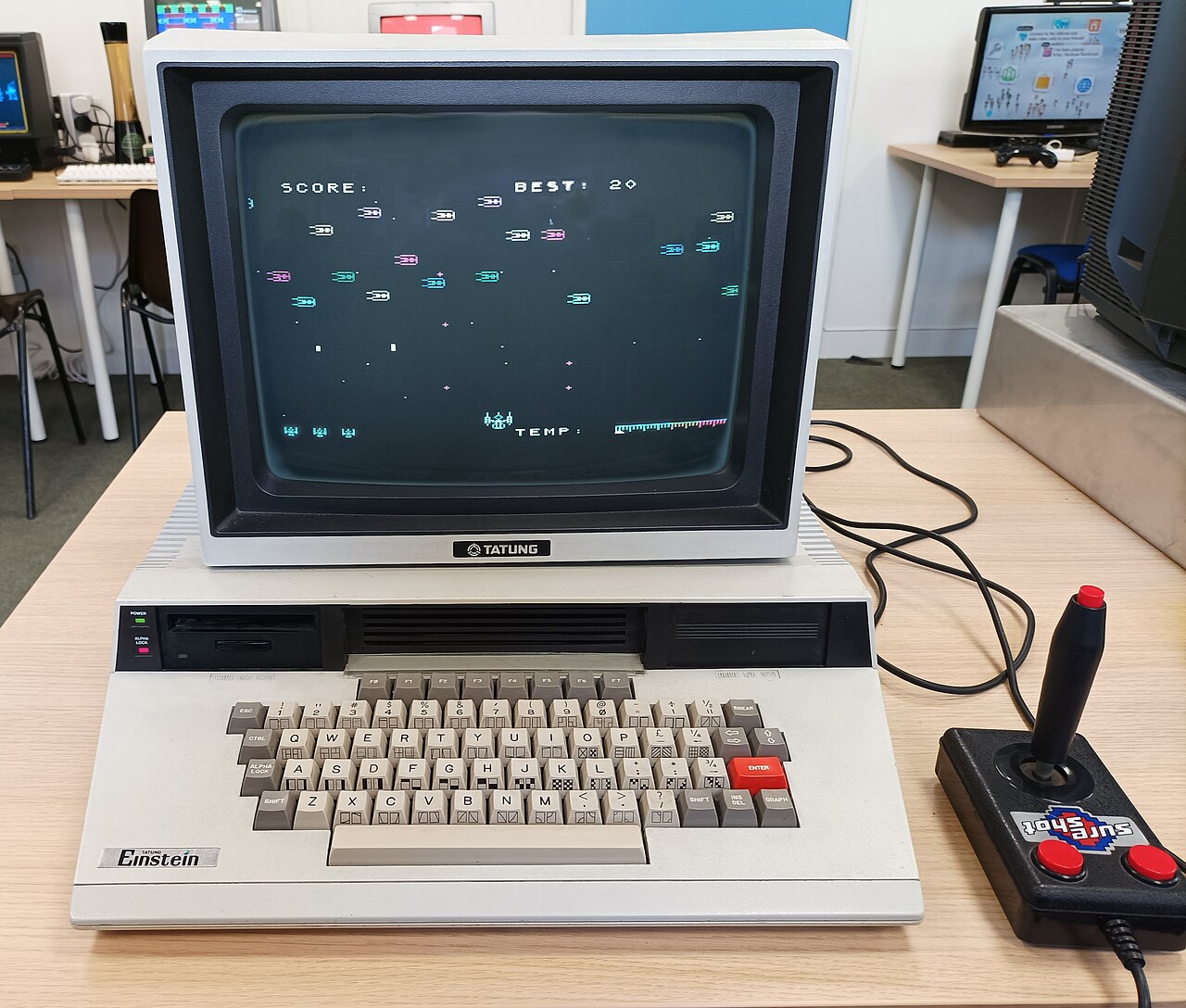
The engineering was as methodical as the design. Crow wrote his code on a Tatung Einstein and squirted it down a custom high-speed serial link into a ZX Spectrum for testing. The setup deserves a moment’s appreciation, because it explains the game’s polish. Developing directly on a Spectrum meant a rubber keyboard, endless tape-loading and a crash costing you the whole session’s work; the Einstein — a bigger, disc-based British machine — gave him a real assembler, storage and fast iteration, with the Spectrum reduced to a target screen at the end of a cable. It was the professional cross-development workflow of a software house, recreated by one teenager because the amateur way wasn’t good enough. Everything in Starquake, from its map size to its frame rate, flows from that refusal to accept the bedroom’s usual limitations. The Spectrum had no sprite hardware whatsoever, so every moving object had to be erased and redrawn in software, pixel by pixel — a routine that could swallow a third of the machine’s processing time. Crow rewrote that routine around a dozen times, counting the T-states of individual machine-code instructions from a reference book and shaving cycles wherever he could, because the whole game depended on it.
His non-negotiable target was smoothness. Many Spectrum games ran at 25 frames per second; Crow locked Starquake to 50, matching the television’s own refresh, and timed his sprite drawing to begin in the blanking interval before the set’s electron beam started each frame, so sprites were always in place before the picture reached them. No shimmer, no flicker — the Ultimate standard, met by one man with a stopwatch mentality. Colour, the Spectrum’s other notorious trap, was handled at the drawing board: since any 8×8 pixel block could hold only two colours, every background graphic was designed around the grid from the start, and among moving sprites BLOB always kept priority, staying clean and white whatever crossed in front of him.
The Shape of a Run
A game of Starquake is a race against your own battery. BLOB’s energy drains constantly — walking, flying, taking hits from the planet’s wildlife and security systems — and is topped up by energy crystals scattered through the caverns, so exploration always carries a meter-watching tension. Hunger, as much as any enemy, sets the pace. Scattered across the 512 screens are the nine pieces of the core, each one walled behind combinations of elevators, teleporters, locked routes and platform-building, and the planet’s teleport network doubles as the game’s memory: every pad you reach becomes a shortcut you own, stitching distant regions into a map that gradually lives in your head rather than on paper. The teleports themselves deserve their fame: step onto a pad and you type the code name of the pad you want to reach, which means the fast-travel network only exists for players who explore it first and write the codes down. In 1985, Starquake’s fast travel ran on pen and paper, and a well-kept notebook was the most powerful item in the game.
It adds up to something startlingly modern. Strip away the hardware and Starquake is an exploration game about learning a huge interconnected world, unlocking its shortcuts, and managing a permanent resource drain — the same skeleton that later, celebrated games would be praised for inventing. Crow arrived at it in 1985 with a toybox, a quota of twenty screens a day, and a hero borrowed from a comic strip’s background.
The Quake Spreads
Starquake reached just about everything with a keyboard: ports followed for the Commodore 64, Amstrad CPC, MSX, Atari 8-bit machines and the Einstein itself, then the BBC Micro, and eventually the Atari ST and IBM PC. It is still routinely named among the very best games on the Spectrum — remarkable for a title whose world, hero and technology were all extrapolated from one screenshot of somebody else’s game. In readers’ polls of the greatest Spectrum games, Starquake sits permanently in the top tier alongside the Ultimate titles it once chased — the student filed next to the masters. It also quietly pioneered a way of working that the whole industry would eventually adopt: build the tools and the test-bed first, prove every mechanic in a sandbox of your own making, and only then manufacture the world at speed. Crow’s construction set was a one-man version of the modern game engine workflow, assembled on a Tatung Einstein in a Tonbridge bedroom. Crow’s career carried him far beyond the bedroom, across the Atlantic and into the American industry, including Blizzard Entertainment. But Starquake remains the purest example of his method: study the best, steal nothing but the ambition, and then out-engineer everyone, one T-state at a time. It never received a sequel. It never needed one.
Keep reading: One Life to Live: The Making of Treasure Island Dizzy · the ZX Spectrum system archive