
Most homebrew heroes get one life in one format. Paco Rebollez has had at least three. The cheerful astronaut at the heart of Jet Paco began as one twelfth of a ZX Spectrum compilation in 2013, resurfaced as a full Nintendo Entertainment System game at the start of 2015, and was still being reworked for new hardware half a decade later. That restlessness is entirely in character for his creators. The Mojon Twins, the Spanish development duo behind Paco, built their reputation on volume, speed and an almost stubborn loyalty to machines the industry had long since abandoned — and Jet Paco, in its NES form as Jet-Paco: Hyper Special Space Agent!, is one of the clearest statements of how they work.
Born on a covertape
Jet Paco started life on the ZX Spectrum, released on 28 May 2013 as part of Mojon Twins Covertape #2, a twelve-game compilation issued in the spirit of the covermounted cassettes that once came Sellotaped to British computer magazines. Paco shared tape space with the likes of Lala Lah, Bootee, Monono and a demo of Sir Ababol 2 — a bundle that doubled as a showreel for the team’s own development framework, the engine they call MK1 and everyone else calls La Churrera. The Churrera, built in C around the z88dk compiler and Alvin Albrecht’s splib2 library, let the Mojons and a generation of Spanish hobbyist developers produce Spectrum platform games at a pace that recalled the bedroom-coder eighties, except with better tools and no publisher breathing down anyone’s neck.
The Spectrum original already contained the whole idea. Paco Rebollez is an astronaut employed to harvest energonia, a crystalline material used to power spacecraft. His company has located an abandoned ship stuffed with the stuff — twenty crystals in all — and Paco, scenting early retirement, volunteers to go inside and gather every last one. The ship, naturally, is hostile: a maze of single-screen rooms patrolled by hazards and creatures moving in fixed, learnable patterns. Paco’s only equipment is the small propulsion unit built into his suit, and his only skill is flight itself.

Thrust, hover, do not touch anything
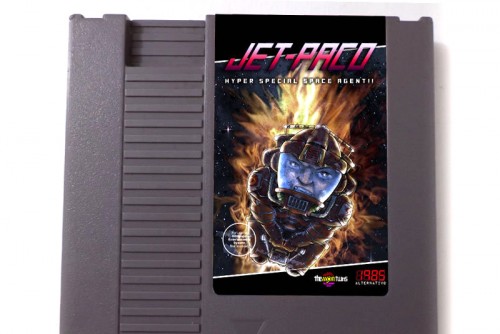
The NES conversion, released on 6 January 2015, keeps the structure and rebuilds everything else. From the title screen you choose between two missions, each asking for the full haul of twenty energonia crystals scattered through a network of rooms connected horizontally and vertically. Exploration is free-form: crystals can be collected in whatever order your nerve and your fuel management allow — except that fuel, happily, is unlimited. Control is pure thrust. Hold the button and Paco rises; feather it and he hovers; let go and gravity files its usual complaint. He can drift up through platforms and settle on them when descending, a small mercy in rooms where the safe gaps are measured in pixels.
What Paco cannot do is fight. There is no gun, no stomp, no weapon of any kind. Every enemy and hazard has to be read, timed and avoided, which turns the game into a study in momentum: the difference between a clean room and a lost life is usually a tap too many on the thrust button. You begin with ten lives and earn no more, a generous allowance that the later rooms spend freely. A counter on the heads-up display tracks the crystals still outstanding, and the chiptune soundtrack by David Sánchez, credited as Davidian or Murciano, keeps the mood considerably bouncier than the difficulty curve deserves. The port was programmed by José Luis Castaño González — na_th_an, one half of the Twins — using Shiru’s NESlib library, with Shiru also handling sound effects and optimisation, and cover art by José Ignacio Ramos, credited as kendroock.
The Mojon machine
To understand why a tiny Spectrum covertape game got a full NES rebuild, it helps to understand the Mojon Twins’ sheer output. Working chiefly as na_th_an and anjuel, the team spent the late 2000s and 2010s releasing game after game for the Spectrum, Amstrad CPC, MSX, NES, Mega Drive and beyond: the Uwol, Quest for Money series, the Sir Ababol games, the many adventures of Cheril, Ninjajar!, Goku Mal and dozens more, many of them built with the Churrera and given away free. Their games share a house style — compact single-screen or flick-screen platforming, leotard-clad heroines and deadpan Spanish humour in the documentation, and difficulty that starts friendly and ends anything but.
The NES became a second home for the catalogue. Sgt. Helmet: Training Day and Sir Ababol had already crossed over before Paco, and Lala the Magical, Yun, Super Uwol and the gleefully self-aware multicart parody 31 in 1 Real Game followed after him. Jet Paco was not an isolated experiment, then, but one stop on a conveyor belt that treated the NES as a living platform rather than a museum piece. The difference between the Mojons and many of their contemporaries is that they also treated their Spectrum work as raw material worth revisiting properly: the NES Jet-Paco is credited as a design and port by the team, not a quick emulation cash-in, with new visuals drawn for the hardware and a soundtrack composed for its sound chip.

A cartridge, crowdfunded
The free release was only half the story. Later in 2015 the Mojon Twins took Jet-Paco to Verkami, the Spanish crowdfunding platform, seeking €4,450 to produce a physical cartridge edition in both NTSC and PAL versions. The campaign passed its goal, with the game itself sitting at the €30 reward tier and the ladder of extras above it reading like a love letter to obsessive collectors: boxed copies with manuals, signed editions, backers’ names in the credits, physical Spectrum copies of Uwol or Goku Mal, a surprise homebrew cartridge from another developer, a Mojon Twins T-shirt — and, at the summit, the chance to be inserted into the game as a modified protagonist sprite, or to receive the NES cartridge mould the team used, made with Doragasu’s Mojo-NES tooling. In 2015, a crowdfunded production run for a brand-new NES game was still a novelty worth reporting; the Mojons were early, thorough examples of the physical-homebrew economy that has since become a scene of its own.
Hindsight: Paco keeps flying
Looked back on from today, Jet Paco‘s January 2015 release was a beginning rather than a finale. In March 2020 the Mojon Twins released Jet Paco & Jet Puri for Sega’s SG-1000, a reworked and expanded edition adding a third mission and a second playable character, Paco’s sister Puri, offered as a lockdown gift to a quarantined audience. A further version, Jet Paco 2023, arrived for the Amstrad CPC. The character, in other words, became a small franchise — remarkable for a spaceman whose entire skill set is going up and not bumping into things. Preservation has one footnote: listings of undumped NES cartridges note that the crowdfunded cartridge edition itself has never been dumped, so the physical run remains exactly that — physical, finite and increasingly collectible.
None of which was predictable from a fifty-five-word news stub. But that is the Mojon Twins in miniature: take a joke-sized Spectrum game about an astronaut with a jet unit in his suit, rebuild it with care for Nintendo’s 8-bit console, press it onto cartridges funded by fans, and then keep porting it for a decade. Paco Rebollez wanted twenty crystals and an early retirement. A decade on, he is still on the clock.