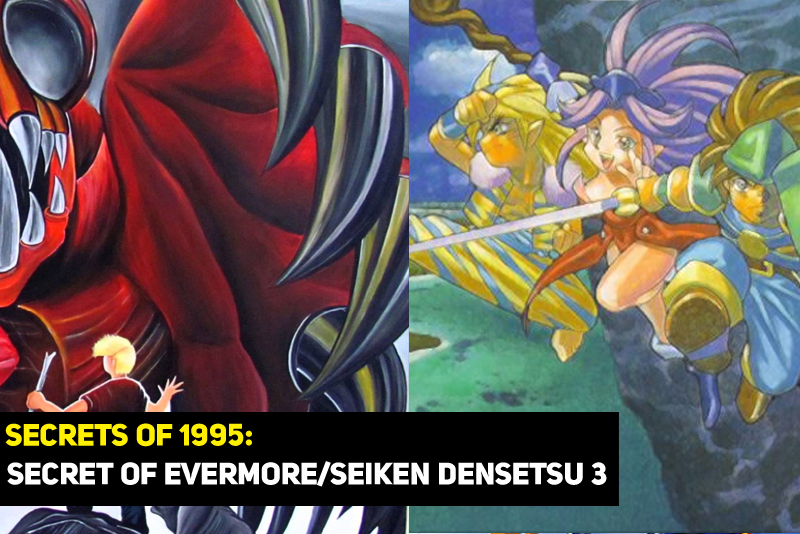
Ask a room of Super Nintendo fans to name the console’s greatest year and 1995 wins the argument more often than not. Chrono Trigger landed that spring. EarthBound finally reached the West. Terranigma closed out a legendary action-RPG trilogy, and Donkey Kong Country 2 proved the machine still had mainstream muscle. Yet for all that abundance, 1995 was also the year Square quietly split its RPG future in two, and the seam of that split runs straight through a pair of games released within weeks of each other: Seiken Densetsu 3 in Japan, and Secret of Evermore in North America.
They were never sold as rivals. They were never even sold in the same country. But because one appeared exactly where the other was expected, they have been compared ever since, and the comparison tells you almost everything about where the 16-bit RPG had been, and where it was about to go.
The one that stayed home
Seiken Densetsu 3 arrived in Japan on 30 September 1995 as the follow-up to the game the West knew as Secret of Mana. Rather than telling one story, it tells six. Players pick a lead character from a roster of six heroes — the swordsman Duran, the amazon Riesz, the beastman Kevin, the magician Angela, the thief Hawkeye and the cleric Charlotte — then choose two companions, and the plot reshapes itself around that party. Three of the six arcs converge on different villains and different final dungeons, which means the cartridge effectively holds several overlapping RPGs at once.
Mechanically it pushed the Mana formula hard. Combat stayed real-time, but a class-change system let each character branch toward light or darkness at two separate points, producing wildly different final forms. A day-and-night cycle and a seven-day week, each day tied to one of the world’s elemental spirits, changed enemy strength and spell power depending on when you fought. It was, and remains, an astonishingly ambitious thing to find on a 32-megabit cartridge.
It also never left Japan. The reported reasons have hardened into legend over the years — a difficult, bug-heavy codebase, a localisation schedule Square could not justify so late in the system’s life — but whatever the precise cause, Western players in 1995 got nothing. What they got instead, one month later, was Evermore.
The one built to replace it
Secret of Evermore launched in North America in October 1995, and its very existence was a first: it remains the only Square RPG of the era designed and built entirely in the United States, by Square’s Redmond studio. A team heavy with first-time game developers constructed it from the bones of the Mana engine — the ring menus, the real-time combat and the two-character party all came across — but pointed it at a completely different fantasy: a boy and his dog, thrown from a 1950s B-movie matinee into worlds assembled from cinema history.
Those worlds were its charm. Prehistoria gave you dinosaurs and a dog reimagined as a wolf; Antiqua riffed on sword-and-sandal epics; Gothica went full gothic horror; Omnitopia jumped to a space station. Instead of magic points, the game ran on alchemy: find ingredients, learn formulas, and mix everything from fireballs to healing salves, with reagents tracked individually. Holding the whole thing together was the debut score of Jeremy Soule, hired as a teenager and asked to evoke adventure serials rather than Japanese RPG grandeur. He delivered one of the most atmospheric soundtracks on the system.
The soundtrack underlined the ambition. Hiroki Kikuta, returning from Secret of Mana, wrote a score that sprawls in every direction at once — more than sixty tracks, by turns pastoral, martial and strange — and the class system gave battles a rhythm the earlier game never had: hit counters, chargeable techniques tied to your chosen class path, and enemies that demanded you watch the calendar as carefully as the health bar. For players who imported it or found it years later through the fan translation, the shock was how modern it felt. Party composition as narrative structure, builds as storytelling, a world clock that mattered: ideas the genre would spend the next decade normalising were all sitting in this one untranslated cartridge.
The myth that would not die
Because Evermore occupied the slot where a translated Seiken Densetsu 3 should have gone, a generation of players concluded that Evermore was the reason the other game never came. It is a tidy story, and the people who made Evermore have spent decades politely unpicking it. The Redmond team was not handed a finished Japanese game and told to bury it; they were a new studio set up to make original games for the American market, and their project ran in parallel with, not instead of, a localisation that Square’s Japanese side never green-lit. Evermore did not block the door. The door was simply never opened.
Time has been kind to both sides of the divide. Seiken Densetsu 3 became perhaps the most famous fan translation of the 16-bit era when Neill Corlett’s team released an English patch in 2000, a landmark of the early emulation scene, and Square Enix finally made it official in 2019, when it arrived in the West as Trials of Mana, followed by a full 3D remake in 2020. Secret of Evermore never received the same second act — it has never been re-released at all — yet its reputation has steadily climbed from ‘the game that was not Seiken Densetsu 3’ to a singular oddity people defend with real affection.
Evermore’s afterlife has been stranger. Where Seiken Densetsu 3 was eventually canonised, Evermore has spent thirty years in rights-and-uncertainty limbo, absent from every retro service and compilation, its survival left to original cartridges and the second-hand market. Yet the people who played it in 1995 tend to remember it with unusual precision: the alchemy shopping lists scribbled in notebook margins, the dog sniffing out ingredients, a volcano, a chessboard battlefield, a final act that winks at the B-movie framing device. It reviewed respectably at the time, too — a fact that surprises people who absorbed the later narrative that it was some kind of booby prize. It was not the game America was promised. It was simply a good one that had the misfortune of arriving in somebody else’s clothes.
Two answers to the same question
Set side by side, the pair mark the exact moment the Japanese RPG stopped being a single pipeline. One game represents the old model at its absolute peak: a flagship Japanese production so dense with systems that it defeated the localisation machinery of its own publisher. The other represents the new model arriving early: a Western studio, Western references, an engine treated as a toolkit rather than a temple, and a score by a composer who would go on to define the sound of The Elder Scrolls.
1995 gave the Super Nintendo many masterpieces. Only this pair managed to be a fork in the road — and retro gaming has been walking down both branches ever since.
Play them today and the strangest thing is how little the old grudge matters. One is a monument, the other is a cult favourite, and the Super Nintendo is big enough to hold both.