
At a glance: Time Pilot · ColecoVision · Coleco/Konami, 1983 · Multidirectional shooter · Score: 8.5/10
Time Pilot has the best elevator pitch of 1982: you are a lone pilot unstuck in time, and your war is all of aviation history at once. Konami’s arcade game flies a free-scrolling, multidirectional dogfight through five eras — 1910’s biplanes, 1940’s Second World War squadrons, 1970’s helicopters, 1982’s jets, and a 2001 of UFOs — shooting down formations to fill a quota, rescuing parachuting friends for bonus points, and facing a mothership at the end of every age. Coleco’s ColecoVision conversion brought it home in 1983, and it is one of the smoothest, most generous shooters on the system.
The control idea is the elegance: your fighter sits at the centre of the screen and rotates through a full circle, the world scrolling around you. There is no forward; there is only facing. Enemy squadrons stream in from every point of the compass, and mastery is a matter of positioning — turning into a formation’s flank, never letting two flights cross your nose at once, and keeping the sky’s centre of gravity where you can see it. The ColecoVision stick, happily, excels here: Time Pilot is an eight-direction game played in long, confident sweeps rather than maze twitches.
Five wars, one aeroplane
The era structure gives the game its variety. The 1910 stage is a gentle turkey shoot of biplanes and a dirigible mothership; by 1940 the sky is crowded with faster, shooting-back opposition; helicopters in 1970 change the geometry with their hovering menace; the 1982 jets are quicker than your instincts prefer; and the UFO finale abandons aerodynamics altogether. Each era ends with its mothership — a bomber, a blimp, a heavy helicopter, a jet bomber, a saucer — which must be shot down under fire before time releases you into the next age. It is a campaign in miniature, twenty years before shooters learned to call it that.
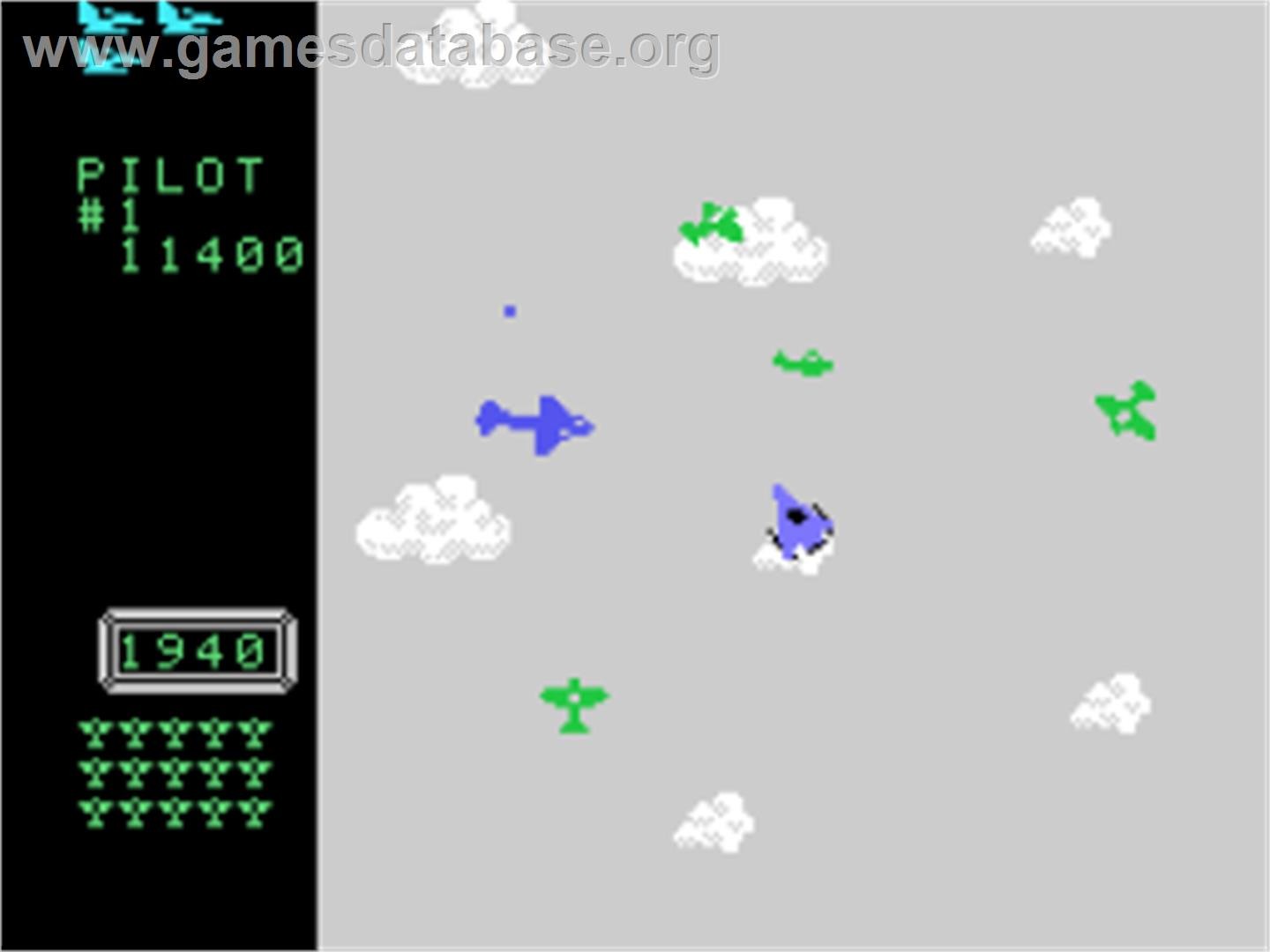
The parachutists are the soul of the scoring game. Friendly airmen drift down through the battle under canopy, and catching one is worth a healthy bonus — but they appear, by design, exactly when the sky is least convenient, and every rescue is a small referendum on your greed. Formation bonuses, mothership kills and rescues stack into a scoring system that rewards the complete pilot rather than the mere survivor. The conversion keeps the full structure: all five eras, the rescue mechanic, the progress meter of downed aircraft, and the mothership duels.
Conversion quality
Time Pilot was an ideal ColecoVision candidate — flat-shaded aircraft, cloud-dotted skies, bold sprites — and the conversion knows it. The skies are the correct arcade azure, the aircraft are distinct by era at a glance, the clouds drift in parallax layers, and the action stays fluid with a sky full of sprites. Something has to give in any 1983 port, and here it is mostly detail and density rather than design; the game you are playing is recognisably and completely Time Pilot, which is more than some of its home contemporaries managed. The sound chip supplies engine drones, gunfire and explosion thumps with period charm.
As part of the ColecoVision’s Konami connection, it is also a reminder of how broad the system’s licensing net was cast: Nintendo and Sega headline the story, but Konami’s catalogue — Time Pilot, Roc ‘N Rope, and the Antarctic Adventure the home crowd met here — gave the library a flavour no rival matched. For modern players, this is an easy recommendation among the system’s shooters: fair, flowing, varied by era, and built for the high-score table. New pilots should learn in 1910, where the game teaches rotation and positioning before the century starts shooting back in earnest.

Flying the centre: a short tactics primer
Time Pilot rewards pilots who think in fields rather than targets. Your fighter’s safety is a function of the sky’s population distribution: the danger is never the formation you are shooting at, it is the second formation arriving perpendicular to it. The professional habits build quickly. Keep moving in long arcs rather than hovering in a sector. Turn into attacks early, when the geometry is cheap. Treat the quota meter as a pace gauge — if you are behind it, take risks against formations; if you are ahead of it, spend the surplus on positioning and parachutist rescues. The mothership fights invert everything: here you are the formation problem, circling a large, slow gun platform that wants you predictable, and the correct technique is the feint — approach on one line, break off as its escorts converge, and take the shot the feint created. Pilots who master the era transitions, arriving at each mothership with lives and rhythm intact, will find the UFO age less a difficulty spike than a victory lap with better special effects.
Konami’s quiet corner of the library
It is easy to tell the ColecoVision story as a two-company duel — Nintendo’s games versus Sega’s — but the library’s third pillar was Konami, and Time Pilot is its flagship here. Konami’s early arcade catalogue had a distinctive flavour: technically ambitious, structurally generous, always built around one clean idea executed completely. Time Pilot’s idea — all of air combat history in one rotating dogfight — is as clean as ideas get, and the ColecoVision became its natural home console, with Roc ‘N Rope and Antarctic Adventure rounding out a Konami corner no rival system could match. For modern players assembling a representative shelf, the Konami cartridges are the connoisseur’s picks: less famous than the pack-in, every bit as essential to understanding what this machine was.
For collectors and first-time pilots
Time Pilot’s cartridge is a friendly acquisition — a mainstream Coleco release that survives in healthy numbers — and it earns a permanent slot near any ColecoVision for one practical reason: it is the system’s best five-minute game. A single credit takes you from biplanes to the edge of the jet age, tests every skill the stick has, and leaves a score on the table that somebody in the room will immediately want to beat. That pick-up-and-compete quality is rarer in the library than it sounds, and it makes the cartridge an ideal travelling companion for the console itself. New pilots should also know that the game is scrupulously fair about its eras: nothing in 1982’s skies is faster than the lessons 1910 taught, and nothing in 2001 is stranger than 1940 was the first time. The century is the tutorial. Fly it in order.
One more practical pleasure deserves recording: Time Pilot is a superb cartridge for an untested console or a new television setup, because its demands are diagnostic — smooth scrolling, busy sprite work, layered sound, precise eight-way control. If Time Pilot plays beautifully, everything else in the library will too. Collectors call such cartridges system-sellers; this one doubles as a system-tester, and it has introduced more sceptical friends to the ColecoVision than any amount of historical argument.
The verdict
Time Pilot on ColecoVision is a first-class conversion of a first-class idea: a century of air war in a single cartridge, flown with a stick that was made for it. Rescue the parachutists. Fear the jets. Mind the saucers.
Score: 8.5/10 — A dogfight through history, and history loses.