
First, an honest word about the headline above, because the original version of this article needs one. When this post first appeared in the summer of 2016, it carried the words “Ultimate Collector’s Guide” and then delivered something much more modest: a short, friendly introduction to Sony’s handheld that was meant to open a planned series of pieces rather than stand as a complete guide. The series approach was a perfectly reasonable idea, but the title promised a book and handed you a pamphlet. So here, finally, is the guide the headline always promised — every PlayStation Portable model explained, the quirks to check before you buy, and the games actually worth hunting down.
The original post also made one claim we should correct before going any further, because it shapes how people value these machines today. It described the PSP as “not a very popular console.” By the only measure the industry really counts, that is simply not true. Sony’s handheld sold somewhere in the region of 80 to 82 million units worldwide, making it one of the best-selling game systems ever made and by far the most successful non-Nintendo handheld in history. It lost its generation to the Nintendo DS, certainly — but the DS sold over 154 million units and beat practically everything. Finishing a distant second to a phenomenon is not the same as being unpopular, and the PSP’s huge production run is exactly why collecting for it remains so approachable today.
The Machine That Tried to Be Everything
Sony unveiled the PSP as nothing less than a Walkman for the new century: a single device for games, films, music and photos, built around a gorgeous 4.3-inch widescreen display at a time when Nintendo’s players were still squinting at screens half the size. It launched first in Japan on 12 December 2004, reached North America on 24 March 2005, and arrived in Europe on 1 September 2005. Under the shell sat a MIPS processor capable of running at up to 333 MHz and graphics hardware that produced games visibly close to PlayStation 2 quality — a genuine shock in a handheld at the time.

The original PSP-1000: chunky, glossy and unmistakably premium for a 2004 handheld. Photo: Wikimedia Commons.
Its games and movies shipped on the Universal Media Disc, a small optical disc sealed inside a protective plastic caddy. The UMD was the PSP’s blessing and its burden: generous capacity and real copy protection for Sony, but load times, a fragile mechanism and a movie business that evaporated once studios lost interest. Games on UMD are region-free, which makes importing Japanese and European titles painless; UMD movies, by contrast, are region-coded, so check before buying films from abroad.
Every Model, Explained
PSP-1000 (2004). The original “fat” model. It carries 32 MB of memory, an infrared port no later model kept, and a reassuring heft that many collectors still prefer. Its screen was impressive for 2004 but is the dimmest of the family, and it lacks TV output entirely. If you want the launch experience exactly as it felt, this is your machine — just expect the battery door and UMD latch to need checking, as both wear with age.
PSP-2000 (2007), “Slim & Lite.” Sony’s first redesign shed roughly a third of the weight and thickness, doubled the memory to 64 MB — which quietly improved loading in games that cached data — and added video output to a television. For many collectors this is the sweet spot: light, capable, and still fitted with a proper UMD drive and a removable battery.
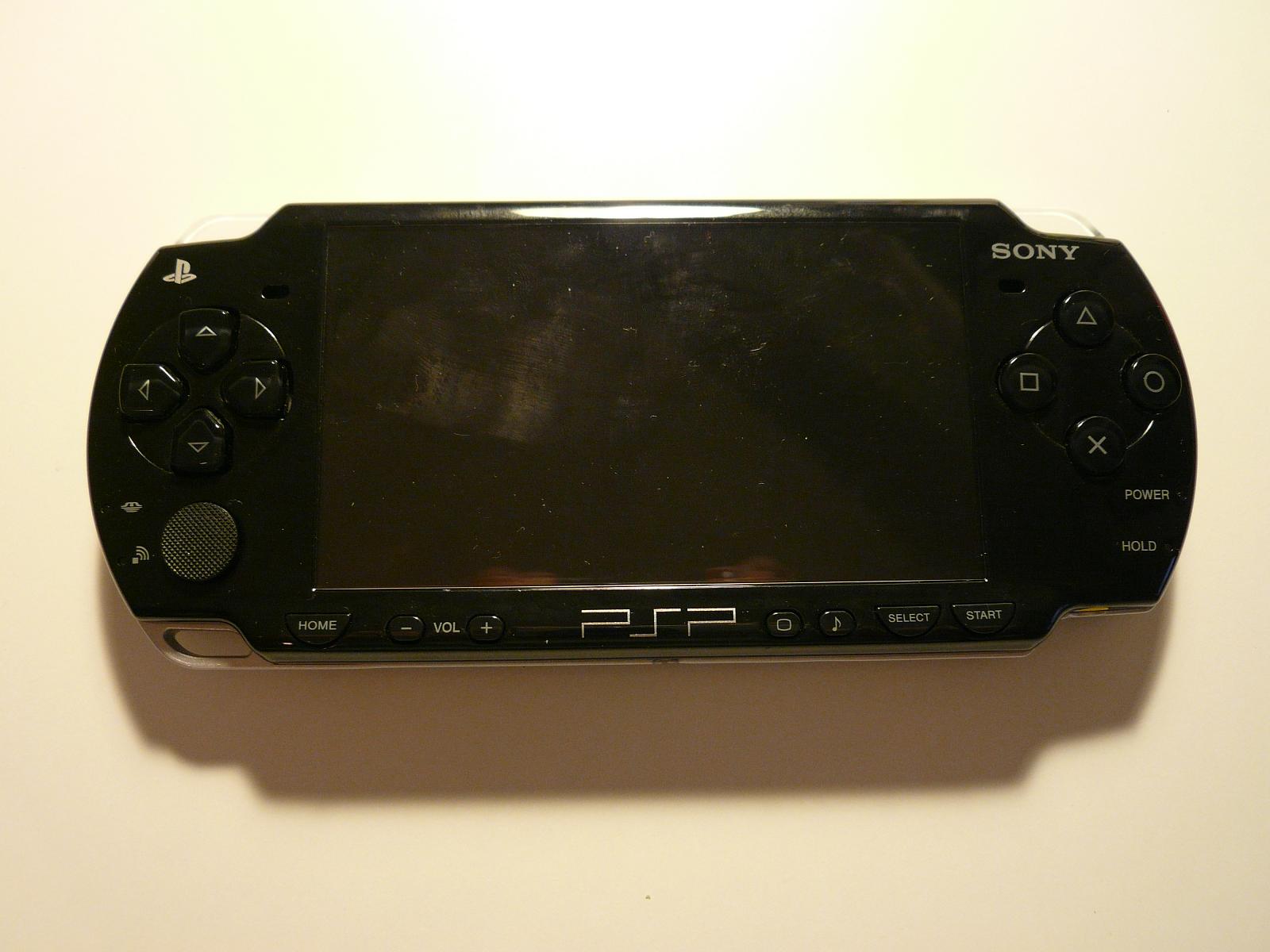
A PSP-2000 “Slim & Lite,” the redesign that added TV output and doubled the system memory. Photo: Wikimedia Commons.
PSP-3000 (2008). The “Brite” revision improved the screen’s colour range and added an anti-reflective finish plus a built-in microphone. One caveat is famous among collectors: its display shows visible interlacing-like lines in motion on some content, an artefact of the new panel that bothers some owners intensely and others not at all. Look at one running before you commit if you can.
PSP Go (2009). The radical one. The Go shrank the format into a sliding design with a smaller 3.8-inch screen, 16 GB of built-in storage, Bluetooth — and no UMD drive at all. It was a download-only machine launched years before the market was ready, and it paid for its bravery commercially. Today it is a fascinating collectible and a lovely way to play a digital library, but remember that its games live and die by your PlayStation account rather than by anything you can put on a shelf: Sony closed the PSP’s built-in store in 2021, although previously purchased games could still be downloaded afterwards through other routes. A Go with a dead account is a paperweight with a great screen.
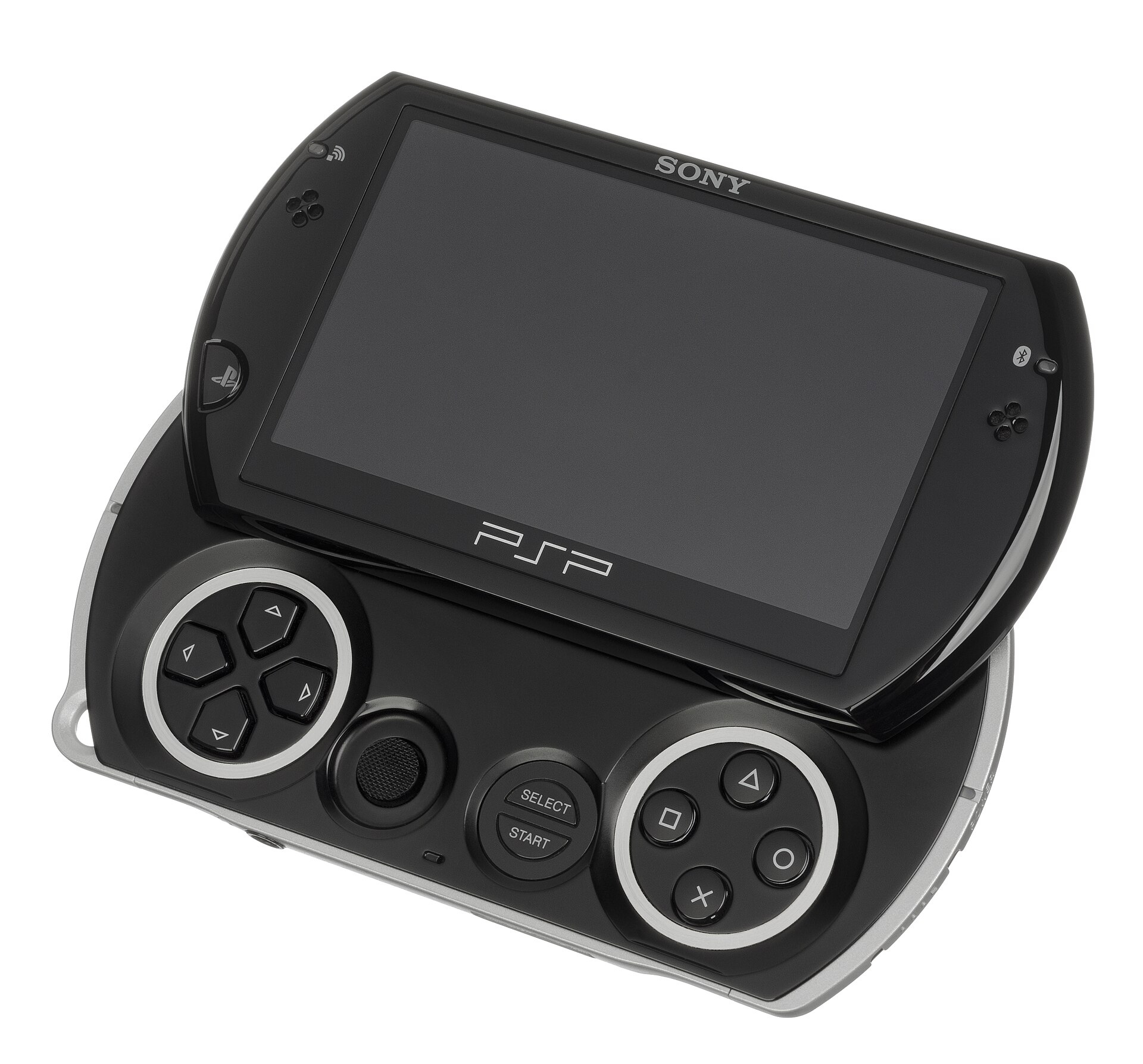
The PSP Go: a beautiful, UMD-free gamble that arrived before download-only gaming was ready for it. Photo: Evan-Amos, Wikimedia Commons.
PSP Street / PSP-E1000 (2011). The budget farewell. Sold mainly in Europe, the Street has a matte finish, a mono speaker, no Wi-Fi at all and a battery you cannot swap. It plays UMD games perfectly well and is often the cheapest way into the library, but it is a stripped machine and prices should reflect that.
Before You Buy: The Collector’s Checklist
Batteries first. The single biggest PSP hazard of the 2020s is the swollen battery. Original packs are now old enough to puff up, sometimes cracking the battery cover from inside. Inspect every machine you buy, budget for a modern replacement pack, and never pay a premium for an “original battery included” as though it were an asset. On the 1000, 2000 and 3000 the pack is at least replaceable in seconds; on the Go and Street it is sealed inside.
The UMD drive. Listen to it. A healthy drive spins up with a purposeful whir; grinding, endless seeking or discs that only read when the machine is tilted all point to a tired laser or mechanism. Also check the disc itself — the caddy’s little window and shutter should be intact, because a damaged shell can jam in the drive.
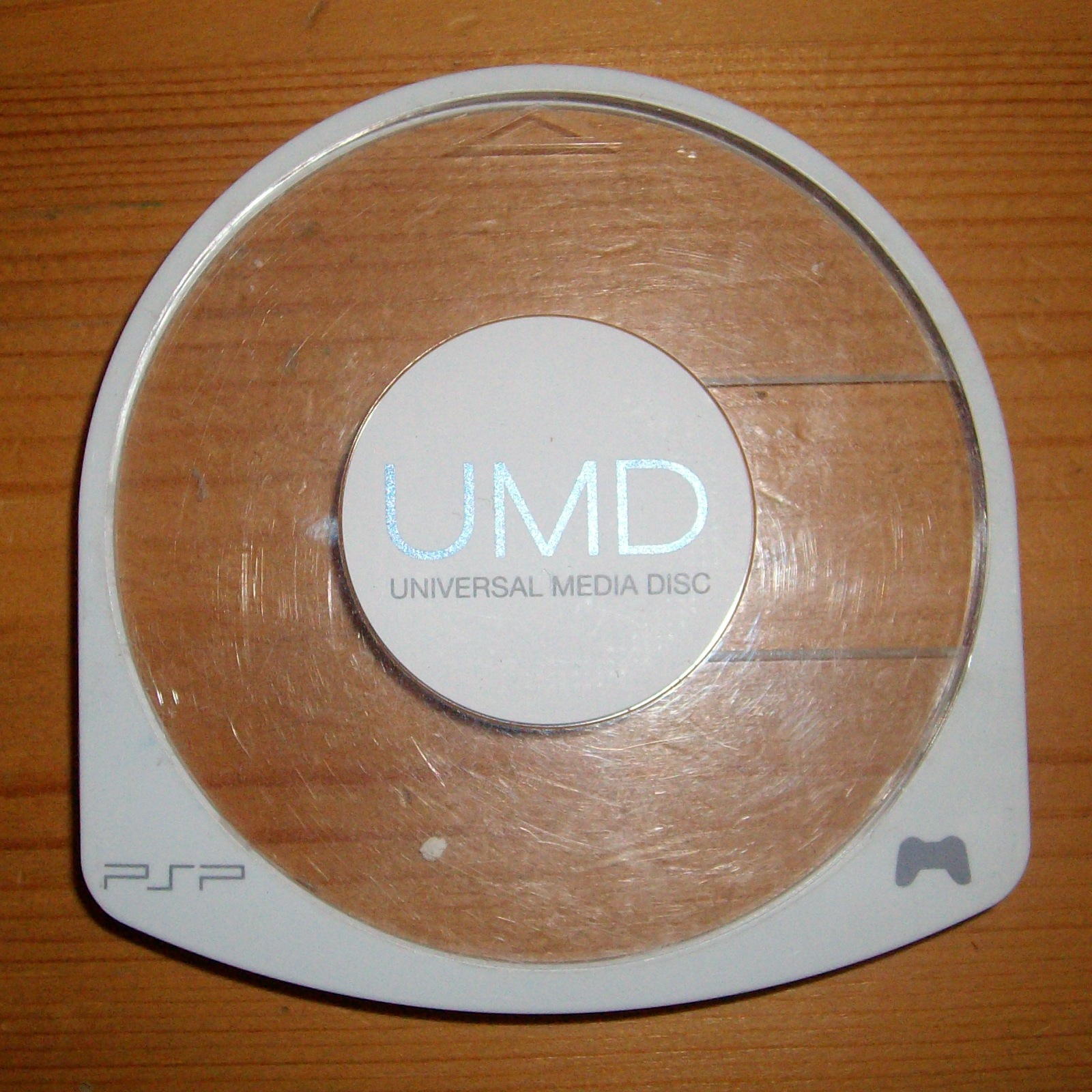
A UMD in its protective caddy. The shell is part of the format: cracked or sprung caddies are the discs to avoid. Photo: Wikimedia Commons.
Screen and stick. Look for yellowing at the edges, dead pixels and dust trapped under the faceplate, all common. Then test the analogue nub in a game’s calibration or a slow camera pan; drift and crunchiness are repairable but should lower the price. Finally, confirm the Memory Stick slot reads a card — your saves, and on later firmware much of the machine’s usefulness, live there.
The Games Worth Hunting
The PSP library runs to well over a thousand releases, and its top end is genuinely elite. Start with the machine’s biggest hitters: Grand Theft Auto: Liberty City Stories, the system’s best-seller at around eight million copies, and its follow-up Vice City Stories; Monster Hunter Freedom Unite, the game that turned Japanese commuter trains into hunting parties; God of War: Chains of Olympus and Ghost of Sparta, which remain technical showpieces; Crisis Core: Final Fantasy VII; Metal Gear Solid: Peace Walker, a full-fat Metal Gear built for portable play; and Kingdom Hearts: Birth by Sleep.
Then dig one shelf deeper, where this system quietly becomes one of the great role-playing machines. Persona 3 Portable adds a whole second protagonist to a classic. Tactics Ogre: Let Us Cling Together and Final Fantasy Tactics: The War of the Lions are two of the finest strategy RPGs ever made, full stop. Jeanne d’Arc, Valkyria Chronicles II, Ys Seven and The Legend of Heroes: Trails in the Sky round out a shelf any JRPG fan would envy. For shorter sessions, Lumines, Patapon, LocoRoco, Ridge Racer, WipEout Pure, Tekken: Dark Resurrection, Daxter and Half-Minute Hero show off the PSP’s pick-up-and-play side.
Hardware collectors should keep an eye out for the limited editions, which carry much of the system’s display value: the camouflage Big Boss pack for Peace Walker, the black-and-red God of War bundle machine, and the Dissidia 012 edition carrying Yoshitaka Amano’s artwork across its face. Complete-in-box examples of these have been climbing steadily.
The Bottom Line
The PSP spent its life being described as the runner-up, and that reputation is the collector’s gift: millions of machines, a deep and varied library, and — the big special editions and a handful of late RPGs aside — prices that still reward the patient. Buy the best-screened 2000 or 3000 you can find, replace the battery before it replaces your battery cover, and build the shelf around the role-playing games, because that is where this “unpopular” little giant was quietly unbeatable all along.