Most lost games are lost for a reason nobody can undo: the code was wiped, the boards were scrapped, the company folded and took its cupboards with it. Wing Force was different. This vertical shooter, built in 1993 for Atlus by a developer called A.I., simply never came out — and then, more than two decades later, a copy surfaced in the most modern way possible, as a listing on an online auction site, where the people who cared most about it could see it, fight over it, and rescue it in public. Our original stub, published on 7 January 2016, reported the rescue as it was unfolding. This is the fuller story of a game the arcade industry misplaced.
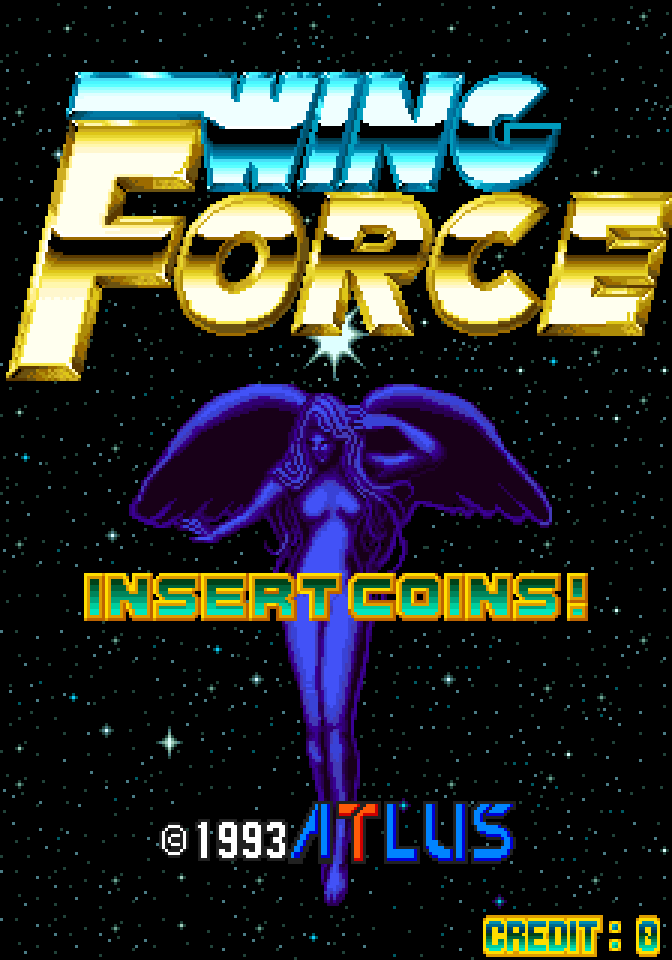
The title screen of Wing Force itself — a genuine screenshot of the preserved game, shared by Arcade Heroes in its January 2016 coverage of the find.
What was known then: an Atlus shooter that never shipped
Atlus in the early 1990s was not yet the role-playing specialist most players now take it for. The Tokyo company published across genres, and its arcade catalogue included shooters developed with A.I., among them BlaZeon, the 1992 horizontal scroller whose bio-mechanical enemy craft could be captured and piloted. Wing Force, developed by A.I. for Atlus to publish, was to be the vertical-scrolling counterpart: a coin-op shoot-’em-up in the mould that Raiden and its contemporaries had made dominant, with fast waves of aircraft, ground targets scrolling beneath you, and outsized bosses anchoring each stage.
For reasons the surviving record does not fully explain — and this article will not invent one — the game was cancelled before release in 1993. No production run followed. Whatever test or prototype boards existed slipped into the private, poorly documented world of Japanese arcade hardware, where a board can sit in a warehouse, a collector’s shelf or an operator’s back room for decades, functionally invisible to history. Reference sites dutifully listed Wing Force as a cancelled title, developed by A.I. and set to be published by Atlus, and for over twenty years that single line was close to everything the public knew about it.
The find: an auction, a bidding war, and a promise
The board reappeared in December 2015 on Yahoo! Japan Auctions. Word travelled quickly through the shmups community — the dedicated forums where shoot-’em-up players document everything from score records to board revisions — and the listing drew exactly the kind of attention a unique prototype deserves. The winning bidder, the collector and preservationist known as Shou (ShouTime), paid ¥301,000 for it, roughly $2,567 at the rates quoted in contemporary coverage. Arcade Heroes, reporting the story on 9 January 2016, drily noted that this counted as cheap for a prototype; one-of-one arcade boards can and do command far more.
What elevates the story from a rich collector’s shopping trip to a genuine preservation milestone is what Shou did next, and had committed to doing. The ROMs were copied from the board and released so that the game could be supported by MAME, the long-running arcade emulation project whose entire purpose is documenting coin-op hardware before it disappears. That decision — spend serious money on a unique object, then give its contents away — is the ethical engine of the whole arcade preservation scene, and Wing Force is one of its cleanest examples. Without it, the game would have gone from one locked room to another. With it, anyone could finally see what A.I. and Atlus had made.

Wing Force in play — again, a genuine screenshot of the preserved game as shared in Arcade Heroes’ 2016 coverage, showing the vertical format and ground targets in the Raiden tradition.
The game itself: familiar bones, its own flourishes
Preservation also means finally being able to judge the thing on its merits, and the recovered Wing Force proved to be a complete, playable piece of work rather than a rough sketch. Technically it ran on hardware described in contemporary reports as almost identical to that of BlaZeon, its A.I./Atlus stablemate — a useful accident of engineering, since familiar hardware made both emulation and, potentially, running the code on real boards a far simpler proposition. Visually, onlookers in 2016 compared it to Raiden: the same brisk vertical assault over detailed terrain, military hardware rendered with the dense pixel shading Japanese arcade art had perfected by 1993.
It was not a mere clone, though. Contemporary coverage picked out touches such as a dedicated "Boss Score" — the game drawing explicit attention to scoring performance against its big set-piece enemies — and a level of graphical detail that suggested a team polishing a product they expected people to play, not abandoning a failed experiment. That completeness is itself historically interesting. Plenty of cancelled games were cancelled because they were broken, behind schedule or plainly poor. Wing Force looks, from what survives, like a finished shooter that fell on the business side of the fence: a release slot that never opened, in an arcade market that by 1993 was brutally crowded with exactly this kind of game.

For comparison only — this is Raiden (1990), not Wing Force. Contemporary coverage compared Wing Force’s look and pace to Seibu Kaihatsu’s classic, the defining vertical shooter of its era. Screenshot: Wikimedia / arcade original.
Why this one matters
It is worth pausing on the method, because the method is the point. Nothing about Wing Force‘s survival was systematic. No archive held it, no publisher reissued it, no museum acquired it. It survived because one board escaped destruction, because an auction listing was spotted by the right community, because the winning bidder happened to believe that ownership carried an obligation to share, and because MAME existed as a destination ready to receive it. Remove any single link in that chain and this article would be a short obituary for a title screen nobody had ever seen.
That fragility is the normal condition of arcade history. Boards were working equipment, not artefacts; when a game failed or faded, its hardware was converted, parted out or binned. The unreleased ones, lacking even the protection of popularity, are the most vulnerable of all. Every case like Wing Force — like Sega’s Hammer Away, found on a prototype board in Portugal and preserved by a similar route shortly before — is therefore two stories at once: the game, and the narrow escape that lets us know anything about the game.
Hindsight: a cancelled game with a permanent address
Labelled clearly as hindsight: the January 2016 moment held. Wing Force did not slip back into obscurity after its news cycle. It remains catalogued as a preserved, playable title in MAME’s documentation of the arcade canon — a cancelled 1993 prototype sitting in the same reference framework as the biggest hits of the era, which is precisely where preservationists argue it belongs. Reference listings that once recorded only a name, a developer, a publisher and a cancellation now point to a real, examinable game.
There is a pleasing symmetry in it. In 1993 Wing Force missed its one chance to exist in front of players, in an industry that offered no second chances. In 2016 it acquired something arguably more durable than a production run: a copied, documented, emulated existence that does not depend on any single board continuing to work. The board Shou bought will, like all boards, eventually fail. The game, this time, will not go with it.