Every games console has a lost peripheral. The Amiga CD32 — Commodore’s short-lived CD-based machine of 1993 — may have the strangest one of all: a set of full-sized boards you stand on. In December 2016, this site reported that an unreleased CD32 game called Biff Boardin’ had surfaced at auction, complete with the board controller it was designed around. The original post was two sentences long and got one important thing wrong, which this feature corrects openly below. Because Biff Boardin’ was never just a snowboarding game. According to the surviving disc and hardware, it was a three-board system — skiing, skating and surfing — and it stands as one of the most gloriously impractical ideas of the CD32 era: motion-controlled gaming, attempted in 1994, with your whole body as the joystick.
⚠️ Correction First: It Was Never Only About Snow
The 2016 stub filed this story as an “unreleased snowboarder,” full stop. That framing is wrong, or at best a third right. When the game’s boards were later displayed and documented by their owner, the package comprised three distinct boards: a skiboard (the snow board of the original listing), a skateboard, and a short surfboard. The CD itself is labelled Biff Boardin’ / Urban Surfin’ / Biff Select V2.03 — three titles on one disc, version-stamped like commercial software approaching a release that never came. “Urban Surfin’” is plainly the skate-and-street side of the package; the surfboard speaks for itself. So the accurate description is a multi-discipline boarding game by Surf Systems Inc., of which snowboarding was only the winter third. The auction listing’s snowboard emphasis seems to have narrowed the story as it travelled, and the correction matters: a snowboard controller is a curiosity, but a three-board, full-body control system for a doomed console is a small lost chapter of gaming history.
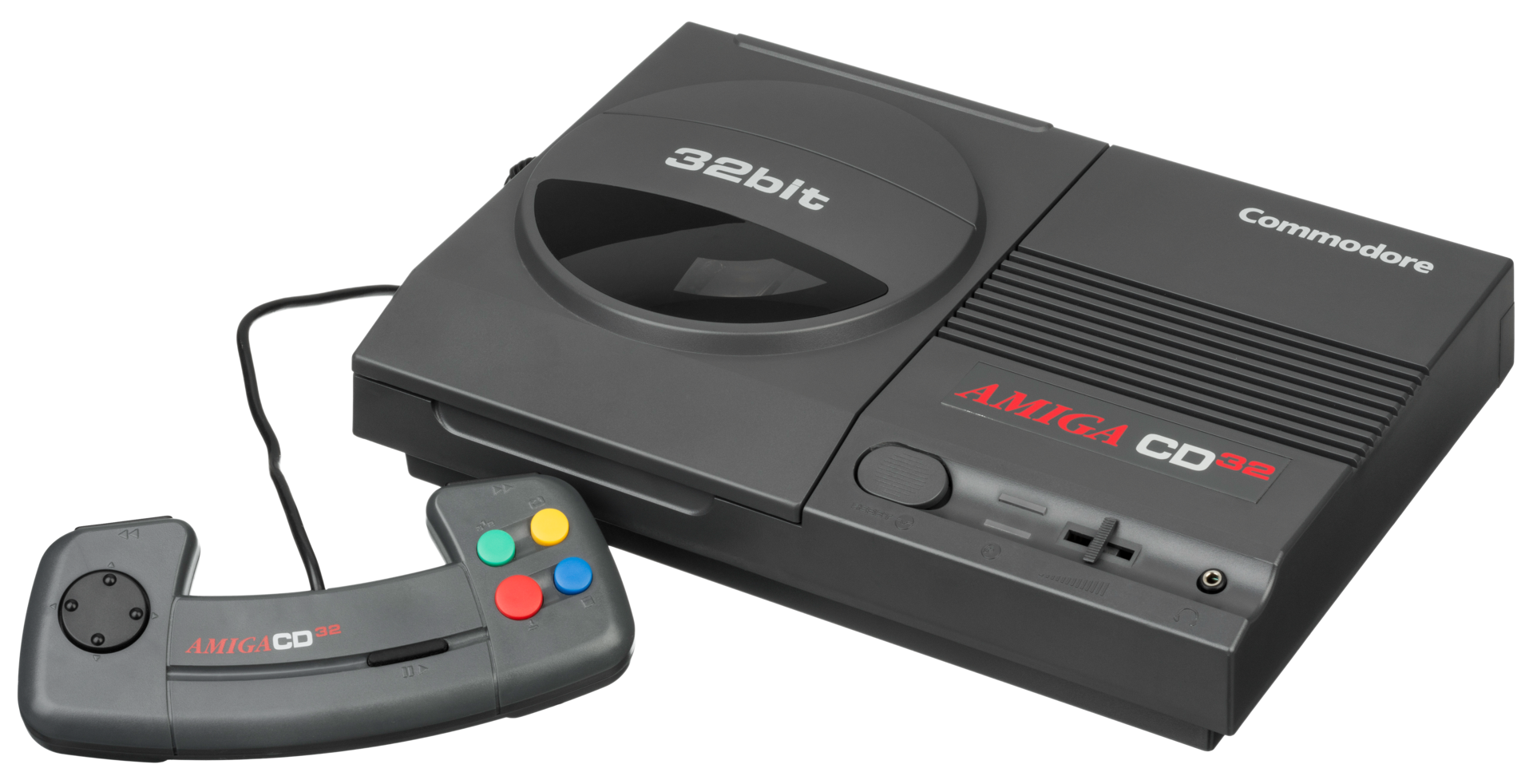
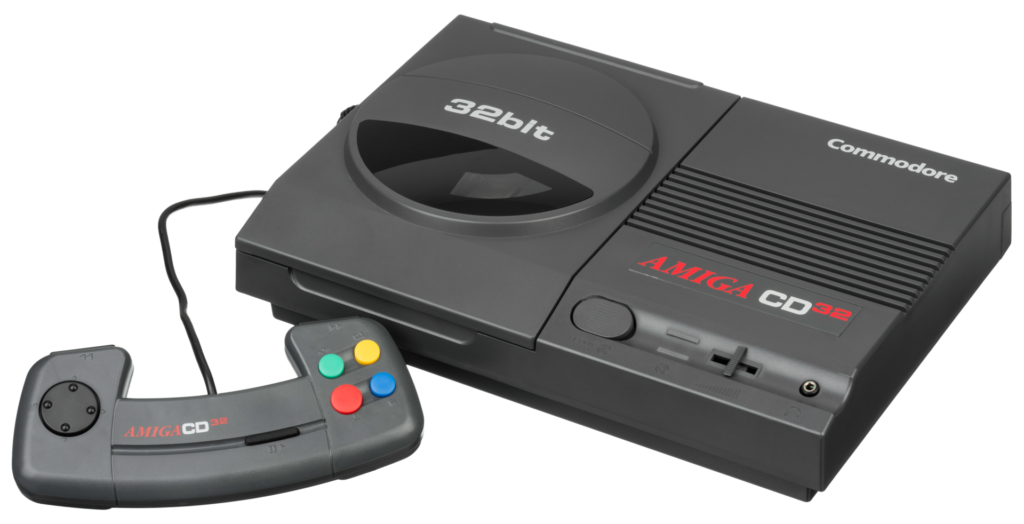
An Amiga CD32 with its standard controller — the joypad Biff Boardin’s boards were meant to replace with the player’s own balance. The console launched in September 1993; Commodore was bankrupt by April 1994. Photo via Wikimedia Commons.
The Machine: CD32 and Commodore’s Last Winter
To understand why Biff Boardin’ died, start with its host. The CD32 arrived in September 1993, built on the AGA technology of the Amiga 1200, and it has a legitimate claim to being Europe’s first 32-bit CD console. It sold respectably in Britain and Germany over its first Christmas. Then the floor fell out: component supply problems starved shop shelves, a patent dispute blocked American sales, and in April 1994 Commodore — the company that had defined home computing for a decade — entered bankruptcy. The CD32’s commercial life lasted roughly seven months, and its software catalogue settled at around 150 titles, many of them straightforward conversions of floppy-disk Amiga games.
That timeline is the whole tragedy of the machine’s unreleased list. Developers planning CD32 projects in early 1994 were building for a platform whose owner was visibly failing. A conventional game might still be finished and sold into the shrinking market. An ambitious game requiring bespoke, bulky, expensive custom hardware — hardware that had to be manufactured, warehoused and shipped alongside the disc — had no realistic path at all. Biff Boardin’ did not need to fail on its merits. The calendar failed it first.
The Idea: Stand On It
Surf Systems Inc. — the name credited on the disc and in CD32 game listings — proposed something genuinely forward-looking. Rather than steering a boarder with a thumb, the player would stand on a real board and lean: weight shifting as input, your sense of balance as the controller. The three disciplines map neatly onto three shapes underfoot, and the “Biff Select” element of the disc label suggests a shell for choosing between them — a package, not a single minigame.
Nobody should pretend we know more than that. No commercial release means no reviews, no manual in wide circulation, no footage from the game’s own era to analyse; the honest record is the hardware, the disc labelling and the catalogue entry that preserves the title among CD32 releases and non-releases alike. What can fairly be said is that the concept anticipated, by well over a decade, ideas the industry later sold by the million. Standing on a board to control a game is precisely the proposition Nintendo’s Wii Balance Board carried to enormous success in 2008, and the skateboard peripheral Tony Hawk: Ride staked a whole product line on in 2009 — to rather less success, which underlines how difficult the idea is to execute and sell even with a healthy platform behind it. Surf Systems were attempting it in the CD32’s seven-month window, as a small outfit, with three boards.

A real snowboarder airborne — the sensation Biff Boardin’s skiboard was meant to translate into control input, fifteen years before balance-board gaming went mainstream. This is a photograph of the sport, not of the game; no verified period screenshot of Biff Boardin’ in play accompanies this feature. Photo via Wikimedia Commons.
The Auction and What Surfaced
What brought the game back into view, in the form this site recorded in December 2016, was an eBay listing: the unreleased title appearing for sale with its accompanying board hardware. Auction appearances are how a great deal of lost software resurfaces — an ex-developer’s loft, a liquidated office, a reviewer’s cupboard — and they are also how it disappears again, into private collections, undocumented. The surviving record of the 2016 auction is thin: reports establish that the game and hardware were offered, but no verified final price or buyer has entered the public sources this feature could check, and we will not invent one.
Hindsight, clearly labelled: what happened afterwards is, happily, documented — because in this case the trail does not go cold. By March 2018, the boards were in the hands of Robert Bernardo of the Fresno Commodore User Group, a long-standing collector and show organiser in the American Commodore community. At that month’s meeting he unboxed a five-foot carton containing the skiboard, the skateboard and the short surfboard, and members took turns standing on them, imagining the handling the CD32 console — brought along the following month — would have asked of them. The group’s report records one very practical piece of curatorship: the boards would be demonstrated at the more controlled environment of the CommVEx Commodore show rather than open exhibitions, for fear that an over-enthusiastic child, a fall, and a lawsuit might follow. Even as a museum piece, the hardware demanded risk assessment.
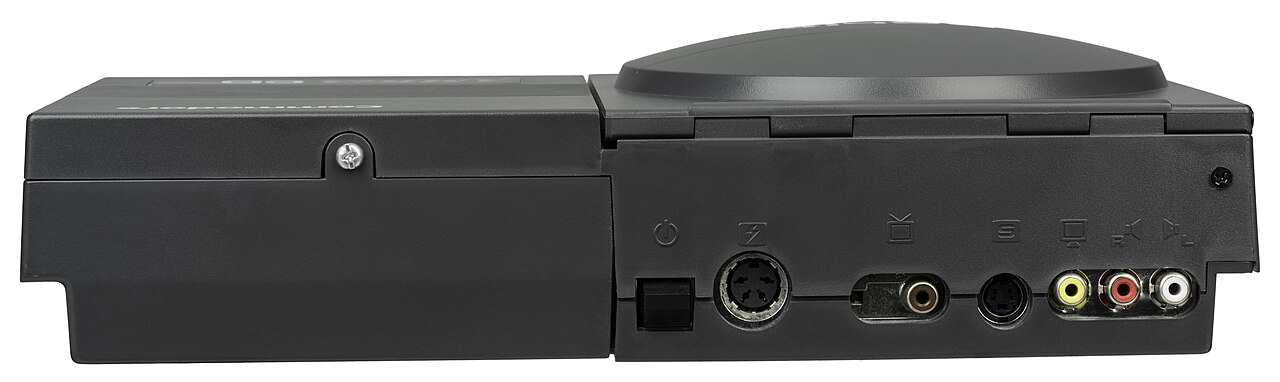
The rear of the CD32 with its cover. Expansion and connectivity were the console’s quiet strengths — the platform Surf Systems’ board interface was built to plug into. Photo via Wikimedia Commons.
Why It Matters
Biff Boardin’ would probably have been, at best, a fascinating novelty in 1994 — one awkward tumble away from a returned product for many households. None of that diminishes it. Unreleased games attached to unique hardware are the most fragile artefacts in the medium: lose the controller and the software is unplayable in its intended form; lose the software and the controller is firewood. That both halves of this package surfaced together, changed hands at auction, and ended up demonstrated at community shows — documented by the Fresno group’s meeting reports rather than sealed in a graded box — is close to the best outcome preservation gets.
And there is a final, satisfying symmetry. The CD32 was a machine built around a good idea executed at the wrong moment, by a company out of time. Its most eccentric unreleased game is exactly the same story in miniature: the right idea — your body is the controller — attempted a decade and a half too early, on the one platform in the world least able to carry it. The boards survive. Stand on one, lean, and you are playing the future as 1994 imagined it — briefly, carefully, and preferably at a Commodore show with adults supervising.