
Insects That Sing: Sound Factory, the Lost SNES Mouse Game, Surfaces After Twenty Years
Every games console has a drawer of might-have-beens, but few entries in Nintendo’s drawer are as strange, as finished, or as quietly sad as this one. In the autumn of 2014, word spread through the preservation community that a playable cartridge of Sound Fantasy — previewed in magazines two decades earlier under its working title, Sound Factory — had turned up in the wild and been captured on video. This was not a demo, a design document or a handful of screenshots. It was a complete Super Nintendo music game, built around the SNES Mouse, designed by one of Japan’s most original interactive artists, produced by the man who created the Game Boy, and shelved by Nintendo in 1994 for reasons nobody at the company ever properly explained. The original version of this article, published in November 2014, reported the discovery in a few excited lines. With the cartridge’s story now much fuller, it deserves a proper telling — starting with a correction.
First, Two Corrections to the Old Story
The 2014 stub on this site repeated two pieces of folklore that the record does not support. The first concerns authorship. Sound Fantasy is sometimes lazily described as a Shigeru Miyamoto project, presumably because anything playful and toy-like at Nintendo gets filed under his name. It was not his game. Sound Fantasy was designed by Toshio Iwai, an interactive media artist, working inside Nintendo R&D1 — the division run by Gunpei Yokoi, the producer of the game and the engineer behind the Game & Watch, the Game Boy and the very idea of wringing fun from modest technology. Miyamoto’s EAD division was a different world, on a different floor, making different games.
The second correction concerns Mario Paint. The old stub claimed Sound Factory was dropped so that Mario Paint could have the Mouse instead. The calendar says otherwise. Mario Paint launched the Super NES Mouse in the summer of 1992, a year before Iwai even began work at Nintendo. Sound Fantasy was not competing with Mario Paint for the peripheral’s launch; it was being prepared, two years later, as the Mouse’s second big bundled showcase, in a large box with the mouse and pad included, much like the Mario Paint package before it. Whatever killed Sound Fantasy, it was not a plumber with a paintbrush. The truth is knottier and more interesting.
An Art Installation Learns to Crawl
Toshio Iwai came to games from the gallery world. During a residency at the Exploratorium science museum in San Francisco, he built an installation called Music Insects: a floor-projected world of little digital creatures that wandered across colours drawn by visitors, turning whatever they crossed into musical notes. It was playful, technological and entirely without enemies, scores or endings — closer to a musical instrument that happened to be alive than to anything the games industry was selling.
In 1993, a friend of Iwai’s who worked at Nintendo suggested the installation could become a video game, and Yokoi’s R&D1 took the idea in. That provenance matters. R&D1 was Nintendo’s workshop for odd, hardware-led experiments, and Yokoi’s famous philosophy — lateral thinking with seasoned technology — is written all over the project: take a modest peripheral nobody quite knew what to do with, and build something nobody else would think of. Development, assisted by the outside studio Tomcat System, ran through 1993 and into 1994. The single installation piece grew into a cartridge containing four distinct music toys.

Four Toys in One Cartridge
The heart of the package was Pix Quartet, the direct descendant of Music Insects. Four coloured insects, each assigned its own instrument, crawl endlessly across a canvas the player paints with the mouse. Whenever an insect crosses a coloured pixel it sounds a note, and because each colour maps to a different pitch for each insect, a doodle becomes a small, looping composition — one the player conducts by drawing, erasing and redirecting the performers. It is less a game than a vivarium that sings, and it remains the clearest statement of what Iwai was trying to do: put a creative tool in the player’s hands and make the tool itself feel alive.
Around it sat three smaller pieces. Beat Hopper put an insect on a pogo stick atop a grid of sounding blocks, part rhythm toy and part Q*bert-style hopper, with modes for free improvisation and for following an ever-extending path without falling. Ice Sweeper reworked the Breakout formula with a musical streak and escalating tricks, eventually handing the player four paddles at once. Star Fly was the gentlest of the set: a night sky in which the player pins stars at different heights to build a melody, music-box style, with the altitude of each star deciding its pitch and the tempo placed under the player’s control.
Preview coverage at the time understood the pitch immediately. Electronic Gaming Monthly called an early version an interesting piece of edutainment in the Mario Paint mould, and GamePro later wrote that what Mario Paint had done for pictures, this game was expected to do for sound. That comparison was both the project’s blessing and its curse: it made Sound Fantasy easy to explain, and easy to postpone.
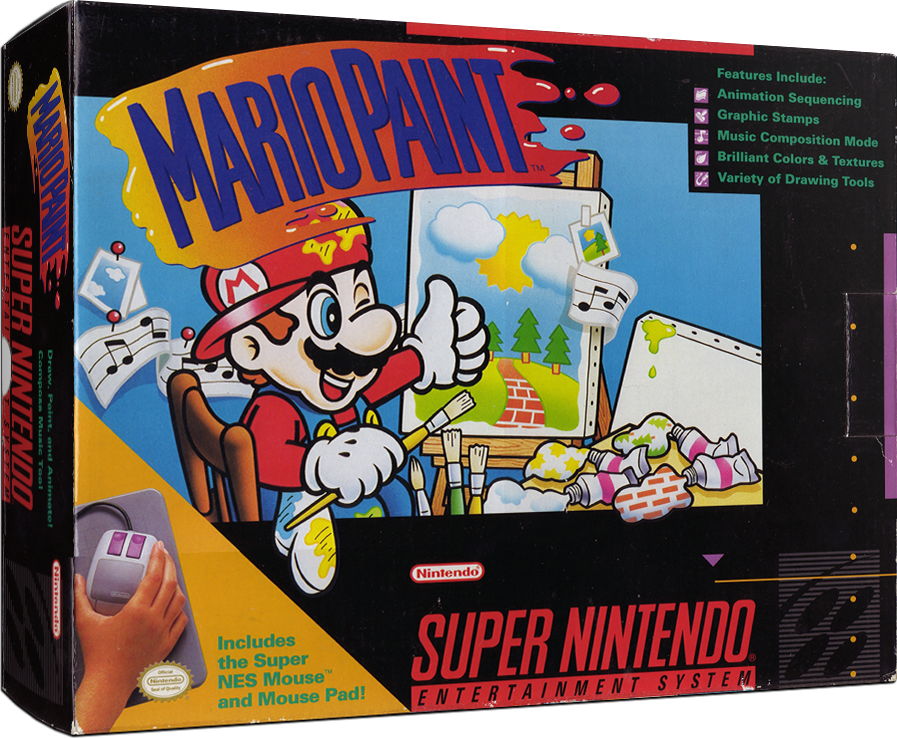
The Mouse Deserved Better — and Mostly Got It
The 2014 stub also undersold the peripheral itself, claiming the Mouse worked with only a few dozen games. The fuller count tells a better story: well over 130 Super Nintendo titles eventually supported the Mouse in some form, although only around forty of those reached players outside Japan, and just two — Mario Paint and the Japan-only Mario & Wario — actually required it. Strategy games, simulations, puzzle games and oddities like the Super Game Boy’s drawing tools all found uses for it. The Mouse was no failure. What it never got, after 1992, was a second flagship: a big-box Nintendo production that showed off what pointer-driven play could do on a television. Sound Fantasy was built to be exactly that.
By September 1994, Electronic Gaming Monthly was telling readers to expect the game that month. Nintendo of America had filed the Sound Fantasy trademark the previous January. The plan, as documented in the magazine coverage, was a worldwide release: a large box containing the game, the mouse and the pad, with the cartridge also sold separately in Japan for ¥6,800. And then — nothing. The finished game simply never shipped, in any territory, and Nintendo has never given an official reason.
Why Would Nintendo Finish a Game and Bin It?
Iwai himself has said he never received an explanation. Personnel changed around him at Nintendo, his residency ended, and the straight answer never came. His own suspicion, offered in a Wired profile a few years later and paraphrased here, was that the ground shifted under the project: the PlayStation and Saturn were arriving with their 3D spectacle, Donkey Kong Country was proving that pre-rendered spectacle could sell the SNES by the million, and the commercial weather favoured action over a gentle music toy with no characters, no levels and no way to lose. A music game with no licence, no mascot and no precedent was a hard thing to take to shops in the autumn of 1994 — however finished it was.
There is a quieter possibility too, which the surviving evidence supports: nothing dramatic happened at all. Games that are merely postponed often stay postponed, and a completed cartridge for a peripheral whose moment had passed could slip down every priority list until the moment was gone for good. Sound Fantasy was not cancelled in a blaze of controversy. It was, by all accounts, simply left behind.

The Long Resurfacing
Nintendo, to its credit, never quite pretended the game did not exist. In April 2005, an exhibition in Tokyo’s Harajuku district celebrating Iwai and the launch of Electroplankton — his DS comeback, built from the same philosophy of musical creatures and player-made sound — put Sound Fantasy’s box art and manual on public display, though the game itself stayed in its cartridge. Five years later, at a 2010 exhibition honouring Yokoi, Iwai brought that cartridge along and played the game in public himself, a designer briefly reunited with his unpublished work in front of an audience.
The October 2014 discovery that prompted this site’s original stub was the next step: a working prototype cartridge surfaced outside Nintendo, and footage of it running began to circulate, proving the game was as complete and as playable as the magazines had promised. Hindsight, from beyond this article’s original date, completes the arc: in April 2015 the prototype’s contents were released publicly after an anonymous buyer reportedly paid around $7,000 for a cartridge in order to preserve and share it, and Sound Fantasy became, at last, a game anyone could study. Twenty years after its planned release, the insects were finally crawling in public.
What Survived of Sound Fantasy
Even without the leak, Sound Fantasy would not have vanished entirely, because Iwai kept rebuilding it. Maxis, whose people had independently admired the Music Insects installation, brought him in to turn Pix Quartet’s crawling composers into the 1996 PC release SimTunes — the one part of Sound Fantasy to reach shops in its own era. Electroplankton carried the same DNA onto the DS in 2005, and Iwai’s Tenori-on, the grid-of-lights musical instrument he later developed with Yamaha, is recognisably a cousin: draw a pattern, watch it perform itself. Sound Fantasy sits at the head of that family tree, the missing link between an art installation in San Francisco and a shelf of instruments and toys that did reach the world.
That is why the 2014 cartridge mattered, and why it still does. Sound Fantasy is not a tantalising fragment or a tech demo that flatters to deceive; it is a finished work by a major artist, produced by one of Nintendo’s founding geniuses, cancelled so quietly that even its creator was never told why. The SNES Mouse got its hundred supporting roles. It deserved its second starring one — and thanks to the collectors and archivists who refused to let a completed game stay a rumour, it finally, belatedly, has it.